49 works in this view — arrow keys or swipe to move between them.
Dance in Art
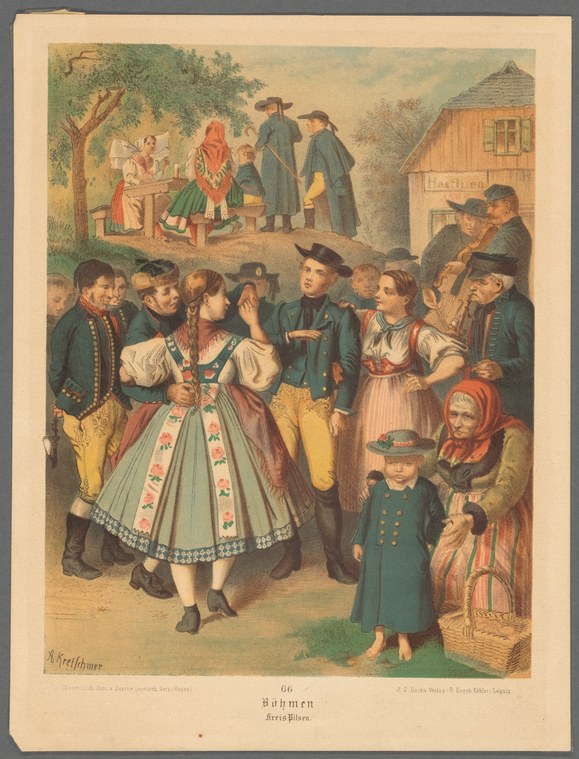
Böhmen, kreis Pilsen
Unknown artist
- Collection:
- Prints depicting dance
- Source:
- New York Public Library
- Rights:
- Public domain — free to use, share and adapt.
- Recorded as:
- Public Domain
The print provides concrete visual evidence of how Bohemian courtship dances and village celebrations were organized, dressed, and performed in the mid-19th century—information rarely available from written sources alone. For dance historians, it captures a moment when folk practice was transitioning from living tradition to documented cultural artifact, and when regional dress became a standardized marker of national identity within the Austrian Empire.
What you are looking at
A village celebration unfolds across two spatial registers in this colored engraving. In the foreground, a woman in a green dirndl dress with white apron and floral embroidery stands at the center of a gathered crowd of young people—men in dark jackets with colored trim, women in traditional dress. The woman's arms are raised in an open, celebratory posture. Behind her, in the middle distance, several figures gather near a simple wooden cottage with yellow-ochre walls, while at left an old tree provides shade. The whole scene is rendered in the warm, documentary style of 19th-century costume studies, with meticulous attention to regional dress: the men wear knee breeches, hats, and embroidered jackets; the women's skirts are full and heavily decorated with appliqué or embroidery. A small child in a dark coat stands to the right. The composition suggests a momentary pause in social dancing—a moment of greeting, challenge, or invitation rather than the execution of a formal step.
The dancing
The central woman stands with weight evenly distributed, arms raised to approximately shoulder height or slightly above in an open, invitational gesture. Her posture is upright and relaxed rather than technically closed or constrained. The surrounding figures are arranged loosely, some facing the central woman, others in conversation or observation. No one is in a strict ballroom hold or closed partner position; the grouping is social and informal. The younger man to the woman's left appears to gesture toward her, suggesting an invitation or courtship ritual. The overall body language reads as social, ceremonial, and participatory rather than performance-oriented.
The dance depicted
This depicts a Bohemian folk celebration, most likely a village wedding, country festival, or courting dance from the Pilsen region (now Plzeň, Czech lands). The dress and setting confirm early 19th-century Bohemian vernacular tradition. The open-armed posture and grouped formation suggest a circle dance or chain dance—forms common to Central European folk practice—rather than a couple dance or waltz. The woman's raised arms and the men's respectful distance indicate a moment of courtship or initiation rather than an active turning movement. The dance appears to be *historic-gilded-age* in the broader taxonomy, as the costume and engraving style date to the mid-19th century when such folk traditions were being systematized and documented by regional costume studies.
How it was made
This is a hand-colored engraving, likely produced by lithographic or wood-engraved process and then colored by hand or light chromolithography—a standard method for mass-producing illustrated costume and ethnographic books in the 1850s–1880s. The artist's signature appears at lower left (K. Feierthal or similar). The technique allowed for precise linework and architectural detail in the cottage and clothing, while the watercolor wash enabled the warm local color and shadow that gives the scene documentary character. Such prints were typically bound into compilations on regional dress and folk practice, circulated to educated middle-class audiences interested in ethnography and national identity.
About this work
A Bohemian village dance celebration from the mid-19th century, rendered as a detailed costume and ethnographic study. The scene captures a moment of social courtship or group initiation within a folk celebration—not a formal waltz or ballroom dance, but the informal, participatory circle and chain dances that formed the basis of Central European peasant culture. The print documents dress, gesture, and social practice with the precision expected of contemporary ethnographic illustration.
The work belongs to a large body of 19th-century European art devoted to the documentation and celebration of regional folk traditions at a moment when industrialization and nationalism were making such practices visible as markers of cultural identity. It sits alongside costume albums, ethnographic lithographs, and folk dance manuals produced across Central Europe, Austria, and Bohemia in the decades following the 1848 revolutions, when folk culture became a vehicle for both romantic nationalism and academic study.
How to look at it
Attend to the woman's open posture and raised arms: this is not a closed couple dance or waltz position, but an invitation or challenge in a group context. Notice the loose, participatory arrangement of the surrounding figures, the absence of formal partnering, and the cottage and natural setting that ground this in village rather than ballroom space. The artist has chosen to freeze a moment of social negotiation or initiation—a pause between movements—rather than the execution of a step. This choice is characteristic of ethnographic illustration, which privileges visibility of dress and social relation over the capture of motion.
The artist
K. Feierthal (or Feierthal) was a 19th-century German or Austro-Czech engraver and illustrator specializing in costume and ethnographic studies. Little is recorded of his biography, but his work appears in several compilations on Central European regional dress published in the 1860s–1880s. His style is consistent with the empirical, color-coded approach of academic ethnographic illustration: precise costume detail, neutral lighting, documentary composition.
The period
This engraving dates to the period of intensive folk culture collection and codification across Central Europe (c. 1850–1890), driven by nationalist interest in regional identity within the multiethnic Austrian Empire. Simultaneously, ballroom dances (waltz, polka, quadrille) were becoming standardized and formalized through dancing master publications. Folk traditions like these Bohemian circle dances were increasingly viewed as authentically national and historically important—a romantic counterweight to modern commercial culture. The print participates in this movement to preserve and classify folk practice through visual documentation.
Where it lives
The print is held in the New York Public Library's collection of prints depicting dance. It is catalogued by title and region (Böhmen, kreis Pilsen / Bohemia, Pilsen district) but lacks specific publication information, artist biography, or accession details in the current record.
Dance in this work
Questions about this work
What dance is being performed here?
The specific dance cannot be named from the image alone, but the open-armed posture, loose group formation, and lack of a formal hold suggest a Bohemian circle dance, chain dance, or village celebration dance—forms common to peasant tradition across Central Europe. The moment captured appears to be one of courtship, invitation, or initiation rather than the execution of a choreographed step.
Why is the dress so important to this image?
The regional costume—the green dirndl with floral embroidery, the men's embroidered jackets and knee breeches—is the primary subject of the print. In the 19th century, folk dress became a marker of national and regional identity, especially within the multiethnic Austrian Empire. The print documents this dress with ethnographic precision, making the costume as much the subject as the dance itself.
Who made this print and when?
The engraving is signed K. Feierthal and likely dates to the 1860s–1880s, based on the style of chromolithography and the costume detail. The artist is not well documented, but appears to have specialized in ethnographic and costume illustration. The print was likely part of a larger compilation on Central European regional dress.
More dance artwork





