49 works in this view — arrow keys or swipe to move between them.
Dance in Art
Nicodeme
Unknown artist
- Collection:
- Prints depicting dance
- Source:
- New York Public Library
- Rights:
- Public domain — free to use, share and adapt.
- Recorded as:
- Public Domain
This work documents the relationship between theatre, pantomime, and dance in the 18th century—a period when these forms were often performed together and when performers routinely crossed between them. The figure's exaggerated costume and gestural address show how theatrical character was conveyed to audiences through the body and dress, a language closely related to ballet's own systems of gesture and expression.
What you are looking at
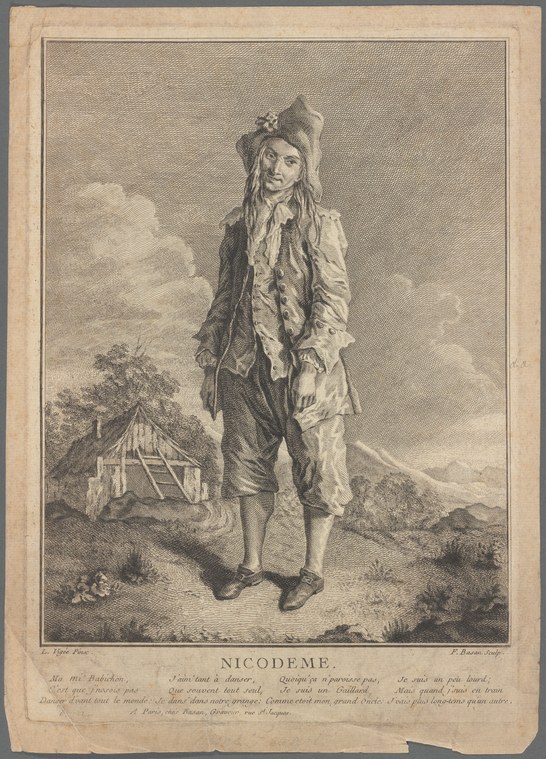
A single figure stands center-stage against a landscape background, dressed in late 18th-century costume: a long coat with deep folds, breeches, and a cap or bonnet tied beneath the chin. The stance is upright and somewhat theatrical, with the body turned slightly toward the viewer. The left arm hangs naturally while the right arm extends outward in a gesture that suggests either greeting or declamation. The setting behind includes a rustic cottage or small building to the left and mountainous terrain, rendered in the soft atmospheric perspective typical of the period. The figure's expression is animated and the pose suggests a dramatic moment—neither purely still nor in vigorous motion, but rather a pause in a narrative or performance. The print has the even tone and fine cross-hatching characteristic of 18th-century engraving.
The dancing
A single figure dominates the composition, posed in three-quarter view with weight evenly distributed on both feet in a stable stance. The right arm is extended outward at approximately shoulder height, palm open, in a gesture of presentation or address; the left arm hangs at the side. The torso is upright and the head is slightly turned toward the viewer, with facial features and expression clearly rendered. The posture suggests theatrical address or declamation rather than balletic line—the frame is open and the gesture directional rather than contained.
The dance depicted
This figure appears to represent a character from a comedy or pantomime rather than a ballet or formal dance. The title "Nicodeme" and the costume—rustic, worn, and comical in its exaggeration—suggest a stock character from commedia dell'arte or 18th-century French farce. The pose is one of address or reaction, typical of theatrical gesture of the period, but the image does not clearly depict dance movement. The figure is frozen in what appears to be a moment of dramatic delivery rather than in an identifiable dance posture or step.
How it was made
This is an engraving, identifiable by the fine parallel hatching lines that create tone and shadow, and the sharp, crisp lines that define form. The technique allows precise rendering of costume detail and facial expression, and the print would have been distributed widely as a theatrical or topical print. The name of the engraver appears at the bottom (the signature is partially legible). Engravings of this type circulated as cultural documents: records of celebrated characters or performers, and as visual commentary on popular entertainment.
About this work
This is a theatrical character print from the 18th century, documenting a figure named Nicodeme in rustic costume. The work belongs to the tradition of character engravings that recorded popular entertainment—commedia dell'arte, French farce, or pantomime—rather than to the visual tradition of ballet or formal dance. The image preserves a moment of theatrical address or comic reaction, capturing both the costume and the performative attitude of a particular character or role. While the figure is clearly an actor or performer rather than a dancer in the formal sense, the print records a mode of embodied performance that shares with dance an interest in visible gesture and the expressive body.
How to look at it
Attend to the gesture of the right arm and the direction of the gaze—these are the primary carriers of meaning in a theatrical image frozen mid-performance. The exaggerated folds of the coat and the rustic cut of the clothing are deliberate comic signals. The figure's stance is stable and presentational rather than dynamic or balletic; this is a character in repose or mid-speech, not mid-movement. The background landscape is subordinate to the figure and appears to be a generic pastoral setting, typical of how character prints framed their subjects.
The artist
The engraver is not conclusively identified in the catalogue record. The signature at the bottom of the print (partially legible) may be P. Benazzi or similar. Engravings of theatrical characters and commedia dell'arte figures were produced in large numbers by specialist printmakers in Paris and other European capitals during the 18th century, often as records of celebrated performers or popular characters. These prints served both as souvenirs and as visual documents of performance conventions.
The period
In the mid-to-late 18th century, theatrical entertainment in France was dominated by the Comédie-Française, the Comédie-Italienne (which specialised in commedia dell'arte and farce), and various fair theatres. Characters like Nicodeme—rustic, comic, wearing exaggerated costume—were stock figures in popular comedy. This was the age of Molière's legacy and the golden age of French farce. At the same time, ballet was developing as a distinct art form under the influence of reformers like Jean-Georges Noverre, who advocated for ballet d'action—narratives told through dance and gesture. The printmaking tradition preserved images of celebrated characters and performers, creating a visual archive of what audiences actually saw on stage.
Where it lives
The work is held as part of the New York Public Library's collection of prints depicting dance. It is catalogued as an 18th-century engraving with the title "Nicodeme," though the artist and precise date are not conclusively recorded.
Questions about this work
Is this actually a dance image?
Nicodeme appears to be a theatrical character print rather than a depiction of formal dance. The figure is posed in an attitude of dramatic address or reaction, not in a balletic posture or mid-movement. However, the work is relevant to dance history because it documents the theatrical context in which 18th-century dancers worked, and it shows how gesture and character were conveyed through the body in performance.
Who was Nicodeme?
Nicodeme was likely a stock comic character from French farce or commedia dell'arte. The name and rustic costume suggest a peasant or valet figure typical of popular comedy in the 18th century. Without additional documentation, it is not possible to determine whether this print records a specific performer or a generalised character type.
What is the relationship between these theatrical characters and 18th-century ballet?
In the 18th century, theatrical entertainment was not rigidly divided into categories as it is today. Performers might dance, act, and use expressive gesture within a single evening's entertainment. The gestural language of commedia dell'arte and farce directly influenced how ballet dancers portrayed character and emotion. Reformers like Noverre argued for ballet to adopt the narrative and emotional clarity of theatre, creating ballet d'action where story and character were expressed through movement and gesture rather than pantomime alone.
More dance artwork





