49 works in this view — arrow keys or swipe to move between them.
Dance in Art
La tarantella
Unknown artist
- Collection:
- Prints depicting dance
- Source:
- New York Public Library
- Rights:
- Public domain — free to use, share and adapt.
- Recorded as:
- Public Domain
The tarantella represents an unbroken tradition of circle dancing and collective celebration in Mediterranean culture; this print is among the most widely circulated 19th-century visual documents of the dance in its original social setting. It captures not just the steps but the atmosphere—the outdoor venue, the live music, the intergenerational participation—that made tarantella a complete social experience rather than a staged performance.
What you are looking at
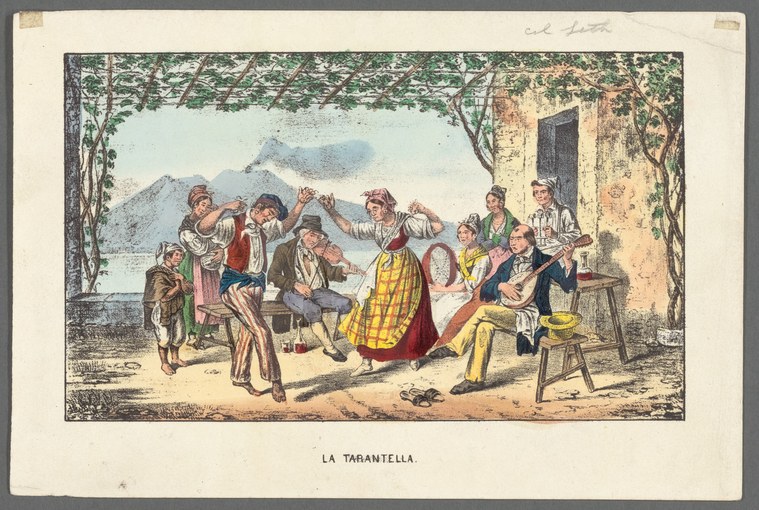
A hand-colored engraving depicts a lively tarantella being danced outdoors beneath a vine-covered pergola beside a stone building. The scene is set in a Mediterranean landscape with mountains visible in the background. A group of figures in bright costumes—yellows, reds, greens, and earth tones—stand and move in a loose circle. The dancers occupy the foreground and middle ground, while musicians with instruments sit to the right. The lighting is natural and bright, casting the figures in sharp relief against the pale sky. The composition balances movement and stillness: some figures are caught mid-gesture with raised arms, while others stand more sedately, watching or waiting their turn.
The dancing
The dancers display the characteristic posture and arm work of Southern Italian folk dance: raised elbows, hands lifted to roughly shoulder height or above, the upper body relatively upright and engaged while the feet move rapidly beneath. No formal ballroom frame is visible; instead, figures dance individually or in loose proximity, many facing toward the center of the circle. The nearest dancers, particularly those in the yellow and red costumes in the foreground, show the rapid, energetic footwork and hand movements typical of tarantella. The group includes both male and female dancers of varying ages; children appear among the adults.
The dance depicted
This is a tarantella, the rapid, whirling folk dance of Southern Italy and Sicily with roots reaching back centuries. The image shows the social version performed outdoors at a festa or gathering rather than the ritual healing dance of the same name. Tarantella was danced in couples or groups, often in a circle, with rapid turning footwork and active arm movements; the music was traditionally provided by tambourine, guitar, and sometimes bagpipes or other folk instruments. The pace and energy visible here—the dynamic postures and the presence of live musicians—confirm this identification. Tarantella remained popular throughout the 19th century and was frequently depicted in period prints and illustrated accounts of Italian folk life.
How it was made
This is a hand-colored engraving, identifiable by the fine parallel line work (hatching) used to create tone and shadow, particularly visible in the foliage and architectural elements. The engraving has been printed and then colored by hand with watercolor or similar pigment—a common and economical method for producing illustrated books and folios on regional customs. This technique allowed rapid reproduction and wide circulation; the work likely appeared in a published series on Italian regional life or customs intended for educated European readers. The hand-coloring adds immediacy and appeals to the taste for picturesque and colorful representations of folk life that dominated European visual culture in the 18th and 19th centuries.
About this work
This is a documentary engraving of the tarantella, one of Italy's most iconic social dances, captured in the moment of performance at a village celebration. The work sits at the intersection of ethnographic observation and picturesque genre painting—a record of living folk practice rendered for an audience that experienced it primarily through prints and travel narratives. The artist has frozen a moment of genuine social joy and collective participation, preserving both the movement vocabulary of the dance and the Mediterranean setting in which it belonged. For dancers and historians, it offers rare visual evidence of how the tarantella was actually performed in its native context, including the role of musicians, the participation of mixed ages and genders, and the characteristic arm and body positions that define the style.
How to look at it
Observe the arm positions and the posture of the central dancers—the raised elbows and active hands are the signature gesture of tarantella, distinguishing it from ballroom or courtly forms. Notice how the artist has captured the energy of rapid turning and footwork not through sequential imagery but through the dynamic tilt of the bodies and the scattered placement of the figures, suggesting continuous motion around the circle. The presence of the musicians on the right and the outdoor setting are equally part of the subject; tarantella was a complete social act, not a formal performance piece. The bright colors and the composition convey the joy and vitality contemporaries associated with the dance.
The period
The tarantella achieved widespread European visibility in the 19th century through travel writing, romantic fiction, and illustrated ethnographic surveys. Travelers and artists were increasingly drawn to picturesque representations of regional folk customs as industrial society accelerated; Italian folk dances, particularly the tarantella, became emblematic of authenticity, vitality, and sensuality in the European imagination. This engraving belongs to that tradition of picturesque ethnography—works produced for middle-class European consumption that blended documentary intent with aesthetic pleasure. The hand-coloring and the composition reflect 19th-century taste for bright, legible scenes of folk life that could be displayed or bound into albums.
Where it lives
The work is part of the New York Public Library's collection of prints depicting dance. It is catalogued as a historical image of the tarantella but without recorded artist, date, or publication details; such information loss is common for 19th-century popular prints, which circulated widely and were often reprinted without consistent attribution.
Dance in this work
Questions about this work
What is the tarantella and why was it important?
The tarantella is a rapid, whirling circle dance from Southern Italy and Sicily with ancient roots. By the 19th century it was the best-known Italian folk dance in Europe and symbolized Italian regional identity and vitality. It was traditionally danced at celebrations and festivals, often accompanied by live music, and involved both men and women of all ages dancing together in energetic, characteristic positions with raised arms and rapid footwork.
How do we know this shows a tarantella and not another dance?
The raised elbows, lifted hands at roughly shoulder height or above, the rapid turning suggested by the dynamic postures, and the circle formation are all signature elements of tarantella. The outdoor village setting, the presence of musicians, and the mixture of male and female dancers also match contemporary accounts of how and where tarantella was danced. The inscription on the print confirms the identification.
Why was this print made and who saw it?
This is a hand-colored engraving produced for circulation as part of a printed book, portfolio, or series on Italian regional customs. It was made for educated European readers—travelers, artists, and middle-class collectors—who were fascinated by picturesque representations of folk life. Such prints were relatively inexpensive, could be bound into albums, and appealed to the Romantic-era taste for authentic, colorful scenes from regions understood as less industrialized and more 'natural' than northern Europe.
More dance artwork





