49 works in this view — arrow keys or swipe to move between them.
Dance in Art
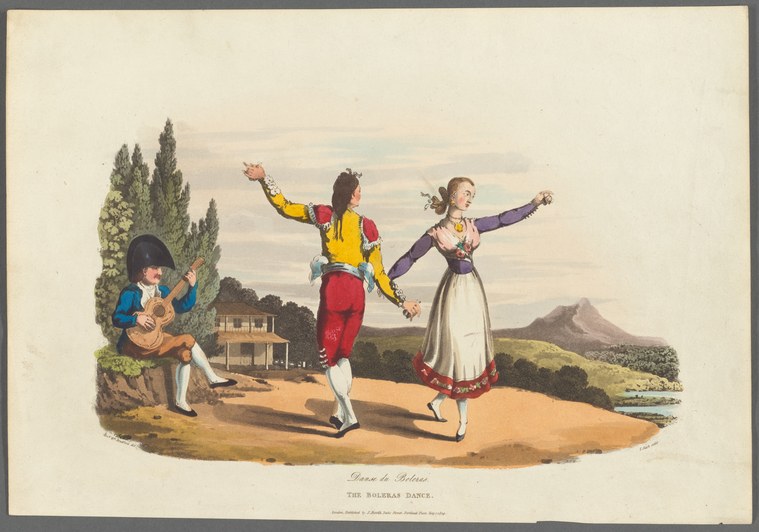
Danse du boleras, the boleras dance
Unknown artist
- Collection:
- Prints depicting dance
- Source:
- New York Public Library
- Rights:
- Public domain — free to use, share and adapt.
- Recorded as:
- Public Domain
The boleras was one of the first Spanish dance forms to achieve sustained popularity in international ballroom and theatrical contexts, and prints like this are among the primary visual records of how it was actually performed and understood in its adopted venues. For dance historians, the image provides concrete evidence of posture, arm frame, costume, and social context that helps distinguish between the boleras and related Romantic dances like the fandango, and it reveals the extent to which European artists and audiences were actively engaged with Spanish cultural forms during this period.
What you are looking at
A Romantic-era genre scene set in an Italianate landscape, with cypress trees, a classical villa, and distant mountains framing a sunlit courtyard. Three figures occupy the foreground: a seated male musician on the left plays a guitar, his body angled toward the pair at center. A man in a striking yellow jacket with red trim stands with arms raised in an expansive, celebratory gesture, his posture buoyant and engaged. A woman in a high-waisted white Empire-line dress with a red border stands beside him, her arms extended to the sides in an open, responsive position. The woman's slight turn and the man's raised arms suggest a moment of flirtation or courtship play. The scene is rendered in hand-colored lithographic or aquatint style with soft washes of color, emphasizing the leisure and gaiety of the moment. The light is warm and diffused, characteristic of Mediterranean afternoon.
The dancing
The male dancer's raised arms and lifted torso suggest exuberance and invitation, a posture of address toward his partner. The woman's arms are spread wide in an open frame, her weight appears centered and her body receptive. Neither figure maintains a closed ballroom hold; instead, the space between them is active and the gesture is more gestural than technically formal. The guitar player's presence anchors the scene as an active participant, not merely decorative. The composition suggests a moment of social interaction—flirtation or playful courtship—rather than a fixed dance figure.
The dance depicted
The title *Danse du boleras* identifies this as a depiction of the boleras, a Spanish regional folk dance form that enjoyed considerable popularity in European ballrooms and theatrical contexts during the early nineteenth century. The boleras was performed by couples and was known for its animated character, use of castanets or hand-clapping, and incorporation of walking, turning, and arm movements. The costume—particularly the man's short jacket and the woman's Empire-line dress—and the open arm positions are consistent with Romantic-era theatrical representations of Spanish dance. The seated guitarist indicates that this is not a formal ballroom setting but a social or theatrical interpretation of folk practice, likely as performed in salons or on stage for educated European audiences.
How it was made
This is a hand-colored lithograph or aquatint, evident from the soft tonal transitions, the quality of line, and the characteristic appearance of watercolor washes over a printed base. The technique allowed for relatively inexpensive reproduction and broad circulation—such prints were common in the 1820s–1840s as souvenirs of theatrical productions, travel, or fashionable dance instruction. The hand-coloring, though applied by a studio process rather than by hand, gives the work an immediacy and charm suited to its intended audience of educated amateurs and dance enthusiasts. This is the form in which most Europeans encountered representations of foreign and regional dances during the Romantic period.
About this work
This is a hand-colored print documenting the boleras, a Spanish folk dance that became fashionable in early nineteenth-century European ballrooms and theaters. The image captures a moment of social courtship-dance in an idealized Mediterranean setting, showing the open arm positions, animated posture, and accompaniment by guitar that characterized contemporary representations of the form. The work belongs to a large body of Romantic-era dance prints that brought representations of regional and exotic dance forms to the homes and salons of European middle-class audiences, often through theatrical adaptations. It is both a dance document and a record of how Europe imagined and performed Spanish culture during the period when nationalism and regional identity were becoming subjects of intense artistic and social interest.
How to look at it
The artist has chosen to capture not a technically precise moment of footwork but a gesture of invitation and response—the open arms and upright posture suggest the animated, flirtatious character for which the boleras was celebrated. Notice the role of the guitar player: he is not background decoration but an active participant whose presence emphasizes that this is social dance, not formal ballroom technique. The idealized setting—the villa, the cypress trees, the warm light—signals that this is a romanticized vision of Spanish peasant life, as imagined by the European audience for whom the print was made. Look at the woman's posture and the space between the dancers to understand how Romantic-era couples danced together in open positions, quite unlike the closed holds of modern ballroom.
The artist
The artist is not recorded. The work is typical of a large, often anonymous production of theatrical and travel prints made in Paris and London during the 1820s–1840s, when hand-colored lithography was the dominant medium for popular dance imagery. Such prints were frequently based on theatrical performances or commissioned by dance teachers and costume designers, and attribution was often withheld or given only to the lithographic workshop or publisher rather than to the artist who made the original design.
The period
The boleras achieved prominence in European ballrooms during the Napoleonic Wars and their aftermath, when contact between France and Spain was intense and Spanish culture became fashionable among the European aristocracy and upper middle class. The Romantic era (1820–1850) saw an explosion of interest in regional, folk, and non-European dance forms, driven by nationalism, orientalism, and the growth of professional dance as a subject of theatrical and artistic attention. Lithography, perfected in the 1790s, made illustrated dance instruction and theatrical imagery widely available for the first time. Prints like this one served multiple audiences: dance teachers used them as references; theater-goers purchased them as souvenirs; and amateur dancers consulted them as guides to fashionable steps.
Where it lives
The work is held in the New York Public Library's collection of prints depicting dance. It is part of a large body of theatrical and instructional dance prints from the early nineteenth century, many of which are now in institutional collections but remain largely unstudied.
Dance in this work
Questions about this work
What is the boleras?
The boleras is a Spanish regional dance form in moderate duple or triple meter, traditionally performed by couples and often accompanied by guitar and castanets. It became fashionable in European ballrooms and theaters during the Napoleonic era and was frequently performed and represented in theatrical contexts throughout the nineteenth century. It is distinct from but sometimes confused with the fandango and other Spanish dances.
Why does the woman's dress look so strange?
The high waistline just below the bust and the simple, flowing skirt are characteristic of Empire-line fashion, which was dominant in Europe from about 1800 to 1820. This style was considered modern, elegant, and vaguely Grecian at the time. The dress in the print is both fashionable evening wear and a theatrical costume, representing how Spanish dances were adapted for European ballrooms.
Is this a real dance or an invention?
The boleras is a real Spanish dance form with a documented history, but what is shown here is a theatrical and social adaptation of it, created for European audiences. The open arm positions, the idealized setting, and the guitar accompaniment are all historically accurate to how the boleras was performed and understood in European salons and on European stages, even if they may represent a stylized version of the original Spanish form.
Why is the guitarist sitting down?
In Romantic-era theatrical and social dance contexts, live musical accompaniment was essential and the musician was often a visible, integrated part of the performance. The seated guitarist's central position in the composition emphasizes that this is a social occasion and that music is part of the social fabric, not hidden away as in later ballroom practice.
More dance artwork





