49 works in this view — arrow keys or swipe to move between them.
Dance in Art
Salvatore Viganò
Unknown artist
- Collection:
- Prints depicting dance
- Source:
- New York Public Library
- Rights:
- Public domain — free to use, share and adapt.
- Recorded as:
- Public Domain
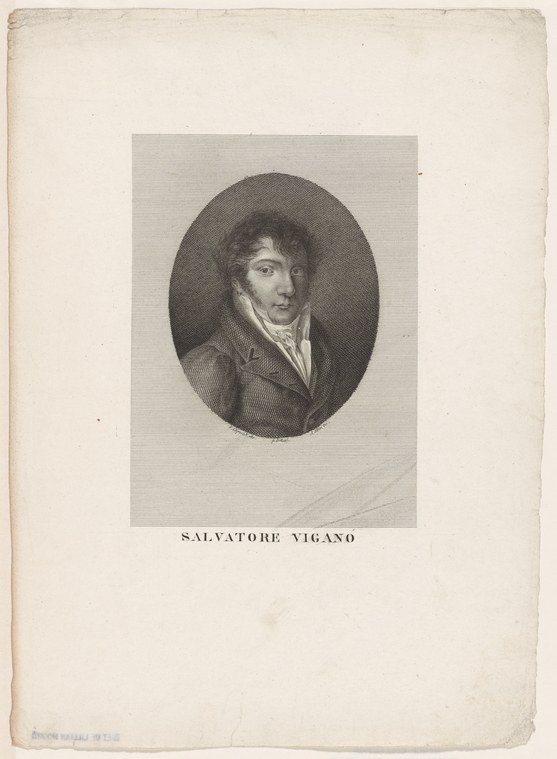
Viganò was a pivotal figure in elevating ballet from entertainment to a serious art form with dramatic and intellectual ambitions. This portrait, distributed via engraving, participated in that legitimation: the formal dress, contemplative pose, and fine artistic execution present him as a peer to painters, poets, and composers. For any historian of 19th-century dance, this image marks the moment when the choreographer began to be celebrated as a creative author rather than a technician.
What you are looking at
This is a portrait engraving of a man in early 19th-century dress, shown in three-quarter view within an oval frame. He wears a dark coat with a white shirt and cravat, his dark hair arranged in the Romantic fashion of the period with some curl at the temples. The face is rendered with fine cross-hatching to suggest form and shadow, particularly around the eyes and cheekbones, and there is a slight downward tilt to the head that conveys thoughtfulness or melancholy. The background is uniform grey, creating strong contrast with the lighter face. Below the oval frame, the name "SALVATORE VIGANÒ" is inscribed in capital letters. This is not a dance scene but a commemorative portrait, likely created to honor the subject's achievements.
The dancing
A single male figure dominates the composition. The head is tilted slightly downward and to the viewer's right, the gaze directed away from the viewer. The shoulders are squared and the body is posed formally; the visible arm and hand are relaxed, resting within the frame. There is no active gesture or movement — this is a portrait of repose rather than action, the posture controlled and dignified.
The dance depicted
This is not a depiction of dance but a portrait of Salvatore Viganò, the celebrated Italian ballet master and choreographer (1769–1821). Viganò was a major figure in the development of European ballet, known for creating large-scale dramatic works that combined dance with pantomime, music, and spectacle. He worked primarily in Italy and Vienna, and his innovations in choreographic narrative and technique were influential throughout the 19th century. The portrait does not show him dancing or teaching, but rather presents him as an intellectual and artistic figure worthy of commemoration.
How it was made
This is a line engraving, a printmaking technique executed with a burin on a copper plate. The fine parallel lines (hatching) and cross-hatching create tone and modelingof the face, while the outline and lighter background are achieved through variations in line density. Engraving was the dominant medium for portrait reproduction in the early 19th century, allowing multiple impressions to be pulled from a single plate. This technique was well-suited to circulation in books, periodicals, and portfolios celebrating notable figures of the arts, making it an effective vehicle for establishing the subject's cultural prominence.
About this work
This is a commemorative portrait engraving of Salvatore Viganò, one of the most important choreographers of the late 18th and early 19th centuries. Though it shows no dancing, it belongs in a gallery of dance imagery because it documents the figure of the choreographer as an intellectual and creator, not merely a performer. Viganò's influence on ballet vocabulary, narrative structure, and the integration of mime into classical dance was profound, and this portrait—circulated through print culture—helped establish him as a master artist rather than a mere entertainer. The work is historically significant as evidence of how the dance profession was being legitimized and commemorated in the Romantic era.
How to look at it
Look at the tilt of the head and the contemplative expression: this pose draws from the Romantic portrait convention of the artist as a figure of inner life and creative thought, rather than the proud, frontal stance of earlier portraiture. The fine engraving technique and the oval frame—both devices borrowed from neoclassical print tradition—lend formality and permanence to the image. The downward gaze and slight melancholy are consistent with Romantic-era portraiture of creative figures, positioning Viganò as a man of intellectual substance rather than physical display.
The artist
The artist is not recorded in the catalogue. The engraving is competent and professional in execution, suggesting it was produced by a trained printmaker working in the early 19th century, likely in Italy or Vienna where Viganò was most celebrated. Such commemorative engravings were typically issued within a few years of the subject's death (Viganò died in 1821) or during a period of high fame.
The period
This portrait dates to the Romantic era, when ballet was undergoing profound transformation. Viganò's career (1769–1821) spanned the transition from 18th-century court ballet to early 19th-century theatrical ballet. He pioneered the *azione pantomima* (pantomime action), blending classical technique with dramatic storytelling and larger ensembles, influencing the development of Romantic ballet. Simultaneously, printmaking was the primary medium for distributing images of celebrated cultural figures, and engraving in particular conferred a kind of artistic legitimacy. The circulation of Viganò's portrait in this medium helped establish the choreographer as an artist-creator, a role still being negotiated in dance in this period.
Where it lives
The work is held in the New York Public Library's collection of prints depicting dance. The catalogue notes only that it is a print and provides the subject's name; the artist, date, and place of publication remain unrecorded.
Questions about this work
Who was Salvatore Viganò?
Viganò (1769–1821) was an Italian ballet master, choreographer, and reformer who transformed ballet from a courtly entertainment into a serious dramatic art form. He created large-scale narrative works combining classical dance technique with pantomime, music, and visual spectacle, and he worked in major European centres including Venice, Vienna, and Milan. His innovations influenced the development of Romantic ballet throughout the 19th century.
Why is a portrait of a choreographer in a gallery of dance in art?
Because the image of the choreographer—not dancing, but presented as a creative intellectual—is itself a historical document about how dance was valued and understood. This engraving records the moment when choreographers began to be celebrated as artists equivalent to painters or composers, a shift central to the professionalization and legitimation of dance.
What is an engraving?
An engraving is a print made from an image incised into a copper plate using a sharp tool called a burin. The plate is inked, wiped clean on the surface (leaving ink in the grooves), and pressed onto paper under high pressure. Multiple identical prints can be pulled from one plate, making engraving an economical way to distribute images of famous figures in the 18th and 19th centuries.
More dance artwork





