49 works in this view — arrow keys or swipe to move between them.
Dance in Art
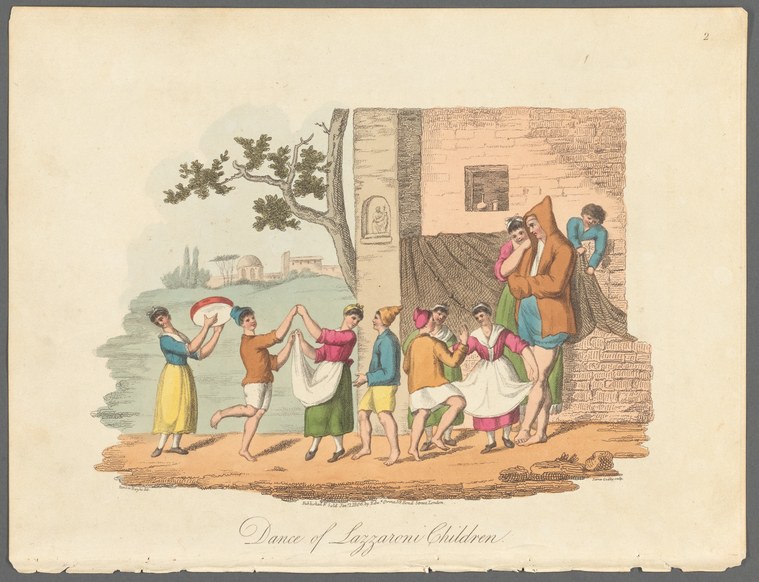
Dance of Lazzaroni children
Unknown artist
- Collection:
- Prints depicting dance
- Source:
- New York Public Library
- Rights:
- Public domain — free to use, share and adapt.
- Recorded as:
- Public Domain
This image documents how 19th-century European artists and audiences understood dance as a marker of social identity, nationality, and 'natural' versus 'cultivated' expression. It offers evidence of how children's movement and street culture were aestheticized and consumed by the educated public, and how the lazzaroni became a visual type through which ideas about spontaneity, poverty, and the Mediterranean were circulated.
What you are looking at
A group of children in bright, loosely-draped clothing play and dance outdoors beside a large brick building in what appears to be a Mediterranean or Southern European coastal setting. On the left, a waterfront landscape with distant architecture and vegetation frames the scene. The children—perhaps eight to ten of them—are arranged in a loose circle or line, their bodies twisted and bent in playful, unstructured movement. Some wear pink, blue, yellow, and orange tunics or shifts; their limbs are bare and their postures suggest spontaneous, joyful activity rather than formal choreography. The style of the building—rendered in warm terracotta and tan with a simple arched window—and the classical landscape beyond suggest this is a scene of everyday life in a poorer district, captured with sympathy and attention to the textures of the clothing and the vitality of the children's play.
The dancing
The children display no formal dance hold or frame. Their bodies are asymmetrical and varied: some bend forward, others extend an arm or leg outward, a few appear to be in mid-leap or mid-twist. One child in the foreground seems to be arching backward, another reaching upward; a third gestures with both arms in an open, uncontained manner. None of the postures suggest trained movement or mutual support. The composition emphasizes individual, spontaneous gesture within a shared space—the informality of play rather than the coordination of technique.
The dance depicted
This is folk or children's social play-dance rather than any named dance style. The title identifies these as 'Lazzaroni children'—the lazzaroni were the poor, often homeless children and youths of Naples and other Mediterranean cities, notorious in 19th-century European imagination for their vitality and apparent lawlessness. The image captures the idea of spontaneous, unsupervised dancing by street children: movement born of joy and physical energy rather than instruction. It belongs to the tradition of picturesque and ethnographic imagery that used the figure of the lazzaroni (or their children) to represent a kind of 'natural' or 'primitive' expressiveness—a contrast to the formal, trained dances of the ballroom or the stage.
How it was made
This is a hand-colored engraving or aquatint, characteristic of early-to-mid 19th-century popular print. The fine line-work of the architecture, landscape, and figures is etched or engraved and then colored by hand in watercolor or gouache. The technique allowed for mass production and circulation among a wide audience—these prints were affordable and collectible, often sold in series on themes of 'national' or 'exotic' life. The controlled linework contrasts expressively with the loose, fluid coloring of the children's garments, which gives their movement an improvised, lively quality.
About this work
This is a hand-colored engraving depicting a group of poor Neapolitan children dancing and playing outdoors, probably dating to the early or mid-19th century. It belongs to the genre of picturesque ethnographic prints that brought scenes of everyday life—especially the lives of the poor and 'exotic'—into the homes of European middle-class collectors. The image frames childhood dance as something spontaneous, energetic, and socially marked: the movement of the street rather than the schoolroom or ballroom. The lazzaroni were a figure of fascination and anxiety in 19th-century European culture, and images like this one commodified their perceived expressiveness and vitality for a cultivated audience.
The work sits at the intersection of dance imagery, social documentation, and Romantic-era exoticizing. It shows us not a named dance or a formal technique, but a moment of play—and in doing so, it reveals the period's assumptions about authenticity, poverty, nationality, and the body.
How to look at it
Notice the variety and asymmetry of the poses: the artist has avoided symmetry or repetition, choosing instead a moment of seeming chaos and individual expression. Look at how the children's limbs extend in different directions, how their torsos twist and bend, and how the loose tunics allow the outline of the body to read clearly. The composition is crowded and informal, without a center or a line of formation—this is the opposite of the structured quadrille or contra-dance being performed in the ballrooms of the same era. The watercolor coloring, applied loosely over the printed line, gives the figures an immediate, spontaneous quality that reinforces the sense of unguarded play.
The period
The early-to-mid 19th century saw an enormous appetite in Europe for prints depicting the life, costume, and customs of the poor, peasants, and 'picturesque' populations at home and abroad. The lazzaroni of Naples held a special place in this imagination—they appeared in literature, travel accounts, and visual art as emblems of a kind of unspoiled vitality and lawlessness. Simultaneously, the development of new print technologies (aquatint, chromolithography) made such images affordable and accessible to a broad audience. This was also the period in which Romantic ideology celebrated the 'natural' movement and expressiveness of the body, especially in contrast to the formal codes of neoclassical training. Children's dance, in this context, could be seen as a privileged site of authenticity—free from the artifice of the ballroom or the stage.
Where it lives
This work is held in the New York Public Library's collection of prints depicting dance. It is part of a broader archival category of early-to-mid 19th-century European popular prints on social, cultural, and ethnic themes.
Dance in this work
Questions about this work
What were the lazzaroni?
The lazzaroni were the poor, often homeless children and young people of Naples and other Southern European cities. They were figures of fascination—and suspicion—in European literature and art of the 18th and 19th centuries, represented as vivid, uncontrolled, and expressively uninhibited. They became a visual type: shorthand for a certain idea of Mediterranean vitality and lawlessness.
Is this depicting a real dance or just playing?
It is depicting play and improvised movement, not a named or choreographed dance. This distinction matters: the image draws its cultural power from the contrast between the 'natural' expressiveness of poor street children and the formal, trained dances of the educated classes. The lack of structure is the point.
Why would the educated classes collect images like this?
Hand-colored prints were affordable luxury items that brought scenes of 'exotic' or picturesque life into middle-class homes. They satisfied curiosity about how others lived, offered reassurance about one's own superiority or civility, and allowed for a kind of aesthetic appreciation of 'authentic' or 'natural' expression that the viewer's own culture had supposedly refined away.
More dance artwork





