49 works in this view — arrow keys or swipe to move between them.
Dance in Art
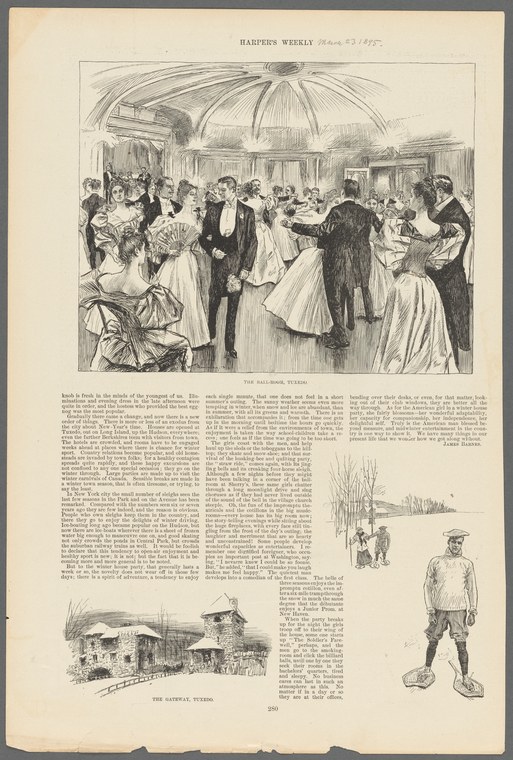
The ball-room, Tuxedo; The gateway, Tuxedo; [unlabeled vignette of a man and a couple in snowshoes]
Unknown artist
- Collection:
- Prints depicting dance
- Source:
- New York Public Library
- Rights:
- Public domain — free to use, share and adapt.
- Recorded as:
- Public Domain
This engraving is a primary visual document of how the Gilded Age elite danced and how they wanted to be seen dancing—formal, controlled, and orderly. It captures the ballroom waltz at its apex as the definitive social dance of the American wealthy, and it does so in a medium (the newspaper engraving) that shaped popular understanding of elite society's customs and appearance.
What you are looking at
This is a wood engraving or steel engraving depicting a formal ballroom scene at the Tuxedo Club, likely from the 1870s-1880s. The composition is dominated by an ornate domed ceiling with radiating panels that draws the eye upward, establishing the grandeur of the space. The ballroom floor is crowded with formally dressed couples and groups: men in black tailcoats and white shirt fronts, women in full-skirted ball gowns with fitted bodices typical of the Gilded Age. In the immediate foreground, a woman in a white gown stands prominently; to her right, a couple appears mid-dance or in conversation. The background dissolves into a crowd of guests, some dancing, others standing in clusters of social interaction. A bicycle leans against the left edge of the composition—an unusual inclusion that grounds the scene in a specific historical moment when bicycles were a novelty among the wealthy. The lighting is even and clear, characteristic of interior engraving technique, with careful cross-hatching creating depth and shadow. Three smaller vignettes appear in the lower margins: a winter landscape labeled 'The Gateway, Tuxedo,' and two figures in winter sporting dress (snowshoes), suggesting these images document different aspects of leisure at this exclusive resort.
The dancing
The dancers visible in the ballroom are arranged in the closed ballroom holds standard to formal Gilded Age dancing—men's right hands at their partners' waists, women's left hands on men's shoulders, right hands joined. The closest couple near center shows the upright posture and restrained frame typical of the period, with no dramatic tilt or lean. Bodies are vertical and controlled, moving through the space with deliberate formality rather than passion. The woman in white in the foreground stands apart, her posture suggesting either a moment of pause in dancing or a social gathering. The numerous figures in the background are rendered more schematically, their bodies compressed and overlapping to convey crowd and movement without individual characterization.
The dance depicted
This depicts a formal Victorian ballroom dance, most likely a waltz or similar rotational couple dance of the 1870s-1880s Gilded Age. The setting at Tuxedo Club—a members' resort in New York's Hudson Valley founded in 1886—confirms the period and social context: this was the playground of wealthy New York society. The dress, the formal domed ballroom, the prescribed closed holds, and the gender-segregated social arrangement all point to the waltz as the dominant dance form of the era. The engraving documents not the choreography but the social spectacle: the formality, the crowd, the sense of occasion. No footwork is visible; the artist's interest lies in capturing the atmosphere of fashionable society dancing rather than the mechanics of the dance itself.
How it was made
This is a wood engraving or steel engraving, identifiable by the fine parallel line-work (cross-hatching) creating tone and shadow, the sharp detail in the architecture and dress, and the characteristic clarity of engraved reproduction. The technique allowed for mass reproduction in newspapers and magazines—this appears to be a page from Harper's Weekly, as indicated by the publication mark at the top. Such engravings required a high degree of technical skill to render fabric texture, human figures, and architectural space legibly at small scale. The engraving was likely created from a sketch or drawing by a staff artist, as was standard practice for newspaper illustration of the period. This medium meant the image reached thousands of readers across the United States, making it a primary source for how the leisure class understood and wanted to portray itself.
About this work
This is a newspaper engraving documenting Gilded Age elite society at the Tuxedo Club, a new and fashionable resort for wealthy New Yorkers. The image captures a formal ballroom scene with waltzing couples, contextualizing the dance within the architecture, dress, and social ritual of the period. The inclusion of the bicycle—a new technology—and the winter sporting vignettes below situate the image as part of a broader feature on the resort and its leisure activities. For dance historians, it offers visual evidence of ballroom posture, hold, and the gender conventions of formal couple dancing in the 1880s. For art historians, it exemplifies the wood engraving as a tool of mass journalism, rendering contemporary manners and fashions for a national magazine audience.
How to look at it
Attend first to the architectural frame—the domed ceiling and the symmetry of the ballroom space establish formality and scale. Then trace the movement: note that the dancers are not frozen mid-step, but rather shown in a kind of tableau vivant, occupying space rather than traveling through it. The woman in white in the foreground is the compositional anchor; the eye returns to her. Look at the hands and arms of the nearest dancing couple to see the prescribed hold of the era: the frame is narrow and upright, with no flexion or sway. Finally, note the dress: the men are nearly invisible in their black coats and white shirts (a convention of formal dress representation), while the women's gowns—with their volume, their fitted bodices, their pale silks—are the visual focus. This tells you something about where the artist (and society) directed attention in the ballroom.
The artist
The artist is not recorded. The image is published in Harper's Weekly, the most influential illustrated newspaper in the United States during the 1870s and 1880s. Harper's employed a large staff of wood engravers and artists who translated contemporary scenes into the medium. Such work was typically collaborative: a sketch artist would attend the event (or work from description), and a separate engraver would render it on wood or steel for printing. The quality of execution here—the assured hand in rendering crowd, architecture, and fabric—suggests a seasoned professional in Harper's stable.
The period
The Tuxedo Club was founded in 1886 and immediately became a symbol of Gilded Age conspicuous leisure. The 1880s saw the waltz at its cultural peak in America—the rotational couple dance had been dominant for decades and remained the formal ballroom standard. The engraving itself dates from this moment of the club's early prestige. In the same period, wood and steel engraving were in their final decades of dominance; photomechanical reproduction was beginning to displace hand engraving by the 1890s. The inclusion of the bicycle in the scene signals the 1880s specifically—bicycles were still novel luxury goods for the wealthy during this decade. Socially, the dance scene documents the moment of greatest exclusivity and formality in American ballroom dancing, before 20th-century innovations (the turkey trot, the fox trot) began to loosen the ballroom frame.
Where it lives
This engraving is held by the New York Public Library as part of its prints collection documenting dance. It is from Harper's Weekly, and the caption and publication mark are visible at the top of the page. Harper's Weekly was a mass-circulation illustrated newspaper, making this a public document of contemporary society rather than a unique artwork.
Dance in this work
Questions about this work
How do I know this is the waltz?
The closed hold with the man's right hand at the woman's waist and the couple's upright, facing position are characteristic of the waltz and similar Victorian couple dances. The formal ballroom setting, the date, and the dress all confirm it. However, the engraving does not capture footwork, so the artist may not have intended to specify a particular dance—the hold could indicate a waltz, a quadrille in couple form, or another ballroom dance of the era.
What was the Tuxedo Club?
Tuxedo Club was an exclusive resort community founded in 1886 in Tuxedo Park, New York, about 40 miles northwest of Manhattan. It became the playground of wealthy New York families and is historically significant as a site of American leisure-class culture. The club is also the origin of the 'tuxedo' as formal wear—it is said that the dinner jacket was first worn there.
Why is there a bicycle in a ballroom engraving?
The bicycle is part of a larger illustrated feature on the Tuxedo Club's facilities and leisure activities. The page includes multiple scenes: the ballroom, the gateway/grounds, and winter sports. The bicycle signals the club's modern amenities and the range of activities available to members.
What does this tell us about how women danced?
Women danced in long, full skirts with fitted bodices and corsets, which constrained their movement. Their role in the couple dance was to follow the man's lead while maintaining an upright posture and proper frame. The engraving shows this clearly: women are decorative and responsive, their bodies aligned with their partners, their feet hidden beneath their skirts.
More dance artwork





