49 works in this view — arrow keys or swipe to move between them.
Dance in Art
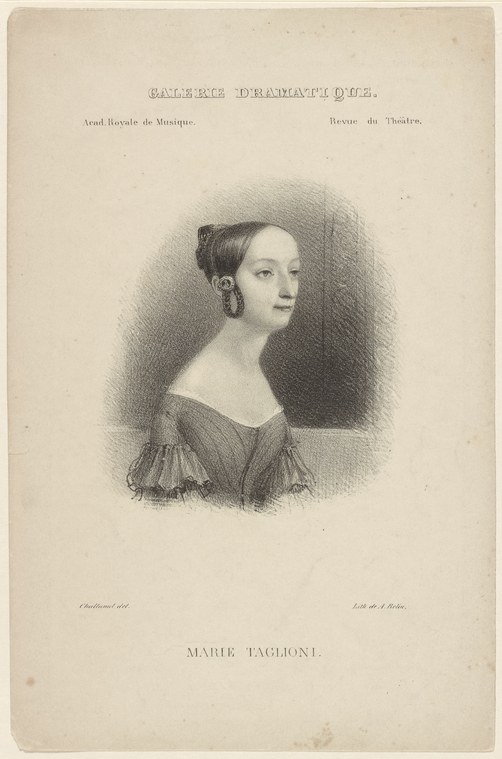
Marie Taglioni, Acad. royale de musique
Unknown artist
- Collection:
- Prints depicting dance
- Source:
- New York Public Library
- Rights:
- Public domain — free to use, share and adapt.
- Recorded as:
- Public Domain
Taglioni defined Romantic ballet and was the first dancer to achieve international celebrity in the modern sense; this portrait documents her historical importance and the celebrity culture that surrounded her. The work also illustrates how Romantic-era dance was documented and marketed to the public through fine prints and theater galleries, shaping how dancers were remembered and imagined.
What you are looking at
A portrait bust of a young woman, shown in three-quarter profile facing left, rendered in fine lithographic stone or engraving. She wears an off-shoulder dress with voluminous puffed sleeves gathered at the wrist in the early 19th-century Romantic style. Her dark hair is drawn back smoothly and arranged in a low chignon at the nape of her neck, a typical coiffure of the 1830s–1840s. The background is a soft, diffused gray tone created through careful stippling or tonal work, which emphasizes the figure without distraction. The print carries ornamental text at top and bottom: "GALERIE D'DRAMATIQUE" with subtitles indicating this is from the "Acad. Royale de Musique" and "Revue du Théâtre," and the subject is identified as "MARIE TAGLIONI" in capitals below.
The dancing
The figure is stationary and posed rather than depicted in motion. Her posture is upright and composed, the shoulders relaxed, the head held with classical dignity. There is no visible indication of the legs or feet. The soft modeling of the shoulders and neck, and the careful attention to the drape and structure of the dress, suggest a formal portrait made to celebrate rather than to document a dancer in performance.
The dance depicted
Marie Taglioni was the most celebrated ballerina of the Romantic era (1804–1884), famous for her ethereal technique and her iconic role in *La Sylphide* (1832). This is a commemorative portrait rather than a representation of her dancing. The inscription identifies her by name and her association with the Académie Royale de Musique (the Paris Opéra), the most prestigious ballet institution in Europe. The work documents her status as a star performer during the peak of Romantic ballet, but the portrait itself does not depict a specific dance or choreographic moment.
How it was made
This is a lithograph or fine engraving, identified by its tonal subtlety and the delicate linear work visible in the background stippling and dress detail. The medium suggests professional production for circulation among theater patrons and collectors. The fine modeling and the careful attention to physiognomy and costume indicate a work of high quality made for a theater gallery or publication—likely the "Galerie d'Dramatique" referenced in the caption—aimed at documenting and celebrating the leading performers of the day.
About this work
This is a commemorative portrait of Marie Taglioni, the supreme ballerina of the Romantic period, produced during her career at the Paris Opéra. It belongs to a tradition of theatrical celebrity portraiture that documented the stars of early 19th-century dance and opera for a growing public audience. The work captures not Taglioni in motion but rather her public identity and the refined elegance associated with Romantic ballet aesthetics—the soft focus, the graceful drapery, the classical restraint of pose.
How to look at it
Focus on the dress and coiffure as markers of historical moment and social status. The off-shoulder cut and puffed sleeves are the height of 1830s–1840s fashion, adapted to balletic elegance. The careful modeling of the face and neck demonstrates the portraitist's aim to capture individual likeness while maintaining the classical restraint associated with Romantic aesthetics. The soft background is typical of lithographic celebrity portraiture and serves to isolate and idealize the figure.
The artist
The catalogue record does not identify the artist. The quality of the lithographic work and the theatrical gallery provenance suggest a professional portraitist working for a Parisian theater publication or gallery in the 1830s–1840s. The style is consistent with the sophisticated portrait lithography practiced in Paris during this period.
The period
This portrait was made during the height of the Romantic ballet era, when Taglioni's performances in works like *La Sylphide* (1832) and *La Sylphide* overseas tours made her an international celebrity. The early 19th century saw an explosive growth in the production and circulation of theater prints and portraits, feeding a booming market for images of celebrated performers. Lithography, newly refined and popularized in Paris, was the ideal medium for this market, allowing fine detail and rapid reproduction.
Where it lives
This print is held in the New York Public Library's collection of prints depicting dance. It is one of many such works documenting theatrical celebrities of the 19th century, likely originally produced as part of the "Galerie d'Dramatique" or a similar theater publication aimed at French and international audiences.
Questions about this work
Is this a portrait of Taglioni dancing?
No. This is a commemorative portrait bust made to celebrate her as a star performer, not a representation of her in motion or during a specific performance. It belongs to the tradition of theatrical celebrity portraiture rather than dance documentation.
What was the Académie Royale de Musique?
The Académie Royale de Musique was the official name of the Paris Opéra, the most prestigious opera and ballet institution in Europe during the 19th century. It was the principal venue for Romantic ballet and the home of the greatest dancers of the era, including Taglioni.
When was this print made?
The catalogue record does not provide a date, but the style and fashion of the dress, combined with Taglioni's biographical dates and her peak career in the 1830s–1840s, suggest the print was made during her active years, likely in the 1830s or 1840s.
What technique was used to make this print?
This appears to be a lithograph or fine engraving, based on the tonal quality and the fine linear detail visible in the background and dress. These techniques allowed for high-quality portrait production and mass circulation at affordable cost.
More dance artwork





