49 works in this view — arrow keys or swipe to move between them.
Dance in Art
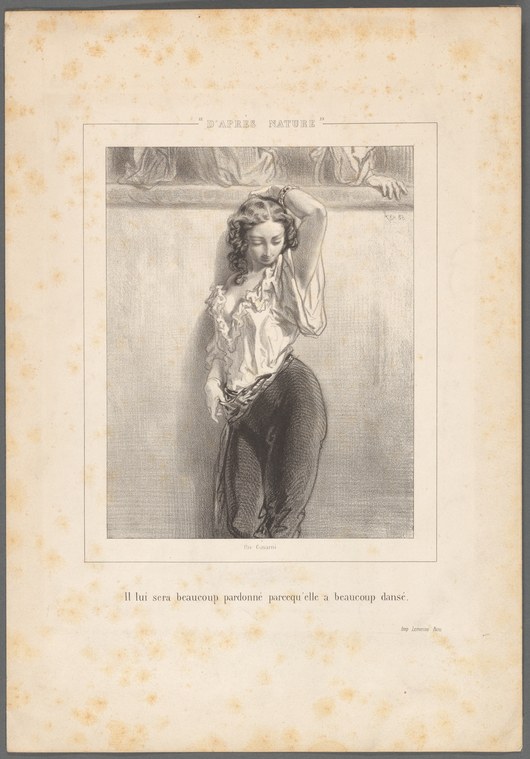
Il lui sera beaucoup pardonné parcequ'elle a beaucoup dansé
Unknown artist
- Collection:
- Prints depicting dance
- Source:
- New York Public Library
- Rights:
- Public domain — free to use, share and adapt.
- Recorded as:
- Public Domain
This work is crucial evidence of how the dancer functioned in nineteenth-century visual culture as a symbol—of modernity, sensuality, artistic aspiration, and moral danger. For dance historians, it reveals not how people danced, but how they thought about dancers and what anxieties and desires they projected onto the performer's body. The image also demonstrates the centrality of the figure print in shaping taste and circulating images of performance to audiences who may never have entered a theater.
What you are looking at
A single female dancer stands in a classical contrapposto pose against a plain background, her body weight shifted onto one leg while the other remains relaxed. She wears a white or cream chemise or corset top with delicate lace detailing at the neckline and sleeves, paired with dark (likely black or dark brown) fitted lower garments or stockings. Her long hair is loosely arranged, falling over one shoulder. Her right arm is raised to her head in a graceful, languid gesture—the hand supporting or touching her hair—while her left arm hangs naturally. The composition is intimate and focused entirely on the figure; there is no stage setting, no corps, no architectural surround. The work is rendered as a refined engraving or lithograph with subtle tonal gradations, emphasizing the play of light on fabric and flesh. The French caption below reads: "Il lui sera beaucoup pardonné parcequ'elle a beaucoup dansé" ("Much will be forgiven her because she has danced much"), a reference to Luke 7:47 and a phrase associated with the sensual or morally ambiguous figure of the dancer in nineteenth-century European culture.
The dancing
The dancer's stance is a study in controlled ease: she stands with one leg bearing weight, the other relaxed, creating an S-curve through the torso. The raised arm—supporting the head in a pose sometimes called the "odalisque" or resting pose—suggests fatigue, reverie, or intimate vulnerability rather than active performance. Her head tilts gently, and her gaze appears downward or inward. There is no turnout of the feet visible, no pointe work, no classical ballet frame. Instead, the pose suggests the languorous, semi-clothed repose associated with academic figure drawing and with the popular dancer or model of the period—a body at rest between performances, or posing for the viewer's contemplation.
The dance depicted
This is not a depiction of dance in motion but of the dancer as a subject of visual culture—a moment of stillness or backstage repose. The work belongs to a large tradition of nineteenth-century European art in which the dancer (often female, often associated with the Paris Opéra or music hall) became a symbol of grace, modernity, sensuality, and moral ambiguity. The figure could represent a ballet dancer, a music-hall performer, or a model; the costume is not specific enough to pin down a particular dance style. The caption's biblical allusion frames her as a figure of redemptive sensuality—invoking the Magdalen who washes Christ's feet—and reflects anxieties and romanticisms about female performers in the period. The image is more about the cultural meaning of the dancer than about the technique of any specific dance.
How it was made
This is an engraving or possibly a lithograph, rendered with fine hatching and tonal work to create volume and shadow. The technique allows for a refined, contemplative image suitable for circulation in illustrated books, albums, or journals. The surface is monochromatic; all modeling is achieved through line and tone. The precision of the medium suggests this was a professional work, likely published or sold as a print; the accompanying French caption and the classical format (rectangular, framed, with title) indicate it was part of a bound collection or series. Such prints were affordable to a educated middle-class audience and played a significant role in shaping how the dancer was visualized and understood outside the theater.
About this work
This is a mid-to-late-nineteenth-century engraving depicting a female dancer in a moment of repose or intimate vulnerability, not in the act of dancing. The work is part of a broader European artistic tradition in which the dancer—especially the female performer—became a central figure of modern cultural fantasy, embodying both artistic grace and sexual ambiguity. The biblical caption transforms the image from mere figure study into a meditation on redemption and transgression, reflecting period anxieties about female performance and morality. As a print, it circulated widely and helped establish the visual language through which dancers and modernity were understood. The image belongs in a dance gallery not because it shows technique or choreography, but because it shows how dancers were seen, imagined, and marketed as modern subjects.
How to look at it
Attend first to the pose itself: the use of contrapposto (weight on one leg, the other relaxed) creates a classical reference, but there is nothing about the stance or costume that is specifically balletic. The raised arm and downturned gaze create a mood of reverie or fatigue rather than exertion or performance. Notice the care taken in rendering the textures of cloth—the lace, the folds of fabric—which makes the figure tactile and intimate rather than distant and theatrical. The caption, crucial to the work's meaning, frames the image as a moral and philosophical statement, not merely an aesthetic one. Finally, consider what is absent: there is no stage, no orchestra, no audience, no choreography—only the body of the dancer, offered to the viewer's gaze in a condition of semi-undress and seeming vulnerability.
The period
The nineteenth century saw an explosive growth in the visual representation of dancers, driven by the rise of the Paris Opéra, the popularity of Romantic ballet (with its emphasis on the ethereal, often costumed female body), and the expansion of commercial music halls and cafés-concerts. Simultaneously, the theater was becoming more accessible to the middle class, and the performer—especially the female dancer—was becoming a modern celebrity. The print industry flourished, making images of famous and anonymous performers available to a broad public. The caption of this work invokes religious and moral language to frame the dancer's body and labor, reflecting widespread anxiety about the sexuality and status of women in performance. The languid, resting pose became iconic in this period: it appeared in photographs, paintings, and engravings, often suggesting both the classical tradition (through the contrapposto) and the intimate, private moment (through the undress and solitude).
Where it lives
The work is held in the New York Public Library's collection of prints depicting dance, indicating it was part of a broader collecting interest in visual representations of performance. The format—an engraved or lithographed print with a French caption, mounted or bound—suggests it was originally part of a published volume, illustrated periodical, or portfolio of similar works.
Questions about this work
Is this a ballet dancer?
The image does not show active dancing or display the specific costume and posture of classical ballet. The figure could be a ballet dancer at rest, a music-hall performer, or a model; the style of undress and repose suggests a more ambiguous or provocative context than a formal theatrical performance. The work uses the dancer as a cultural symbol rather than documenting a specific dance practice.
What does the caption mean?
The phrase "Much will be forgiven her because she has danced much" alludes to Luke 7:47, in which Jesus forgives a sinful woman (often identified as Mary Magdalen). In the nineteenth century, this phrase was used to romantically frame the female dancer as a figure of sensuality and moral ambiguity, suggesting that her artistic labor and bodily grace might redeem or excuse her lower social status and sexual availability. The caption transforms the image into a moral and philosophical statement about art, sin, and redemption.
When was this made?
The catalogue record lists the date as unknown. Based on the style of the engraving, the costume, the aesthetic of the pose, and the themes of the work, it appears to date from the mid-to-late nineteenth century (roughly 1850–1900), when such prints of dancers were most popular and when this particular pose and philosophical framing were most common in European art.
Why is the dancer alone, not performing?
The moment chosen—repose, solitude, semi-undress—was itself a selling point in nineteenth-century imagery of dancers. It offered viewers an intimate access to the dancer's private body, as if catching her unguarded or off-stage. This genre of image was part of a broader commodification of the female performer in the period, allowing middle-class audiences to fantasize about dancers' lives and bodies outside the theater.
More dance artwork





