49 works in this view — arrow keys or swipe to move between them.
Dance in Art
La kermesse flamande
Unknown artist
- Collection:
- Prints depicting dance
- Source:
- New York Public Library
- Rights:
- Public domain — free to use, share and adapt.
- Recorded as:
- Public Domain
The kermesse is one of the foundational subjects of Flemish and Northern European art, and this image documents what popular social dance looked like — costume, spacing, partnering, and the role of music and community gathering — in the early modern period. For historians of folk dance and social choreography, images like this are rare evidence of how ordinary people danced before the 20th-century camera.
What you are looking at
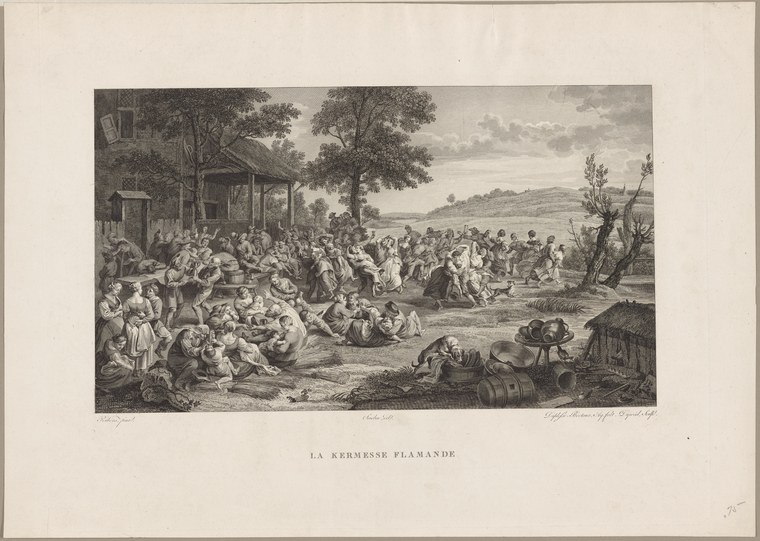
A crowded outdoor festival or fair scene, rendered as an engraving in the Flemish tradition. Dozens of figures populate a sunlit clearing bordered by trees and simple structures — a pavilion or tent shelter on the left, barrels and goods scattered in the foreground on the right. The composition is organized around multiple centers of action: couples dancing in the middle ground, small groups seated and standing throughout, musicians and revelers distributed across the space. The light is even and clear, typical of Northern European summer festivity. The scene reads as a genre study of popular leisure — the kind of kermesse (village fair) common in 16th–17th-century Flemish art — with dance as one activity among eating, drinking, socializing, and music-making. A distant landscape with water and hills is visible in the background, framing the gathering.
The dancing
The dancers visible in the middle distance are in profile and three-quarter view, some in pairs with apparent contact holds, others moving individually. The women wear long skirts with visible movement — the fabric caught mid-swing suggests rapid footwork. The men are in breeches and tunics. Most figures are upright and animated; arms are raised, bent, or engaged with partners or instruments. The grouping is informal and overlapping; no rigid formation is apparent. The sense is of concurrent, small-scale partnerships rather than coordinated ensemble work.
The dance depicted
This is a kermesse scene, which traditionally depicts social dancing at a rural festival — the kind of mixed-gender, community-based merrymaking that was common in the Netherlands, Flanders, and German-speaking regions from the 16th century onward. The specific dances are not identifiable from the image, but the context suggests folk dances of the region: the dress, the outdoor setting, the mixture of music, food, and dance all point to regional folk celebration. The engraving does not freeze a single moment of formal dance instruction or performance but rather captures the ambient sociability of the occasion.
How it was made
This is an engraving, identifiable from the fine parallel hatching, the use of line to model form and shadow, and the even tonal gradations typical of burin work on copper. The technique allowed for wide circulation via printing and made this kind of genre scene accessible to educated collectors and print-buyers across Northern Europe. The scale and finish suggest a work of some care, likely by a skilled printmaker; engravings of this quality and subject matter were popular in the 16th and 17th centuries for their documentary value and entertainment.
About this work
A crowded village fair or kermesse, depicted as an engraving in the Flemish tradition. The work captures a moment of communal festivity in which dance, music, food, and socializing are woven together — not a formal dance performance or lesson, but the ambient dance culture of a rural Northern European community. The title 'La kermesse flamande' (The Flemish Fair) anchors the work in a specific tradition and geography. As a print, it likely circulated widely among collectors and served both as entertainment and as a record of regional custom.
How to look at it
Attend to the scattered distribution of dancers across the composition: this is not a staged or formal dance but a simultaneous, overlapping set of partnerships and solo movements. Notice how the artist has rendered the women's skirts — caught mid-swing, with loose fabric and visible movement — to convey the speed and energy of the dancing. The presence of musicians (recognizable by instrument shapes and positioning) shows that music and dance are coordinated but not strictly synchronous; different groups may be dancing to different rhythms or the same tune at different tempos. The eating, drinking, and talking happening at the same time show that dance here is woven into leisure, not separated as a performance.
The artist
Unknown. The style and subject matter are consistent with 16th- or 17th-century Flemish printmaking, a tradition in which genre scenes of rural life, festivals, and proverbs were popular. The quality of the line work and composition suggests a trained printmaker working within an established workshop practice, but without a signature or secure attribution, the maker remains anonymous.
The period
The kermesse as a subject flourished in Flemish and Dutch art from the mid-16th century onward, reaching a peak in the work of Pieter Bruegel the Elder and his followers. These prints and paintings documented a way of life — and a form of social dance — that was becoming a subject of artistic and antiquarian interest even as industrialization and social change were transforming rural Europe. The engraving medium itself was the primary technology for circulating images across Europe in this period, making prints like this ambassadors of regional culture to distant audiences.
Where it lives
Held by the New York Public Library in its Prints collection. This is a historical print, likely 16th–17th century, and part of a broader documenting tradition of European genre scenes and regional customs.
Dance in this work
Questions about this work
What is a kermesse?
A kermesse (also spelled kermes or kirmes) is a village fair or outdoor festival, typically held in Flanders and the Low Countries. It usually included food, drink, music, games, and social dancing. The kermesse became a major subject in Northern European art, especially among Flemish and Dutch painters and printmakers, because it represented a distinctive regional tradition and a form of communal life that seemed picturesque or worth recording.
Can I tell what dances these are?
No. The image shows social partnering and movement consistent with 16th–17th-century Northern European folk dance, but the specific names or figures are not legible. What we can see is the costume, the outdoor setting, the presence of musicians, and the informal, mixed-gender partnerships — all typical of kermesse dancing. For named dances of the period, you would need written sources or more detailed compositional evidence.
Who made this engraving?
The artist is not recorded. The style and subject matter are consistent with Flemish printmaking of the 16th–17th century, a period and place where genre scenes were highly popular and widely produced. Many such prints were made anonymously or by workshop artists whose individual names were not preserved.
How was this image used?
As a print, this engraving could be cheaply reproduced and sold to collectors, wealthy households, and scholars interested in documenting regional customs and ways of life. Prints like this circulated across Northern Europe and served both as entertainment and as a form of ethnographic or antiquarian interest — a window into how 'other people' lived and celebrated.
More dance artwork





