49 works in this view — arrow keys or swipe to move between them.
Dance in Art
Jocko
Unknown artist
- Collection:
- Prints depicting dance
- Source:
- New York Public Library
- Rights:
- Public domain — free to use, share and adapt.
- Recorded as:
- Public Domain
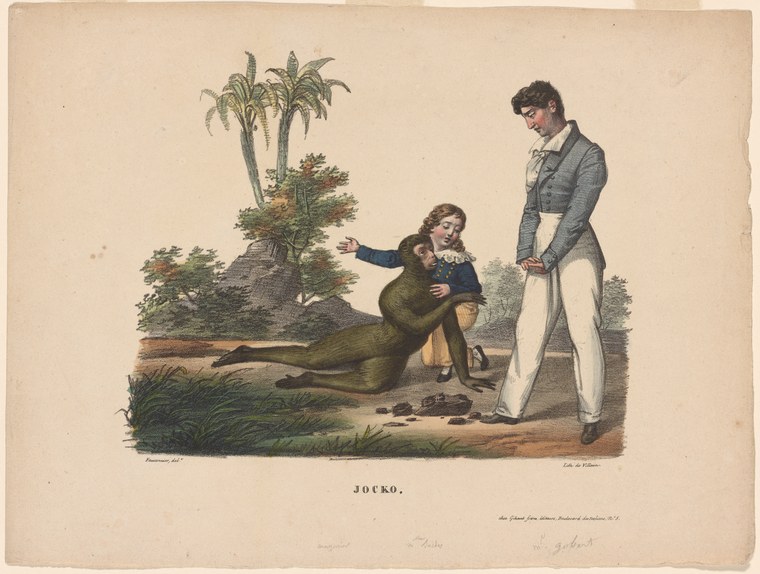
This print documents a crucial moment in the history of animal performance and the staging of the human-animal boundary. Jocko's fame was tied directly to the visual spectacle of his body in motion, making this image a primary record of how early 19th-century audiences understood the relationship between gesture, imitation, and civilization. For historians of performance, this work illustrates how movement—whether human dance or trained animal gesture—functioned as a site of wonder and moral instruction in the popular theater and visual culture of the Romantic period.
What you are looking at
A man in early 19th-century dress—blue jacket, white trousers, and boots—stands upright on the right, observing a chimpanzee seated on the ground to the left. The ape, rendered in naturalistic detail with dark fur, is positioned as if in motion or performance, with one arm extended toward the standing man in a gesture that suggests interaction or imitation. A second figure, a young boy in dark clothing, stands between them, also watching. The setting is a tropical landscape with palm trees rising behind the group and scattered rocks on sandy ground. The composition suggests a scene of display or demonstration—the ape appears to be performing or being instructed, while the two human figures maintain the formal posture of onlookers. The print is hand-colored in greens, browns, and flesh tones, with fine linear detail characteristic of 19th-century engraving.
The dancing
The chimpanzee's posture is the focal point: it reclines or sits with weight shifted to one side, one arm extended in a gesture that mimics human movement or could suggest the beginning of a leap or acrobatic motion. The standing man maintains a formal upright stance, his body angled slightly toward the ape, suggesting instruction or direction. The boy's position—intermediate between the two—and his downward gaze suggest he is witnessing rather than participating. The spatial relationship between the three figures, with the ape and man roughly at eye level despite their different heights, emphasizes the comparison or parallel between human and animal movement.
The dance depicted
The title *Jocko* refers to a celebrated chimpanzee that was exhibited widely in Europe in the early 19th century, most notably in the play *Jocko, ou le Singe du Brésil* (1825) and its adaptations. This image appears to document or imagine a moment of the ape performing or being trained to move in human-like ways—a form of animal performance that was popular in theatrical and circus contexts of the period. The extended arm and reclined posture suggest acrobatic or imitative movement rather than a structured dance form, but the composition frames the ape's motion as a spectacle to be observed and evaluated, consistent with how trained animals were displayed for public entertainment. The historical ape Jocko became a symbol of animality brought into civilized society through training and exhibition.
How it was made
This is a hand-colored engraving or lithograph, likely printed from a plate in the 1820s–1830s. The linear precision of the figures, the fine cross-hatching visible in the shadows, and the texture of the ground suggest engraving; the signature-like notation at bottom left (partially legible) is consistent with print culture publication marks. Hand coloring—applied after printing—is evident in the deliberate application of green to foliage, brown to rocks and tree trunks, and flesh tones to the human figures. This technique allowed for wide circulation and affordable distribution, making this the kind of image that would reach middle-class households, natural history enthusiasts, and theater-goers curious about the famous ape. The print's format and finish suggest it was issued as a theatrical souvenir or natural history illustration.
About this work
This is a colored engraving documenting or imaginatively rendering a moment of animal performance: a chimpanzee named Jocko in a posture suggesting acrobatic movement or human-like gesture, observed by two human figures in a tropical setting. Jocko was a real animal exhibited across Europe in the 1820s–1830s, most famously as the subject of a popular stage play in which the ape was portrayed as capable of learning and imitating human behavior. The print captures the cultural fascination of the period with the boundaries between human and animal, civilization and nature, that animated both theater and natural history in the early 19th century. While not dance in the formal sense, the image documents a form of bodily spectacle—the display of movement as entertainment—that occupied a liminal space between animal training, circus performance, and theatrical art.
How to look at it
Look first at the ape's posture: the artist has chosen to depict not a passive or docile animal, but one captured in a moment of dynamic movement or imitation. The extended arm echoes a human gesture, inviting the viewer to recognize similarity and difference simultaneously. Notice the positioning of the two human figures—they are not restraining or dominating the ape, but observing it, almost as peers in a transaction of display. The tropical setting, with its palm trees and exposed ground, frames this as a scene of contact and exhibition rather than natural habitat, emphasizing that this is a moment of cultural performance, not nature.
The artist
The artist is not recorded in the catalogue. The engraver's mark at the lower right is partially legible but does not resolve to a known hand in standard references. The print's production values and style suggest a professional print workshop, likely French or English, specialized in theatrical or natural history subjects for middle-class circulation. The unsigned or attribution-lost status is common for commercial prints of this period, where engravers often worked anonymously or in collective production.
The period
The 1820s–1830s saw intense fascination with non-European animals and peoples as subjects of display, study, and moral instruction. The play *Jocko, ou le Singe du Brésil* premiered in 1825 and was performed widely; it dramatized the capture and "civilization" of an ape through training and affection, themes that aligned with contemporary anxieties about evolution, education, and the nature of humanity. Prints like this one capitalized on the play's success and on wider curiosity about natural history and the exotic. In dance and theater, the period saw growing interest in pantomime and acrobatic spectacle as alternatives to or complements of narrative ballet, making animal movement a subject of serious attention alongside human choreography.
Where it lives
The print is held in the New York Public Library's collection of prints depicting dance. It is catalogued under the broad designation 'dance,' though its inclusion in that collection reflects 19th-century understanding of 'dance' as any spectacular or trained bodily movement, including animal performance.
Questions about this work
Was Jocko a real chimpanzee?
Yes. Jocko was a celebrated performing ape exhibited across Europe in the 1820s–1830s. The chimpanzee became famous after appearing in the 1825 play *Jocko, ou le Singe du Brésil*, which dramatized an ape's capture and gradual "civilizing" through training and companionship. The character and the real animal became conflated in popular culture, generating prints, plays, and merchandise.
Is this a dance?
Not in the formal sense, but the print was collected as a dance image because 19th-century curators understood 'dance' expansively to include any spectacular display of trained or expressive movement. The ape's posture suggests acrobatic or imitative gesture—forms of bodily spectacle that shared audiences and contexts with theatrical dance and pantomime.
What is the boy doing in the image?
The boy appears to be a trainer, handler, or witness to the performance. His youthful presence may also suggest the civilizing or educational dimension of the scene—the ape is being instructed or trained, and the boy observes or participates in that process. In some versions of the Jocko narrative, a boy or young person was the ape's primary companion.
Why would a print collection include an image of an ape?
Early 19th-century print collections often conflated 'dance' with 'movement spectacle,' and trained animals were understood as a category of performance art alongside ballet and pantomime. Prints of animal performers circulated widely and were collected by the same audiences interested in theatrical imagery, making them part of the visual archive of performative culture.
More dance artwork





