49 works in this view — arrow keys or swipe to move between them.
Dance in Art
A children's dancing lesson
Unknown artist
- Collection:
- Prints depicting dance
- Source:
- New York Public Library
- Rights:
- Public domain — free to use, share and adapt.
- Recorded as:
- Public Domain
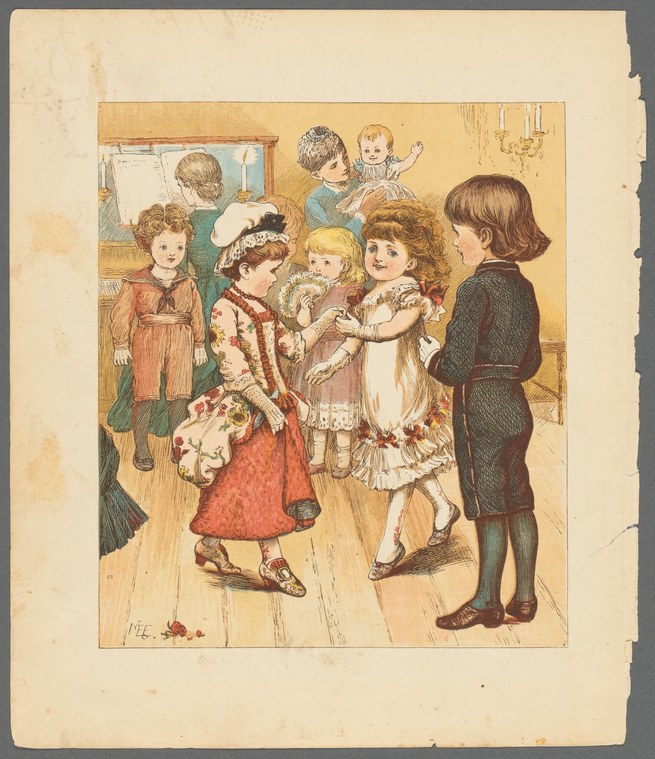
This image documents the crucial and often invisible work of dance instruction—how social dance was taught to children and embedded in childhood formation. For historians of dance pedagogy, childhood, and gender in the 19th century, it is a rare visual record of an actual lesson in progress. The composition centers the instructor and the learners equally, making visible the labor and attention that social dance required.
What you are looking at
A children's dancing lesson is underway in a domestic interior, likely a drawing room or studio. The space features wooden floorboards, a window with blue-green panes, and a chandelier visible in the background, suggesting a well-to-do household. Seven children are gathered in a loose group facing or near an adult instructor (partially visible at left), who appears to be leading the lesson. The children wear late 19th-century dress: the girls in white or pale-colored frocks with decorative details, some with elaborate collars or lace trim; the boys in darker jackets or waistcoats. One small child in the background is held aloft by another figure, possibly demonstrating something or simply delighting in the movement. The lighting is warm and domestic, rendered in soft yellows and ochres. The composition captures a moment of attention and mimicry—some children appear to be watching or listening intently while others are poised as if waiting their turn or preparing to move.
The dancing
The children stand in various poses of readiness and attention rather than in formal ballroom hold. Some have their arms at their sides or held loosely; others have arms raised or extended, as if following an instruction or example. The postures are upright but natural, not stiffened into adult ballroom frame. The smallest children lack the bodily awareness of older ones, creating a pedagogical hierarchy visible in the composition. The instructor's presence at the edge of the frame suggests demonstration-and-imitation as the teaching method. The overall impression is of tentative, learning bodies rather than accomplished dancers executing a choreographed phrase.
The dance depicted
This is a depiction of social dance instruction for children, most likely in the late 19th century. The formal dress, domestic setting, and mixed-gender grouping suggest ballroom dance fundamentals—probably minuet, waltz, or quadrille steps adapted for young learners. The artist has chosen to show the pedagogical moment rather than polished performance: children of varying ages and attentiveness, an instructor guiding from the sideline, and the tentative posture of learners. No specific dance style is clearly marked in the bodies or props, but the setting and era point to Victorian-era social dance training as it would have occurred in middle-class or gentry households.
How it was made
This is a hand-colored print, likely a chromolithograph or hand-tinted wood or metal engraving based on the soft color palette, linear definition, and the characteristic warm cream ground. The technique allowed gentle color modeling and fine linework that captures both the domestic intimacy of the scene and the children's individual expressions. The style of execution—careful cross-hatching in shadows, delicate line work in faces and dress—suggests a late 19th-century commercial print, possibly from a periodical, children's book, or a series of domestic scenes meant for middle-class circulation and consumption.
About this work
This is a hand-colored print documenting the instruction of social dance to a group of children in a late 19th-century domestic setting. It captures not a moment of choreographed performance but rather the pedagogical act itself: the adult instructor guiding younger bodies through fundamentals of ballroom etiquette and movement. The artist has prioritized the human complexity of the scene—the varied attention and readiness of the learners, the tenderness of the teaching relationship, the care taken with period costume detail—over any spectacular display of dance skill.
The work belongs in the history of dance because it preserves a specific social practice: the transmission of ballroom dance as a marker of class, refinement, and marriageability in Victorian childhood. It shows dance not as performance but as pedagogy, and reveals the domestic sphere as a site of cultural instruction. The print medium ensured that such scenes circulated widely, normalizing dance lessons as part of respectable child-rearing.
How to look at it
Look first at the posture and positioning of each child: notice that no two bodies are identically posed, and that the younger and older children are marked differently by the artist. Then trace the implied line of attention from the instructor (at left, partially cropped) toward the different children, some of whom are clearly watching, others less focused. Observe the care taken with dress—the different textures of lace, the collar details, the boys' jackets—which anchors the scene in a specific time and class position. Finally, note the moment the artist has chosen: not a polished demonstration or a completed phrase, but the suspended moment of instruction, in which the lesson is still in progress.
The period
The late 19th century saw the expansion of professional dance instruction and the formalization of ballroom dancing as a codified system of etiquette and technique. Social dance instruction for children became increasingly professionalized and widespread in middle-class and gentry households. At the same time, prints and illustrations of domestic life became a major form of popular visual culture, distributed through periodicals, gift books, and collected series. Scenes of children in lessons—music, drawing, languages, dance—were popular subjects, reflecting both the cultural investment in childhood development and the sentimental idealization of child life in the Victorian period.
Where it lives
This work is held in the New York Public Library's collection of prints depicting dance, where it is catalogued as a children's dancing lesson of unknown date and artist. The collection focuses on the representation of dance in visual culture rather than on unique or precious objects, suggesting that this print was understood as representative of a type and period rather than as a singular artistic statement.
Dance in this work
Questions about this work
What kind of dance is being taught?
The exact dance style is not marked in the image, but the formal dress, mixed-gender group, and domestic setting point to ballroom dance fundamentals—likely minuet, waltz, or quadrille steps adapted for children. The late 19th-century context and the presence of an adult instructor leading from the side suggest a systematic approach to social dance pedagogy rather than play or improvisation.
Why would children learn formal dance?
In the 19th-century middle and upper classes, proficiency in social dance was a mark of refinement, respectability, and marriageability. Dance instruction was part of a broader program of training in manners, movement, and cultural capital that differentiated genteel children from others. For girls especially, dancing was considered both an accomplishment and preparation for adult social participation.
What does the artist's style tell us about this image?
The hand-colored print technique and careful attention to domestic detail suggest a commercially produced work, likely intended for wide circulation rather than a fine-art audience. This implies that scenes of children's dance lessons were popular subjects in Victorian visual culture—normalized enough to mass-produce but valuable enough to preserve, indicating how central dance instruction was to idealized childhood.
More dance artwork





