49 works in this view — arrow keys or swipe to move between them.
Dance in Art
A children's dancing lesson
Unknown artist
- Collection:
- Prints depicting dance
- Source:
- New York Public Library
- Rights:
- Public domain — free to use, share and adapt.
- Recorded as:
- Public Domain
This image is valuable historical evidence of how dance was taught to children as a form of social and moral education, not as performance art. It shows the gendered choreography of courtship—the boy's deferential gesture, the girl's composed but animated response—as a learned behavior, drilling children into the movement vocabularies their class expected of them. For dance historians, it documents the vernacular pedagogy of ballroom dance at a moment when such instruction was routine among the middle classes.
What you are looking at
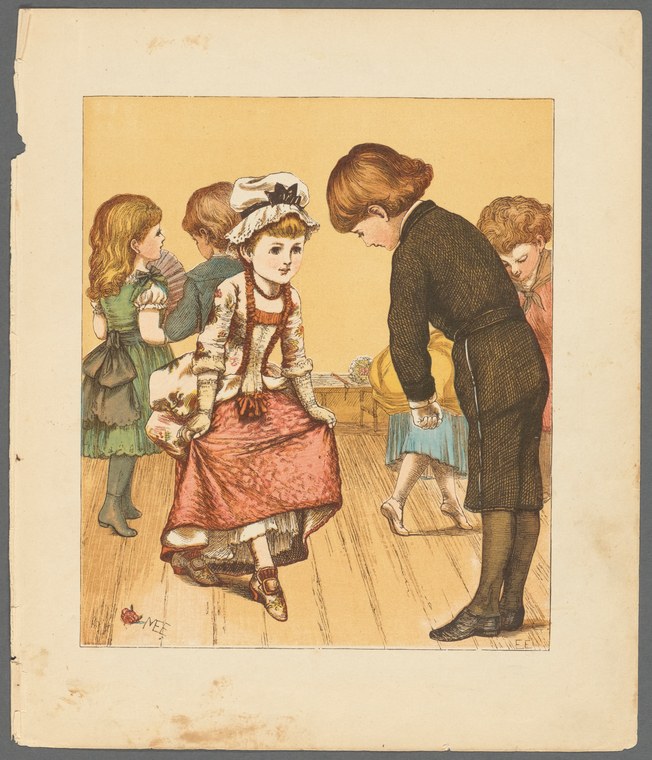
A dancing lesson in progress, set in an interior with a wooden floor and pale yellow walls. Five children are present: a boy in a dark suit stands at the center-right, bowing deeply toward a girl in a white lace cap and coral-pink skirt who is mid-turn, her right leg extended. Two younger girls in green dresses stand to the left observing or waiting their turn, while another child in reddish tones is visible at the far right. The scene captures a formal instructional moment, with careful attention to the children's postures, the delicate fabrics of their period clothing, and the spatial arrangement that suggests a structured dance practice or social dancing lesson typical of late-nineteenth-century child socialization.
The dancing
The central couple demonstrates a formal social dance position: the boy leans forward in an exaggerated bow with one leg extended behind, while the girl maintains an upright, almost balletic posture with her skirt lifted, suggesting active footwork or a turning motion. Her weight appears to be on her left foot, with her right leg extended or kicked. The two observing children stand with arms at their sides, attentive and stationary. The composition emphasizes the boy's courteous gesture and the girl's composed but energetic response, framing this as instruction in etiquette and coordination rather than uninhibited play.
The dance depicted
This depicts a formal social dancing lesson for children, most likely a waltz, polka, or other ballroom dance of the Victorian or Edwardian era. The boy's deep bow and the girl's lifted, extended leg are consistent with courtship dances taught to children of genteel families. The presence of multiple children in sequence suggests a teaching context—each child learning steps and deportment in turn. The formal clothing, interior setting, and careful posture indicate that this was not entertainment dance but domestic instruction in social propriety, a central element of upper-middle-class childhood education in the late 1800s.
How it was made
This is a hand-colored or printed chromolithograph or colored engraving, evident from the fine line work defining the figures, the carefully modulated flesh tones and fabric textures, and the pale yellow background wash. The artist has used color selectively—coral, green, and brown—to distinguish the figures while maintaining a light, delicate overall effect. The technique allowed for fine detail in the children's faces and the rendering of lace, buttons, and fabric folds, and the hand-coloring suggests a moderately high-value object intended for middle-class homes rather than mass circulation.
About this work
This work documents a specific moment in childhood education: the formal instruction in ballroom dance that was a marker of genteel socialization in the late nineteenth century. The artist has captured not just movement but a teaching sequence, showing the demonstration, the learners' attention, and the emotional tenor of the occasion—the boy's courteous bow and the girl's composed but lively response. It belongs in a gallery of dance imagery because it records how dance functioned as a technology of class formation and gender training, embedded in the domestic sphere and administered through careful physical instruction.
How to look at it
Attend first to the two central figures and the precise moment the artist chose: the boy mid-bow, the girl mid-turn or extension, both poised but in motion. This freeze-frame captures the sequence of a dance figure rather than a static position—you are seeing instruction in action. Notice how the two attending children are positioned as witnesses and learners, framing this as pedagogy rather than entertainment. The formality of the postures, the delicate rendering of fabrics, and the careful composition all reinforce the message that this dance is a serious matter of social training, not spontaneous joy.
The artist
The artist is not recorded in the catalogue. The style and execution suggest a commercial illustrator or printmaker working in the late nineteenth century, likely German or British based on the typography visible in the image. The hand-coloring and careful rendering of children's physiognomy point to someone with training in figure drawing and familiarity with the conventions of domestic genre scenes—a common specialization among illustrators of children's literature and educational or gift books of the period.
The period
In the Victorian and Edwardian eras, ballroom dancing was a compulsory skill for children of the middle and upper classes, taught formally in schools and at home as part of a broader curriculum of social polish and courtship preparation. Dance masters or dancing masters traveled between families or held classes in studios; this scene likely depicts either a private lesson or a small group class. At the same time, popular lithographs and engravings depicting children engaged in genteel pursuits (lessons, games, family scenes) were widespread in Europe and America, sold as affordable art for the home. This work sits at the intersection of two genres: the domestic instruction scene and the commercial print celebrating childhood.
Where it lives
Held in the New York Public Library's collection of prints depicting dance. This is a popular print, likely one of many copies, reflecting its circulation as affordable domestic imagery rather than a singular, precious artwork.
Dance in this work
Questions about this work
What dance is being taught here?
The image does not contain enough specificity to identify a single dance form with certainty. The boy's deep bow and the girl's extended leg are consistent with many ballroom or social dances of the period—waltz, polka, or quadrille among them. What is clear is that this is a formal social dance taught as part of children's education in genteel families.
Why are the other children standing still?
They are waiting their turn or observing the demonstration. In formal dance instruction, especially in small-group or private lessons, it was common for some pupils to watch while others performed, then rotate. This allowed the instructor to correct and refine technique one pair or dancer at a time.
What does the boy's bow mean?
The deep bow was a gesture of courtship etiquette. In social dancing, the boy or man initiated the dance with a bow to invite the girl or woman to dance, demonstrating deference and politeness. Teaching this gesture to children embedded courtship conventions and gender roles into their bodily practice from an early age.
Who would have owned a print like this?
Middle-class families, schools, and nurseries. Such prints were affordable and circulated widely as decorative objects and implicit instruction in how childhood 'should' look—orderly, decorous, and oriented toward social refinement. They functioned as both art and soft propaganda for a particular vision of childhood and class.
More dance artwork





