49 works in this view — arrow keys or swipe to move between them.
Dance in Art
The day of the fete
Unknown artist
- Collection:
- Prints depicting dance
- Source:
- New York Public Library
- Rights:
- Public domain — free to use, share and adapt.
- Recorded as:
- Public Domain
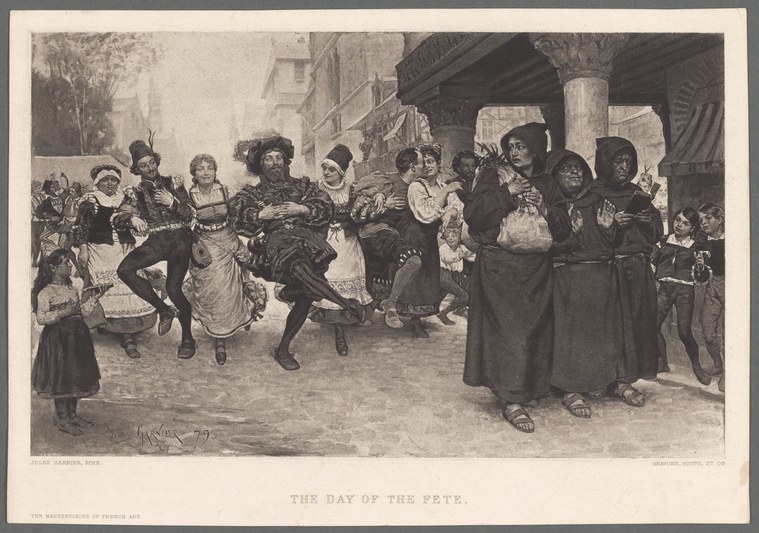
This engraving is a historical document of street and carnival dance as a public, social practice—the kind of dancing that occurred outside formal theater or dance school. For historians and dancers interested in how ordinary people moved in celebration, how costume and festivity were linked, and how artists chose to represent social dancing, this image provides concrete visual evidence of gesture, dress, participation patterns, and the mixing of social classes in festive contexts.
What you are looking at
A lively street festival or carnival scene rendered as a black-and-white engraving. In the foreground, a group of masked and costumed revelers dominate the composition: a man in blackface and striped trousers dances with exaggerated energy, his body twisted mid-movement; a woman in an elaborate white bonnet and dark dress gestures expressively; other figures in period costume—including what appears to be theatrical or carnival dress—cluster around them, some clapping or playing instruments. The background recedes into architecture (a bridge or viaduct with supporting columns visible on the right) and city streets lined with spectators. The crowd is dense but not chaotic; groups of figures at various depths suggest a public celebration rather than a formal theatrical performance. The technique and composition—the careful cross-hatching, the depth recession, the narrative grouping of figures—suggest this is a reproduction or interpretation of an earlier work, possibly from the 18th or 19th century.
The dancing
The central male dancer exhibits extreme physical abandon: his torso is contorted, one leg appears to be in mid-kick or high step, his arms are splayed, and his overall posture conveys vigorous, uninhibited movement. The woman beside him strikes a contrasting pose—more upright and gestural, her arms raised in expression rather than in active partnering. Other figures around them adopt supporting roles: some maintain a loose circle, others clap or gesture encouragement. The dress and body language suggest social or street dancing rather than trained technique; the movement reads as spontaneous and celebratory, not balletic or formally structured.
The dance depicted
This depicts social festive dancing, most likely a European carnival or street fête scene. The presence of blackface costuming and theatrical masks, combined with the street setting and mixed-gender group, suggests 18th- or 19th-century carnival traditions, possibly French or Continental European. The exaggerated, uninhibited movement of the central figure—particularly the high-energy leg action and twisted torso—is consistent with improvised social dance rather than codified steps. The clapping figures and informal arrangement suggest participatory street or folk celebration. Without more specific historical documentation, the exact regional or period-specific dance form cannot be definitively named, but the visual language points to carnival or fête dancing traditions.
How it was made
This is a black-and-white engraving or etching, identifiable by the parallel line hatching used for shading and the tonal control achieved through varied line density. The technique allows precise detail in costume and architectural elements while creating depth through atmospheric perspective in the background crowds. The formal engraving process (as opposed to the spontaneity of the scene depicted) suggests this was a reproduction for circulation—either copied from an earlier painting or lithograph, or created as an independent print work. The print was likely distributed as a popular image, given the legible subject matter and accessible technique. The scale and finish suggest a work intended for a broad audience rather than a collector's specialty print.
About this work
This engraving documents a street carnival or fête scene, capturing the moment of social festive dancing in what appears to be an 18th- or 19th-century European city. The composition centers on uninhibited, high-energy movement by costumed revelers, with the surrounding crowd as both audience and chorus. The work sits at the intersection of social history, carnival tradition, and artistic representation of lower-class or folk celebration—a subject that fascinated artists of the Romantic and later 19th-century periods as they documented customs and popular culture.
As a print, it circulated accessible imagery of dance and festivity to a wide audience. The engraving technique preserved fine detail in the costumes and architectural setting while the energetic central figures convey the spirit of the celebration. The work belongs in a dance archive because it documents how festive social dance was understood, staged, and valued enough to be reproduced and distributed in print form.
How to look at it
Attend to the moment of maximum energy in the central male dancer's movement—the artist has chosen to freeze him in an exaggerated, almost contorted pose that emphasizes the physicality and freedom of festive dancing. Note how his twisted torso and high leg action contrast with the more restrained gestures of the woman beside him and the looser group arrangement, which breaks from the formal partnering holds of ballroom dance. The architectural framing and crowd recession tell us this is a public space, a street or square, not a ballroom—the setting itself shapes what kind of movement is possible and expected.
The period
This image reflects a period of intense artistic interest in carnival, street life, and popular customs, particularly during the Romantic era and the 19th century. Artists were increasingly documenting and romanticizing folk practices, costumes, and social dances as industrialization transformed urban life. The use of blackface costume in this scene, now recognized as deeply problematic, was a common element of European carnival tradition and theatrical representation in this period. The engraving format allowed wide circulation of such imagery, making dance and carnival scenes popular subjects for print collectors and a broad public.
Where it lives
The print is held in the New York Public Library's collection of prints depicting dance. The catalogue record provides no attribution, date, or medium specification, but the image itself identifies it as a black-and-white engraving or etching, likely a 19th-century reproduction or contemporary work based on its style and subject matter.
Dance in this work
Questions about this work
What is the blackface figure doing in this image?
This engraving documents a European carnival tradition in which blackface was a stock costume element, now understood as a racist practice. The figure is engaged in festive social dancing as part of a carnival or street fête celebration. The presence of this imagery in historical art reflects historical racism; it does not justify it. Modern viewers should recognize it as evidence of a harmful convention while using the work to study actual movement practices, social participation, and the economics of festive culture.
How do I know this is a fête or carnival and not a formal dance?
Several visual clues indicate social street dancing rather than formal theater: the outdoor urban setting (street, bridge, architecture), the mixed crowd of spectators and participants, the loose circular arrangement without formal partnering holds, the exaggerated and uninhibited movement of the central figure, and the presence of costumes and masks typical of carnival tradition rather than stage costume. The overall composition emphasizes spontaneous celebration rather than trained technique.
What was 'the fête' in the 18th and 19th centuries?
A fête was a public celebration, festival, or fair, typically street-based and involving music, dancing, food, and theatrical elements. It was a space for mixed social interaction, costume play, and uninhibited movement—distinct from formal ballroom dancing or stage performance. Fêtes were documented extensively in art of this period because they represented folk culture, popular customs, and the energies of urban public life.
More dance artwork





