49 works in this view — arrow keys or swipe to move between them.
Dance in Art
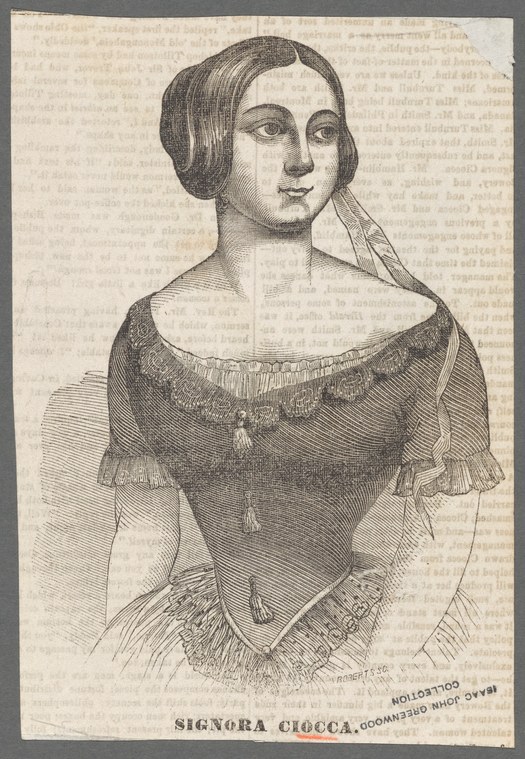
Signora Ciocca
Unknown artist
- Collection:
- Prints depicting dance
- Source:
- New York Public Library
- Rights:
- Public domain — free to use, share and adapt.
- Recorded as:
- Public Domain
This engraving preserves the image of a professional female dancer from an era when few women left documented records of their lives and work, yet it lacks the contextual information needed to tell her story. For researchers interested in the history of women in theatrical dance, the circulation of such portraits themselves—as commodities, as markers of fame, as objects of collection—is itself a window into how female performers were valued, marketed, and remembered.
What you are looking at
A three-quarter-length portrait of a young woman, identified in the inscription as Signora Ciocca, rendered in a fine engraving technique. She is shown from the waist up, her body turned slightly to the left while her face addresses the viewer directly with a composed, elegant expression. Her dark hair is parted in the center and swept back in wings that frame her face in the fashion of the mid-nineteenth century. She wears a off-shoulder dress with a broad collar of gathered lace or similar material, and short puffed sleeves with deep lace cuffs that extend nearly to the elbow. The bodice is fitted and decorated with intricate cross-hatching to suggest fabric texture and shadow. A ribbon or scarf drapes from her shoulder across her chest. The background is filled with small printed text—possibly a page from a book or publication—which suggests this is a reproductive engraving, perhaps a portrait plate extracted from a larger work. The light is even and studio-like, with careful modeling of the face and neck.
The dancing
The figure is a single standing woman, poised in a formal three-quarter stance with her weight evenly distributed and her body held with balletic uprightness. Her shoulders are relaxed and level; her arms hang naturally at her sides, visible only to mid-forearm. Her neck is elongated and her head held high, the posture of someone trained in deportment. There is no suggestion of active movement or partnering; this is a portrait of a person, not a document of dance in action.
The dance depicted
The identity of Signora Ciocca and her significance to dance history cannot be established from the image alone. The engraving is a formal portrait and carries no visual evidence of dance technique, costume, or performance context. The woman's excellent posture and the formality of her presentation suggest balletic training or status as a performer of theatrical dance during the nineteenth century, but the portrait itself depicts her at rest. Without additional documentation or context from the holding institution, it is not possible to determine which dance form she practiced, in what era she performed, or why her portrait was engraved and distributed.
How it was made
This is a wood or steel engraving, a technique that permits fine detail and mass production. The clarity of line, the subtle modeling through parallel hatching, and the even tone indicate skilled work by a professional reproductive engraver, likely after a drawing or painting. The presence of text block as background suggests this is a page or plate from a published work—a book, journal, or bound portfolio of portraits—which implies a mercantile or institutional purpose and a circulation among educated readers. Engravings of this kind were common in European periodicals and collections of notable figures during the 1800s.
About this work
A mid-nineteenth-century engraved portrait of a woman identified as Signora Ciocca, rendered in the formal, genteel style of theatrical or aristocratic portraiture of the period. The quality of the work and the care taken in the engraving suggest she was a figure of some note, likely a professional dancer or performer in the European theatrical tradition. The inscription and the circulation of the print as a collected page imply she held public status during her lifetime, yet her specific achievement, nationality, and dance form remain undocumented in the available record. She appears in the New York Public Library collection of prints depicting dance, which indicates she is recognized by that institution as a dance historical figure, but further research is needed to establish her legacy.
How to look at it
Attend to the extreme formality of the pose and the care taken in the rendering of costume and facial features. This is not a candid or action-based image; it is a public presentation of identity and status. The frontality of the gaze and the careful arrangement of the dress are conventions of portraiture, not of dance documentation. The viewer is meant to recognize the subject, to see her beauty and her refinement, and to understand her as a person of note—but the engraving itself does not show how she moved or what she performed.
The period
The engraving dates from the nineteenth century, an era of rapid expansion in theatrical dance in Europe and a period when the star system emerged as the dominant mode of theatrical production. The formal dress and styling suggest a date in the mid-1800s, during the Romantic era of ballet, when leading female dancers achieved international celebrity and their images were widely distributed. The practice of engraving and collecting portraits of notable performers was part of a broader culture of theatrical celebrity, sustained by print media, and directed toward an educated, theater-going public.
Where it lives
The work is held by the New York Public Library as part of its collection of prints depicting dance. The presence of text block as background and the inscription suggest it was originally part of a bound volume, book, or portfolio of collected portraits, possibly a theatrical or celebrity annual or a collected set of reproductive engravings.
Questions about this work
Was Signora Ciocca a famous dancer?
Her appearance in the NYPL's dance collection suggests she was significant enough to be included in a documented archive of dance history. The professional quality of the engraving and the formality of her presentation indicate she held public status as a performer. However, without additional research, her specific achievements, roles, and historical importance cannot be determined from this portrait alone.
What kind of dance did she perform?
The portrait provides no visual evidence of technique or dance style. Her posture suggests balletic training and her elegant presentation is consistent with theatrical dance of the Romantic era, but the image does not show her dancing or in performance costume. The answer would require external historical documentation.
Why is this a portrait and not a dance scene?
Theatrical celebrities of the nineteenth century were often memorialized in formal portraiture designed for collection and display, separate from action-based images of performance. This served both a commercial purpose—selling prints to fans—and a cultural one, elevating the subject to the status of notable personage worthy of formal representation.
More dance artwork





