49 works in this view — arrow keys or swipe to move between them.
Dance in Art
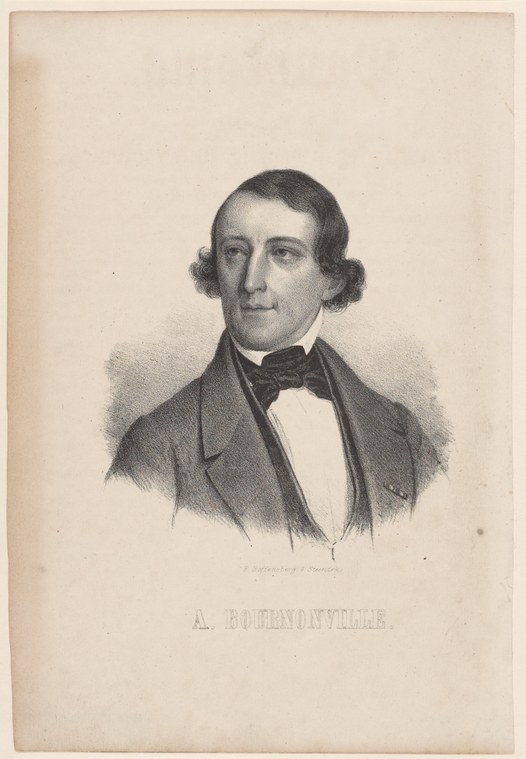
A. Bournonville
Unknown artist
- Collection:
- Prints depicting dance
- Source:
- New York Public Library
- Rights:
- Public domain — free to use, share and adapt.
- Recorded as:
- Public Domain
Bournonville's pedagogical system and choreographic legacy remain central to international ballet training and repertory. This portrait is one of the few contemporary visual records of his appearance, valuable both as historical documentation and as a tangible link to the early 19th-century ballet world he shaped. Understanding the person behind the method enriches knowledge of how classical ballet technique developed and was transmitted.
What you are looking at
A three-quarter length portrait of a man in formal 19th-century dress, rendered as a lithograph or engraving. He is posed against a plain background, wearing a dark jacket with a white shirt front and a black bow tie, the standard evening wear of the period. His dark hair is parted and styled in the fashion of the 1830s–1850s. The artist has rendered the face and shoulders with careful attention to physiognomy and the subtle modeling of light across the features, using fine cross-hatching and tonal gradation characteristic of mid-century reproductive prints. The composition is symmetrical and formally posed, the subject looking directly outward with a neutral, dignified expression. Below the portrait, the name "A. BOURNONVILLE" is printed in capital letters.
The dancing
This is a portrait head rather than a figure study of movement. The subject is seated or positioned at rest, shown from the torso up, with shoulders squared and no active gesture. The formal pose and clothing convey authority and professional standing. There is no dance movement visible; the image documents a person rather than an action.
The dance depicted
The inscription identifies the subject as A. Bournonville, almost certainly Auguste Bournonville (1805–1879), the legendary Danish ballet master and choreographer who directed the Royal Danish Ballet for nearly fifty years. Bournonville was one of the most influential figures in 19th-century ballet, credited with developing the Bournonville Method—a pedagogical system emphasizing fluidity, épaulement, and the integration of upper-body movement into classical technique. He was also a renowned dancer in his youth, celebrated throughout Europe. This portrait documents the man himself rather than dance practice, serving as a record of his appearance during his lifetime, likely during his most prominent years as a choreographer and teacher.
How it was made
This is a lithograph or possibly an engraving, executed in black ink on cream or off-white paper. The technique relies on fine linear hatching and tonal layering to build form and shadow, particularly evident in the modeling of the face and the rendering of fabric. The reproductive nature of the print—evidenced by the even tone, the commercial paper stock, and the printed text below—suggests this was a commercial portrait, likely issued for circulation among ballet circles, the press, or the general public as a record of a notable public figure. Such prints were a standard way of documenting and promoting artists during the 19th century.
About this work
This is a formal portrait lithograph of Auguste Bournonville, the dominant figure in 19th-century Danish and European ballet. Although it depicts no dance movement, it is essential visual documentation of a choreographer whose methods and works shaped ballet practice across generations. Bournonville's influence on pedagogy and style—preserved in the still-active Bournonville Method taught at the Royal Danish Ballet—makes this portrait a document of dance history at a foundational level: it records the face and bearing of a man whose artistic vision remains alive in living practice. The work belongs in a dance collection as a historical record of the architect of an entire school of ballet technique.
How to look at it
Observe the formal frontality and the direct gaze outward—conventions of 19th-century portraiture that assert the subject's status and presence. The attention to fabric and facial feature records a specific moment in time and a particular person's appearance. The print's technical quality (the fine hatching, the controlled tones) indicates both the importance of the subject and the resources devoted to circulating his image. Viewers familiar with accounts of Bournonville's bearing and personality may read character and temperament in the composed expression and upright posture.
The artist
The artist is not recorded in the catalogue. The execution suggests a professional printmaker working in the mid-19th century, likely based in Denmark or a major European cultural center. The quality of the work and the fact of its publication indicate it was made by a skilled practitioner of lithographic or engraving technique, probably working on commission to document a public figure of note.
The period
This portrait was almost certainly made during Bournonville's tenure as ballet master at the Royal Theatre in Copenhagen, which began in 1830 and continued until 1877. The 1830s–1860s were the height of his creative power and fame, a period when Romantic ballet was at its zenith in Europe and Bournonville was establishing himself as a choreographer of major works including *La Sylphide* (1836, his adaptation of the French original) and *Napoli* (1842). The formal, dignified character of this portrait reflects the social standing of ballet masters in this era—they were not merely dancers but intellectuals and artists of rank, often elevated to positions of cultural authority. The lithographic medium was the standard vehicle for distributing portraits of celebrated figures in mid-19th-century Europe.
Where it lives
This print is held in the New York Public Library's collection of prints depicting dance. It is one of a large body of 19th-century portrait prints, lithographs, and engravings documenting dancers, choreographers, and theatrical figures—a collection type that served both historical and promotional functions.
Questions about this work
Who was Auguste Bournonville?
Bournonville (1805–1879) was the most influential ballet master of the 19th century. He danced throughout Europe as a young man, then directed the Royal Danish Ballet for nearly fifty years, creating a distinctive pedagogical approach—the Bournonville Method—that emphasized fluidity, épaulement, and harmonic coordination of the whole body. His method remains taught and performed worldwide and has shaped generations of dancers.
What is the Bournonville Method?
A system of ballet training and movement quality developed by Bournonville and codified by his students and successors. It emphasizes flowing port de bras (arm carriage), refined épaulement (shoulder movement), and a particular quality of lightness and musicality. It differs from the more rigorous, turnout-focused Cecchetti and Vaganova methods, though all three remain central to professional ballet training.
Why is a portrait in a dance collection?
This portrait documents the physical appearance of one of dance's most important historical figures. While it shows no movement, it is primary visual evidence of Bournonville's life and presence, valuable to scholars, dancers, and historians seeking to understand the personality and legacy of the man whose artistic vision shaped an entire school of ballet.
When was this portrait made?
The catalogue record does not provide a date. Based on the style of dress, hair, and printing technique, it was likely made between the 1830s and 1870s, during Bournonville's active years as a choreographer. A more precise date would require additional research into print archives and Bournonville biography.
More dance artwork





