49 works in this view — arrow keys or swipe to move between them.
Dance in Art
American fashion plates
Unknown artist
- Collection:
- Prints depicting dance
- Source:
- New York Public Library
- Rights:
- Public domain — free to use, share and adapt.
- Recorded as:
- Public Domain
This work matters as evidence of the commercial visual culture surrounding women's dress in the 1890s–1900s, a period when the silhouette—puffed shoulders, tiny waist, long skirt—was as much a marker of class and fashion-consciousness as the ability to dance in it. Fashion plates shaped how women saw themselves and how they moved in public; they are primary sources for understanding the material constraints and aspirations embedded in everyday feminine dress.
What you are looking at
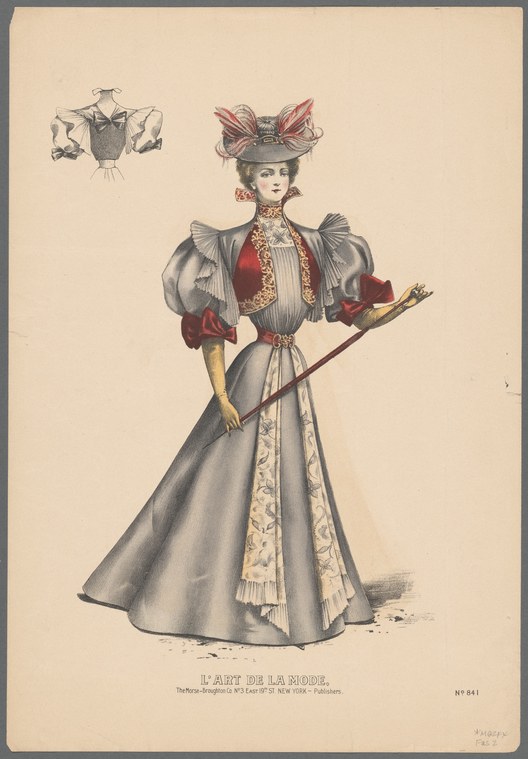
A fashionably dressed woman stands in three-quarter pose against a plain background, her body angled to show the silhouette of her ensemble to full advantage. She wears a high-collared blouse with leg-of-mutton sleeves—voluminous at the shoulder and fitted at the forearm—in pale grey or lavender silk, worn beneath a darker burgundy or wine-colored vest or short jacket. A long skirt in pale grey extends to her ankles, with decorative white lace or embroidered panel running vertically down the front. Her tiny waist is emphasized by the fitted bodice. She wears a large hat trimmed with burgundy ribbon or feathers, tilted slightly forward, and carries a walking stick or parasol handle in her right hand with a casual but deliberate gesture. In the upper left, a separate small illustration shows a close-up detail of the sleeve construction—the distinctive puffed shoulder characteristic of the 1890s–1900s silhouette. The overall presentation is that of a fashion plate: a type of commercial illustration meant to display current styles to potential buyers or admirers of fashionable dress.
The dancing
The single figure is posed in an elegant contrapposto stance, weight shifted slightly to one side, with the torso turned to present the garment's construction and detail to the viewer. The arms hang naturally, one holding the walking stick or parasol. There is no active movement or dance position: the posture is static and formally composed, designed to display the cut and construction of the clothing rather than to capture a moment of motion.
The dance depicted
This image does not depict dance. It is a fashion plate—a commercial illustration from the 1890s–1900s era—designed to present current styles in women's dress to a fashionable audience. The woman's pose is a standard fashion-plate convention: stationary, frontal or turned slightly, aimed at displaying the garment's construction and silhouette rather than capturing any movement or dance step. The walking stick or parasol is an accessory of daily dress, not a prop associated with any dance form.
How it was made
Hand-colored or color-printed engraving or lithograph, a standard commercial medium for fashion illustration in the late 19th and early 20th centuries. The technique allowed rapid reproduction and distribution of fashion designs, and the careful articulation of seams, pleats, and fabric textures provided dressmakers and buyers with precise reference for construction. The delicate line work and careful shading suggest either a skilled engraver's hand or a lithographic stone, with color applied by hand or in separate stone passes. The presence of the inset sleeve detail indicates this was drawn by someone with close knowledge of tailoring.
About this work
This is a fashion plate—a commercial illustration meant to display current women's dress styles—from the 1890s–1900s era, housed in a collection labeled "Prints depicting dance" but not itself depicting dance. The woman's static, formally composed pose is typical of the fashion-plate genre; her elaborate costume—high-collared blouse, leg-of-mutton sleeves, fitted bodice, long skirt—shows the silhouette that defined the Gibson Girl era and the turn of the twentieth century. The work is a document of dress history and the commercial visual culture that surrounded women's fashion, not a representation of dance or movement.
Its inclusion in a dance collection likely reflects either an error in cataloguing, or a broader collecting practice that captured all fashionable imagery of the era as context for theatrical costume and social dress. Fashion plates do touch dance history—they record the clothing women wore to balls, social dances, and theatrical performances—but this particular image is about the fashionable body at rest, displayed for inspection and purchase.
How to look at it
Attend to the precise rendering of the sleeve construction—the inset detail in the upper left shows how the dressmaker was meant to cut and seam the puffed shoulder. Notice the tiny waist and the long, heavy skirt: this is a silhouette that required corsetry and limited the wearer's stride and flexibility. The woman's posture is the formal, slightly stiff stance required by such clothing; it is a document of how fashion constrained the body, even in a visual culture increasingly concerned with movement and dance.
The artist
The artist is not recorded. The style and technique suggest a professional fashion illustrator or engraver working for a commercial fashion publication in the 1890s–1900s, likely European (the style and French or European publication mark visible). The notation "L'ART DE LA MODE" at the bottom indicates this plate appeared in a fashion journal or fashion-focused publication. The care taken with the sleeve inset and the precision of the line work point to a trained engraver or lithographer, but fashion plates were often unsigned or attributed only to the publication.
The period
This plate dates to the 1890s–1900s, the height of the "Gibson Girl" silhouette and the "New Woman" era. In fashion, this was the moment of the exaggerated leg-of-mutton sleeve, the corset-enforced hourglass figure, and the long heavy skirt—a silhouette that constrained movement but was nonetheless associated with modernity and fashionable leisure. In dance history, this was the era of ballroom standardization (waltz, quadrille, cotillion), music-hall performance, and the early development of ragtime-influenced social dances. The clothes in this plate were worn to balls and theatrical performances; they shaped how the women who wore them could move, turn, and hold their bodies in public spaces.
Where it lives
The work is held in the New York Public Library's collection of prints depicting dance. The notation "L'ART DE LA MODE" (The Art of Fashion) at the bottom indicates it was published in or intended for a French or European fashion journal or magazine. It is catalogued as American fashion plate, but the style and publication context suggest European (possibly French or German) origin and circulation, likely reprinted or distributed in America.
Questions about this work
Why is a fashion plate in a collection of dance images?
Fashion plates document the clothes people wore to dance events and performances, and the silhouettes that defined how dancers moved in their era. This plate shows the 1890s–1900s woman's dress worn to balls and social dances. However, the image itself does not depict a person dancing or in any dance position; it is a static display of dress design. It may have been misfiled, or collected as contextual material for understanding dance costume and the body in the period.
What is a fashion plate?
A fashion plate is a commercial illustration—usually an engraving or lithograph, hand-colored—designed to show current styles in dress to buyers, dressmakers, and fashionable women who wanted to keep current. Fashion plates were published in fashion journals and magazines and distributed widely. They were business documents as well as art: they taught people what to wear and how to understand fashionable dress.
What does the sleeve detail in the upper left show?
The inset illustration shows a close-up of the leg-of-mutton sleeve construction—the distinctive puffed shoulder and fitted forearm that defines the silhouette of the 1890s–1900s era. It is a technical aid for dressmakers, showing how the sleeve was to be cut, seamed, and fitted. Such details were standard in fashion plates aimed at the trade.
What can this image tell us about how women moved in this era?
The corset-enforced waist, the long heavy skirt, and the structured bodice all constrained movement: the wearer could not stride freely, could not bend easily at the waist, and had to move with a specific posture and carriage. Yet this was the dress of ballrooms, theaters, and social dancing. Women danced in these clothes—waltz, quadrille, cotillion—and the silhouette became part of the aesthetic and the etiquette of social dance.
More dance artwork





