49 works in this view — arrow keys or swipe to move between them.
Dance in Art
American fashion plates
Unknown artist
- Collection:
- Prints depicting dance
- Source:
- New York Public Library
- Rights:
- Public domain — free to use, share and adapt.
- Recorded as:
- Public Domain
This work matters to dance history not as an image of dance, but as evidence of how women's bodies and movement were constrained and shaped by Edwardian fashion. The weight of the skirt and train, the restriction of the corset, and the formal posture all shaped how women could move on the ballroom floor. Understanding what dancers wore illuminates what they could do.
What you are looking at
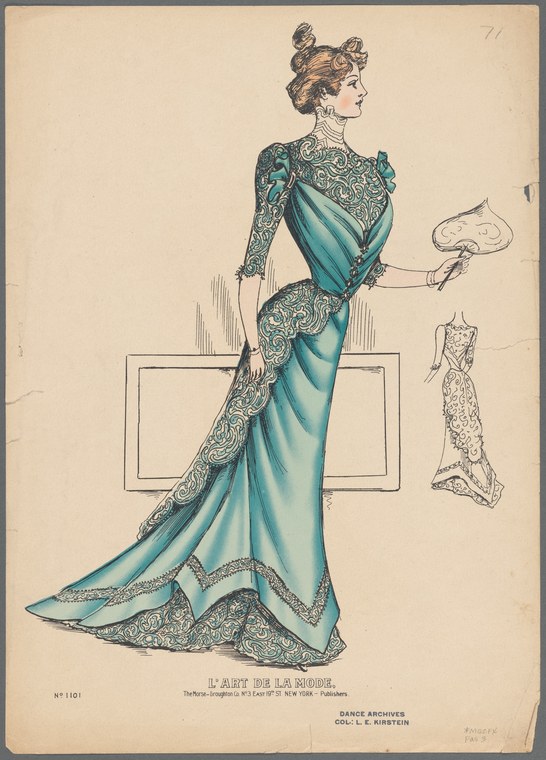
A fashionably dressed woman in an elegant Edwardian gown stands in three-quarter profile, gazing downward with a contemplative expression. She wears a striking teal or peacock-blue draped skirt with a sweeping train that pools at her feet, paired with an ornately decorated corseted bodice in gold and jewel tones. The bodice features intricate beadwork or embroidery covering the shoulders and extending down the front in elaborate scrolling patterns. Her hair is arranged in the high, pompadoured style of the early 1900s, topped with a decorative comb or ornament. In her right hand she holds a delicate fan, fashioned in a heart or leaf shape. To the right of the main figure are two smaller sketches showing garment details—the train construction and what appears to be a close-up of the bodice decoration or a separate dress design. The background is plain, with a simple rectangular frame around the standing figure suggesting a fashion plate layout. The overall composition is elegant and refined, focused entirely on displaying the garment's construction and ornamental richness.
The dancing
The single figure is depicted standing still, weight evenly distributed, in a pose designed to display the garment rather than to capture movement. Her posture is upright and dignified, with shoulders back and one arm gracefully extended holding the fan. The pose suggests a moment of pause—perhaps preparing for or reflecting after a social event—rather than active dance. There is no suggestion of weight shift, the forward or backward lean, or the frame that would indicate partnered dance or active movement.
The dance depicted
This image does not depict dance. It is a fashion plate—a commercial illustration intended to display a woman's garment. The woman is posed statically in an elegant but motionless stance, holding a fan as a fashion accessory. No dance style, hold, or movement is suggested by her posture, positioning, or the composition.
How it was made
This is a hand-colored engraving or lithograph, characteristic of early 20th-century fashion publishing. The precision of the line-work and the careful placement of color suggest professional commercial production. The two supplementary sketches at right—showing garment construction details—are typical of fashion plates, which served both as advertisement and as a guide for dressmakers and consumers. The technique allowed for multiple impressions and hand-coloring, enabling wide distribution to fashion magazines and department stores.
About this work
This is a fashion plate from an American fashion publication, likely from the early 1900s, showing a woman's evening or formal gown in the haute couture styles of the Edwardian era. The work is a commercial illustration, not a dance image. It belongs in a dance art collection only if the collection is documenting how fashion and social dress are represented in visual culture, or how the garments dancers and ballroom participants wore shaped the aesthetic conventions of the period. The presence of the fan and formal dress suggests this image may relate to social dancing contexts—ballrooms, formal dinners, or the courtship rituals of the era—but the image itself captures a moment of fashion display, not dance.
How to look at it
Notice the weight of the fabric—the train alone suggests limited mobility. The woman's posture is centered and static; she is not leaning into a partner, not showing weight shift, not suggesting the motion that would be required to waltz or perform a two-step in this gown. Her pose is that of a display mannequin, even if she were a living model. This is the aesthetic convention of the fashion plate: the garment is the subject, and the figure is its support.
The artist
The catalogue record does not identify the artist. The notation 'L'ART DE LA MODE' at the foot and the publisher information suggest this came from a French or French-influenced fashion journal. The style and hand-coloring technique are consistent with early 1900s commercial fashion illustration, a field that employed numerous skilled printmakers and colorists whose individual names often went unrecorded.
The period
This plate dates to the Edwardian era (c. 1900–1910), when American and European fashion were defined by the Gibson Girl silhouette—a S-bend corset creating an exaggerated curve, high pompadoured hair, and elaborate trimming. This was the age of the waltz, the two-step, and the rise of social ballroom dancing as a marker of middle and upper-class respectability. Women's formal dress of this period was designed for display at social events, including dances, but the restrictive corsetry actually limited movement. The fashion plate as a medium was booming in this period, circulating ideals of feminine elegance through illustrated magazines and trade publications.
Where it lives
The image is held in the New York Public Library's Dance Archives collection. It is catalogued as part of 'American fashion plates' but carries no further identifying information. The notation at the foot suggests it was published in or derived from L'Art de la Mode, a fashion periodical.
Questions about this work
Why is this in a dance collection if it is not about dance?
Fashion plates are included in dance archives because they document how dancers and ballroom participants dressed. The garment's construction, weight, and silhouette shaped what movements were possible. The image is evidence of the material culture and physical constraints within which ballroom and social dance took place.
What era is this gown from?
The style is Edwardian, dating to roughly 1900–1910. The pompadoured hair, the S-bend corset creating the hourglass silhouette, and the elaborate beadwork and trim are all characteristic of that period. The construction and ornament suggest a formal or evening gown.
Is the fan significant to dance?
Yes. The fan was an essential accessory in ballroom and courtship rituals of the Edwardian era. Women used fans to signal attention, regulate temperature in crowded ballrooms, and frame their posture and gesture. It was as much a tool of social communication as a practical object.
More dance artwork





