49 works in this view — arrow keys or swipe to move between them.
Dance in Art
Folk and ethnic costumes
Unknown artist
- Collection:
- Prints depicting dance
- Source:
- New York Public Library
- Rights:
- Public domain — free to use, share and adapt.
- Recorded as:
- Public Domain
The work documents a moment when theatrical and ceremonial gesture were performed with the precision and studied positioning that also characterized stage dance, and when the female body in formal dress was a primary vehicle for displaying social rank through physical deportment. For dance historians, it offers evidence of how dramatic scenes were staged, how the female body was positioned in moments of supplication or honor, and what the visual conventions of deference and respect looked like in performance contexts of the period.
What you are looking at
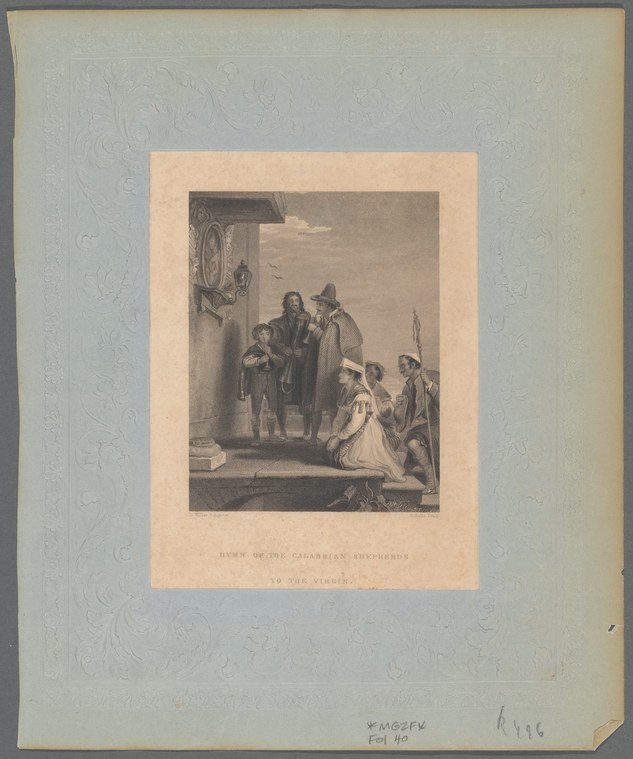
A theatrical scene depicting a formal audience or presentation before architectural elements suggesting a palace or noble residence. A woman in a long white gown kneels or bows before a standing male figure in dark coat and hat; another man in similar dress stands nearby, while two additional figures—one seated and one standing—occupy the right side of the composition. The setting is spare, with classical architectural details visible at left (a decorative panel or doorway). The lighting is diffuse and atmospheric, rendered in the mezzotint or stippled engraving technique characteristic of late 18th-century narrative prints. The mood is formal and reverential, the moment frozen at a gesture of respect or supplication.
The dancing
The central female figure is in a deep curtsy or kneeling position, her body folded forward at the waist with arms at her sides, a posture of deference conventional to court ceremony. The standing male figure faces her upright, his bearing formal and commanding. Two onlookers—one seated, one standing—witness the exchange from the right, their poses suggesting surprise or attention. The spatial arrangement and body angles create a narrative moment of social hierarchy rather than synchronized movement; this is ceremonial gesture, not dance proper, though the woman's extended line and the precision of her posture place her in a performative context.
The dance depicted
This print does not depict social or theatrical dance in motion, but rather a formal court ceremony or dramatic tableau—likely a scene from a play or historical narrative involving a woman of rank performing obeisance to a superior. The kneeling figure's extended posture and the formal dress suggest aristocratic or courtly protocol rather than any dance idiom. The composition echoes conventions of history painting and theatrical illustration, and may document a moment from a period drama or legendary tale, but the figures are fixed in ceremony, not engaged in the rhythmic, patterned movement that defines dance. The catalogue title 'Folk and Ethnic Costumes' may refer to the garments depicted, but the scene itself is theatrical narrative, not dance documentation.
How it was made
This is a mezzotint or stippled line engraving, a reproductive technique that creates tonal gradation through dense patterns of small marks. The soft modelling of light and shadow across the figures' forms and the atmospheric quality of the background are characteristic of mezzotint's capabilities for subtle chiaroscuro. The technique was common for narrative and theatrical prints from the 1770s–1820s, allowing wide circulation of scenes from plays, historical events, and literary subjects. The print was likely made after a painting or drawing, for a commercial print market, which explains its formal mounting on cream card stock within a patterned border.
About this work
This engraving presents a formal scene of court ceremony or dramatic tableau, featuring a kneeling woman in white facing a standing figure in dark dress, witnessed by onlookers. While the catalogue record identifies the work as depicting 'folk and ethnic costumes,' the image shows theatrical or historical narrative rather than dance practice—a moment of social deference rendered in the language of late 18th-century history painting and theatrical illustration. The work belongs in a dance history collection not because it documents choreography, but because it captures the formal gestural and sartorial conventions of an era when the border between court ceremony, theatrical performance, and social dance was fluid, and because the composed postures and dress tell us how bodies were arranged and displayed in formal settings.
How to look at it
Look first at the precise arrangement of bodies: the geometry of the kneeling figure's curved spine and extended line, the upright formality of the standing figure, the triangular spatial relationship between the main actors and the witnesses. These are composed positions, not captured motion—the artist has frozen a moment of formal ceremony that was itself choreographed through convention. Notice the rendering of the woman's dress, the fine detail of her posture, and the contrast between her posture of submission and the commanding stillness of the standing figure. The print's soft tonal range and atmospheric background create a theatrical frame, distancing the scene slightly and rendering it as spectacle rather than immediate reality.
The period
The print dates from the late 18th century, a period when theatrical prints and narrative engravings were a major form of visual culture and played a central role in circulating images of plays, historical scenes, and literary subjects. This was also the period of the rise of Romantic ballet and the increasing association of female performers with postures of grace, submission, and refined deportment. Mezzotint and stippled engraving were the dominant reproductive techniques for such scenes, offering middle-class audiences access to images of courtly and theatrical life. The formal dress and architectural setting suggest aristocratic or court contexts, at a moment when such settings were increasingly the subject of nostalgic or historical drama.
Where it lives
The work is held in the New York Public Library's collection of prints depicting dance, suggesting it was acquired as part of efforts to document visual representations of movement and performance. The catalogue title and the collection context indicate it was identified as related to dance or costume history, though the image itself presents theatrical narrative. The print is mounted on cream board with a decorative border, a common format for 18th- and early 19th-century prints intended for collection and display.
Questions about this work
Is this actually a dance scene?
Not in the sense of choreographed movement or social dance. The scene depicts a formal moment of ceremonial gesture—a woman performing obeisance—rendered with the precision and theatrical framing common to narrative prints of the late 18th century. For dance historians, it matters because it shows how bodies were positioned and displayed in formal performance contexts, and how the language of gesture and deportment conveyed social meaning.
What is the woman doing?
She is kneeling or in a deep curtsy before a standing male figure, in a posture of respect or supplication. Her extended line and formal dress suggest a moment of theatrical or ceremonial significance—likely from a play, historical narrative, or court scene.
What does 'folk and ethnic costumes' in the title mean?
The catalogue title may refer to the garments depicted—the woman's dress, the men's coats and hats—which may have been identified as representative of a particular period, region, or social class. However, the image itself is a formal theatrical scene, not a documentation of folk or ethnic dance practice. The title may reflect how the work was catalogued or interpreted at the time of acquisition.
More dance artwork





