49 works in this view — arrow keys or swipe to move between them.
Dance in Art
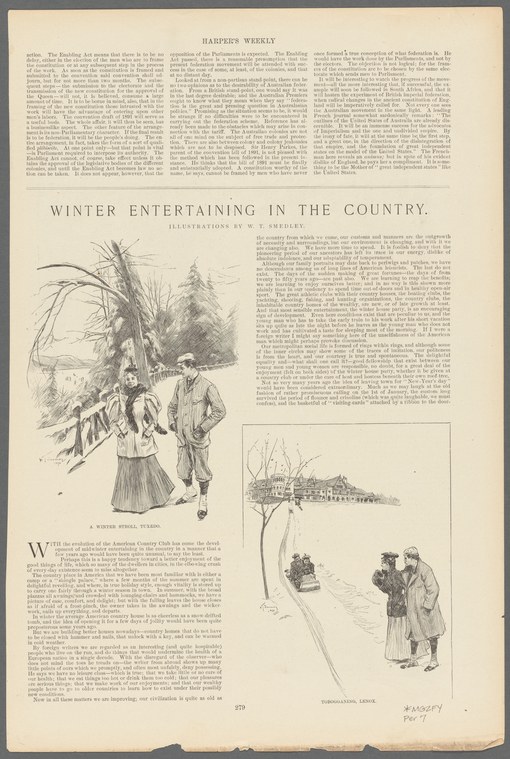
The ball-room, Tuxedo; The gateway, Tuxedo; [unlabeled vignette of a man and a couple in snowshoes]
Unknown artist
- Collection:
- Prints depicting dance
- Source:
- New York Public Library
- Rights:
- Public domain — free to use, share and adapt.
- Recorded as:
- Public Domain
The work is valuable not as dance documentation but as evidence of how leisure, gender, and class were performed in late-nineteenth-century America. The careful rendering of winter dress and the choice to show couples outdoors together, moving in snow, reveals social norms about propriety, courtship, and the use of the female and male body in non-theatrical contexts. Historians of fashion, courtship ritual, and American leisure culture will find it instructive.
What you are looking at
This page from *Harper's Weekly* presents three winter scenes at Tuxedo Park, a fashionable resort in New York. The largest illustration dominates the upper left: a man and woman in heavy winter coats and hats stand with skis or snowshoes, positioned against a backdrop of evergreen trees laden with snow. Their stance is upright and formal, suited to the cold-weather sporting context. Two smaller vignettes appear below and to the right: one shows a distant view of the Tuxedo clubhouse nestled in a snowy landscape with bare trees; the other depicts a couple in dark coats and a woman in lighter dress moving through deep snow, again equipped with snowshoes. The illustration style is pen and ink, with fine crosshatching creating shadow and texture. The page itself is letterpress text with integrated wood or steel engravings, typical of the magazine's format from the Gilded Age.
The dancing
The figures are clothed in heavy layers—fur-trimmed coats, hats, and gloves appropriate to the season—which obscures the body line and joint articulation. In the main scene, the couple stands with weight evenly distributed, their posture dignified but static; there is no sense of active movement or momentum. The snowshoe-equipped figures in the lower vignette are caught mid-stride, legs stepping forward through snow, but the artist has rendered only the gross motor action of walking rather than any refined technique. The compositions emphasize the social setting—couple pairing, formal dress, leisured pose—over the mechanics of any specific dance form.
The dance depicted
These illustrations do not depict dance in the formal or technical sense. They record winter sports and outdoor recreation at a prominent leisure destination, framed as fashionable social activity. The snowshoeing and standing poses represent recreational movement, not choreography. The context is reportage of American Gilded Age leisure culture, showing what wealthy New Yorkers did at their country retreats in winter.
How it was made
The work is an engraving (likely wood or steel) integrated into a letterpress page of *Harper's Weekly*, a major American illustrated newspaper of the period. The fine-line technique allows both pictorial detail and rapid reproduction at scale. This format—engraved vignettes nestled among text columns—was the standard vehicle for illustrated journalism in the 1880s and 1890s, reaching a mass middle- and upper-class readership. The technical skill evident in the shading and perspective suggests a professional illustrator trained in the tradition of magazine illustration.
About this work
This is a page from *Harper's Weekly* documenting social life at Tuxedo Park, a celebrated winter resort. The three scenes capture fashionable leisure activity—outdoor recreation in snow—as practiced by the wealthy American elite. The illustrations use the engraving medium to document contemporary social practice, a function central to the magazine's mission. While the work does not depict dance as a formal practice, it records movement and social congregation in a carefully curated leisure setting, and thus belongs to any visual archive of how the body was dressed, posed, and moved in public during the Gilded Age.
How to look at it
Attend to the clothing, posture, and grouping: the couple stands as a unit, formally dressed, with the woman's silhouette softened by her coat and the man's bearing upright and protective. The lower scenes show movement through snow but no balletic grace or rhythmic articulation—it is functional winter travel, not performance. The artist's choice to show the couple paused rather than in stride suggests that the point is their social presence, not their motion. The magazine's text (not fully legible in the image) would have framed this as fashionable society news, teaching readers what the elite wore and where they gathered.
The artist
The artist is not recorded in the catalogue. The illustration style—assured pen work, skilled anatomy and perspective, integration of figure and landscape—is consistent with the staff of professional illustrators who worked for *Harper's Weekly* in the 1880s–90s. The magazine employed both named contributors and uncredited staff artists; attribution would require consulting the magazine's archives or contemporary mastheads.
The period
Tuxedo Park was founded in 1886 as an exclusive gated community in Orange County, New York, and became iconic as a destination for the leisure class. The 1880s–90s saw the rise of 'society' as a codified social sphere, with winter sports and resort life as markers of status. In dance history, this period saw the professionalization of ballet in America (with the arrival of European dancers and companies) and the emergence of ragtime and social dance in ballrooms and public halls—a sharp divide between elite theatrical dance and popular social dancing. These illustrations sit outside both domains, documenting instead the genteel outdoor recreation that served as courtship and leisure for the wealthy.
Where it lives
This is a page from *Harper's Weekly*, a major American illustrated newspaper. The collection is held by the New York Public Library. The page belongs to the library's print and graphic materials holdings, and is catalogued within the broader *Harper's Weekly* archive.
Questions about this work
Is this a dance illustration?
No. The image documents winter recreation and leisure at Tuxedo Park, not choreography or formal dance practice. The figures are shown in outdoor winter dress, moving or posed in snow, but the artist has not rendered any specific dance technique or form.
Who were the people at Tuxedo Park?
Tuxedo Park was an exclusive gated community founded in 1886 for wealthy New Yorkers. Membership was by invitation, and residents included prominent families of the Gilded Age. The resort offered hunting, fishing, and winter sports as leisure pursuits, and served as a venue for high society gatherings and courtship.
What publication is this from?
*Harper's Weekly* was a major American illustrated newspaper published from 1857 to 1916. It combined news, editorial commentary, and detailed engravings, reaching a large middle- and upper-class readership. The magazine's staff of professional illustrators documented contemporary social life, fashion, and current events.
Why show this in a dance archive if there is no dance?
The image is relevant to dance history as documentation of how movement, dress, and the body were presented in elite American social contexts. It reveals the conventions of gender, posture, and social grouping that governed non-theatrical movement and courtship rituals in the Gilded Age.
More dance artwork





