49 works in this view — arrow keys or swipe to move between them.
Dance in Art
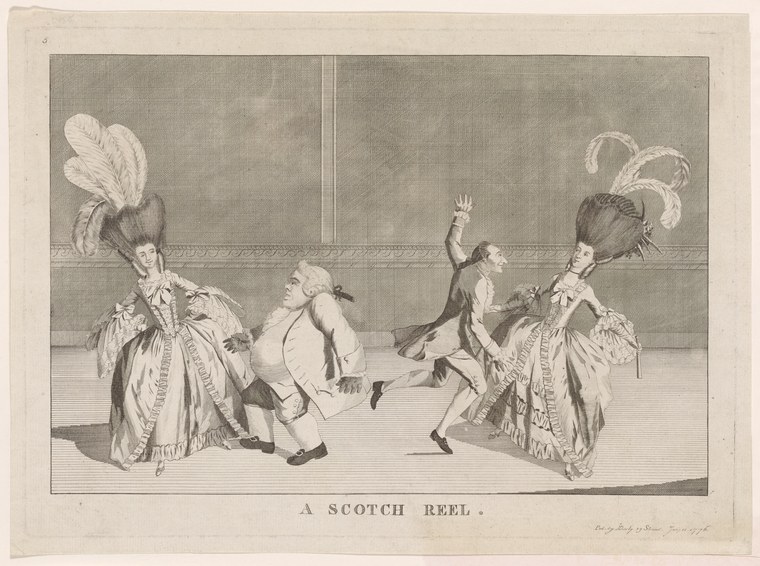
A Scotch reel
Unknown artist
- Collection:
- Prints depicting dance
- Source:
- New York Public Library
- Rights:
- Public domain — free to use, share and adapt.
- Recorded as:
- Public Domain
The print is rare visual evidence of Scottish reel technique and style in the 18th century, when the dance was transitioning from folk practice to polite society. The caricatured gestures reveal contemporary attitudes toward folk dance—simultaneously fashionable and transgressive—and the physical demands that distinguished reels from the more controlled baroque dances of the aristocracy.
What you are looking at
A satirical engraving depicting four figures in an energetic social dance, arranged in two pairs across a sparse interior with plain walls and a simple cornice line. The figures wear 18th-century dress: the two outer figures sport extravagant wide skirts with ruffled trim and towering plumes in their hair, while the inner pair wear breeches and coats. All four lean into vigorous, angular gestures—arms splayed, bodies twisted, knees bent in exaggerated attitudes of movement. The composition suggests a moment mid-reel, with the figures caught in rapid transitions. The engraving's title, "A Scotch reel," appears below in small capitals. The scene conveys both the formal costume conventions of polite dance and a deliberate caricature of its physical extremity.
The dancing
Four dancers arranged in two pairs suggest a reel's typical couple formation. The outer figures (in skirts) and inner figures (in breeches) employ sharply flexed limbs and pronounced torso rotations that exaggerate the vigour characteristic of folk reels. Arms are raised, extended, or bent at acute angles; weight appears to shift from foot to foot in quick, emphatic postures. The artist has captured the upright carriage expected of fashionable dress while caricaturing the vigour and speed of the footwork, with all four bodies tilted or twisted to suggest rapid turning and directional changes.
The dance depicted
The title and composition identify this as a Scottish reel, a country dance for couples or groups performed in rapid 2/4 time with frequent turning and travelling figures. Reels were popular in Scottish social dancing from at least the 17th century onward and became fashionable in polite society across Britain by the 18th century. The print captures the characteristic quick, directional changes and the close interaction between partners or adjacent dancers. The exaggerated postures suggest the artist's satirical intent—poking fun at the physical abandon required to dance the reel well, and perhaps at the contrast between formal dress and vigorous movement.
How it was made
This is an engraving, identifiable by its fine parallel lines (hatching) used to model form and shade. The technique allowed precise reproduction of the design and wide distribution through print. Engravings of this type circulated as satirical commentary on fashionable life and were accessible to a broad public beyond the aristocracy who commissioned paintings. The clean, economical line and shallow picture plane are characteristic of 18th-century British satirical prints, which often used exaggeration and comic distortion to critique social manners.
About this work
This engraving documents the Scottish reel as it existed in 18th-century fashionable society, capturing both the dance's characteristic quick turning and the comic tension between formal dress and vigorous movement. Reels had ancient roots in Scottish folk tradition but by the 1700s were danced in ballrooms across Britain by the gentry and emerging middle classes. The print's satirical tone—evident in the caricatured gestures and exaggerated poses—reflects a common 18th-century anxiety about decorum: the reel demanded speed and energy that seemed to threaten the composure expected of polite behaviour. As an engraving, it reached a popular audience and offers evidence of how the reel was seen, performed, and mocked in this period.
How to look at it
Watch how the artist has frozen the dance at a moment of maximum energy and directional change: no one stands upright, and every body twists or tilts. Note the contrast between the fineness of the engraving line—which records every ruffle and plume of fashionable dress—and the violent, splayed poses. The artist has chosen a moment that makes the reel look almost chaotic, inviting the viewer to laugh at the gap between the dancers' aspirations to elegance and the physical abandon the dance demands.
The artist
The artist is not recorded. The print is part of a satirical tradition in 18th-century British visual culture in which engravers like Thomas Rowlandson and James Gillray commented on fashion, manners, and social life through exaggeration and mockery. The style and subject suggest a date in the latter 18th century, when such prints were widely produced for middle-class consumption.
The period
The 18th century saw the rapid rise of Scottish and English country dances in fashionable ballrooms, a process documented in published dance manuals and satirical prints. Reels, originally Scottish folk dances, gained prestige partly through their association with the Scottish Enlightenment and romantic interest in national tradition. Simultaneously, they represented a challenge to the baroque court aesthetic: they were faster, more egalitarian in participation, and less concerned with rigid geometric formation. Satirists exploited the contrast between the decorous aspirations of polite society and the physical vigour required to dance well.
Where it lives
The work is held in the NYPL's collection of prints depicting dance. As a satirical engraving, it was produced for popular circulation and viewing, likely by a commercial printmaker whose name was not recorded or has not survived.
Dance in this work
Questions about this work
What is a Scottish reel?
A Scottish reel is a social country dance performed in quick 2/4 time, typically by couples or groups who travel around the room or set while executing rapid turns and close interaction. Originating in Scotland, reels became fashionable across Britain in the 18th century and remain central to Scottish ceilidh dancing. The dance requires speed, timing, and the ability to coordinate with partners—qualities that made it both admired and, in satirical contexts, liable to be mocked.
Why is this engraving funny?
The print exaggerates the physical postures of the reel to comic extremes: limbs splayed, bodies twisted, all dignity apparently abandoned in pursuit of speed and energy. The joke lies in the contrast between the fashionable dress (which speaks to aspiration toward elegance and control) and the vigorous, almost violent movement. The artist is gently mocking both the reel's physical demands and perhaps the earnestness of middle-class dancers trying to master a fashionable dance.
How do we know this is an 18th-century print?
The costume—the high-crowned hats with plumes, the cut of the coats and breeches, the style of women's dress with its gathered skirts and trim—all point to the mid-to-late 18th century. The engraving style and the fashion for satirical social commentary through prints are also consistent with this period. However, the exact date is not recorded in the catalogue.
More dance artwork





