49 works in this view — arrow keys or swipe to move between them.
Dance in Art
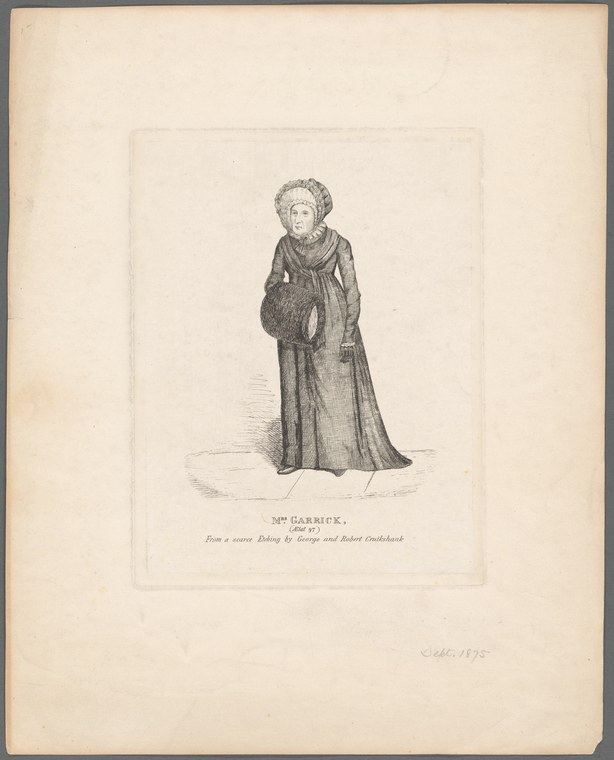
Mrs. Garrick (Ætat 97)
Unknown artist
- Collection:
- Prints depicting dance
- Source:
- New York Public Library
- Rights:
- Public domain — free to use, share and adapt.
- Recorded as:
- Public Domain
While the image itself does not depict dance, it documents the material culture and appearance of the theater world of the early 19th century, and the high regard in which the Garrick family—central figures in British theater—were held. For a gallery of dance in art, it offers a portrait of a woman embedded in the theatrical world, and serves as evidence of how theater personalities were visualized and commemorated for public consumption.
What you are looking at
A single female figure stands alone against a plain background, wearing the full-length dress and bonnet of early 19th-century fashion. She is posed in three-quarter view, weight settled on one leg, her body upright and formal. Her dress is a long, high-waisted gown with a full skirt falling to the ankle, and a shawl or wrap is draped across one arm. The figure's posture is static and dignified rather than animated—there is no suggestion of motion or the mid-gesture freeze that characterizes dance imagery. The engraving is finely detailed in the costume and facial features but minimal in setting, with only a thin ground line suggesting a stage or performance space.
The dancing
One woman, posed standing. Her weight is settled and centered; there is no tilt, no extension, no sense of traveling or turning. Her arm hangs naturally with the drapery; her frame is closed and self-contained. The pose is that of a portrait—a presentation of the figure to the viewer—rather than a moment of choreographed movement.
The dance depicted
This image does not depict dance. The figure is stationary and posed; no footwork, hold, partnering, or gesture suggests movement. The title 'Mrs. Garrick (Ætat 97)' indicates this is a portrait of a woman in late life, not a representation of her dancing. The theatrical context (the reference to George and Robert Cruikshank on the inscription, who were known for theatrical prints) and the engraved medium place it in the world of theater and performance, but the image itself shows a portrait, not a performance or choreographed moment.
How it was made
This is an engraving, executed on paper with fine parallel lines to create tone and modeling. The technique is evident in the careful hatching of the dress and the delicate rendering of the face. The quality and finish suggest professional work; engravings of this kind were used to document theatrical personalities and circulated as prints to a wide audience of theater-goers and collectors. The inscription 'From a scarce Drawing by George and Robert Cruikshank' attributes the design to the Cruikshank brothers, celebrated for satirical and theatrical prints in early 19th-century England.
About this work
This is a portrait engraving of Mrs. Garrick, wife of the celebrated actor David Garrick, recorded at age 97. It captures a woman of the Georgian or early Regency era in formal dress, presented as a single standing figure of dignity and restraint. The work belongs to a tradition of theatrical portraiture—recording the likenesses of celebrated stage personalities and their families for a print-buying public. The Cruikshank attribution places it within the tradition of English theatrical and satirical printmaking, where such images served both as memento and as commentary on the theatrical world.
How to look at it
This is a portrait, not a dance image: look at it as a record of early 19th-century dress, deportment, and the way theatrical figures were presented to the public. The formality and stillness are intentional—this is a document of a person, not a moment of performance. The fine engraving technique allows the viewer to read the subtle gradations of the fabric and the careful attention to the figure's face and bearing.
The artist
George and Robert Cruikshank were brothers and leading exponents of English satirical and theatrical printmaking in the late 18th and early 19th centuries. Both were prolific designers and engravers known for sharp social observation and theatrical subjects. Engravings after their designs circulated widely and were collected by theater enthusiasts and the general public.
The period
This portrait dates to the early 19th century (likely early 1800s, given Mrs. Garrick's age of 97 and her husband David Garrick's death in 1779). The engraving was created when such prints were a major form of theatrical publicity and celebrity culture. The Regency era saw a flourishing of theatrical portraiture and theatrical prints as a commercial and cultural medium. David Garrick himself had been the dominant figure of the English stage in the mid-18th century; this portrait of his widow preserves the memory of his theatrical legacy through her likeness.
Where it lives
The work is held in the NYPL's collection of prints depicting dance, though it is not itself a dance image. It came to the collection as part of the broader documentation of the theatrical world and may have been catalogued under dance and theater due to its theatrical subject matter and the Garrick family's prominence in theater history.
Questions about this work
Is Mrs. Garrick dancing in this image?
No. This is a standing portrait, not a depiction of dance. The figure is posed stationary and formal, as was standard for theatrical portraiture of the period. There is no gesture, movement, or choreographic content.
Who was Mrs. Garrick?
She was the wife of David Garrick (1717–1779), the most celebrated English actor of the 18th century and a dominant figure in theater history. This print records her at age 97, likely created sometime in the early 1800s after her husband's death.
Who are George and Robert Cruikshank?
Brothers and leading English printmakers and satirists of the late 18th and early 19th centuries. Both were prolific designers of theatrical and satirical prints that circulated widely among the theater-going public and collectors.
Why is this in a dance collection?
The print documents the theatrical world and a celebrated theatrical family. It was catalogued in the NYPL's dance collection as part of the broader material culture of theater, though the image itself does not depict dancing.
More dance artwork





