49 works in this view — arrow keys or swipe to move between them.
Dance in Art
The polka on 19th-century music covers
Unknown artist
- Collection:
- Prints depicting dance
- Source:
- New York Public Library
- Rights:
- Public domain — free to use, share and adapt.
- Recorded as:
- Public Domain
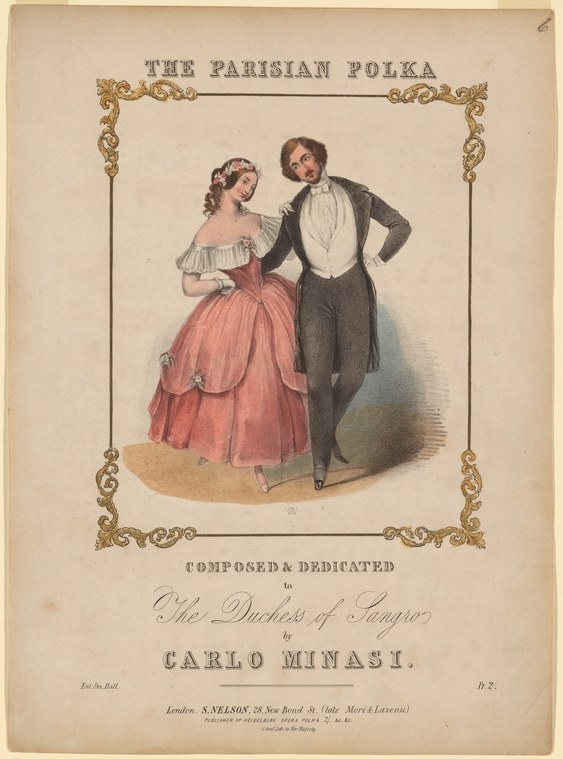
This work documents the social life of the polka as a phenomenon of 1840s–50s urban fashion, not merely as a choreographic form. It shows how dance was embedded in courtship, display, and the rituals of refined leisure, and how the music industry created and circulated images that shaped how people understood and performed dances. For historians of the polka or of 19th-century social dance, this cover is a primary source for understanding the dance's cultural meaning.
What you are looking at
A young couple in elegant 19th-century dress stands in a pose of flirtation or courtship. The woman wears a pale pink ball gown with a fitted bodice, off-shoulder neckline with white ruching, and a voluminous skirt caught mid-movement in gathered folds. Her hair is arranged in the fashionable style of the 1840s–50s, parted and pulled back. The man, beside her, wears formal evening dress: dark coat with white shirt front, and stands with a proprietary posture, one hand near her waist. Both figures are positioned against a neutral ground with a delicate gold scrollwork border framing the composition. The title and attribution are printed below: "The Parisian Polka / Composed & Dedicated to the Duchess of Sangro by Carlo Minasi." The print is a hand-colored lithograph, and the figures are rendered with the genteel restraint typical of commercial dance music covers of the period.
The dancing
The couple stands in an upright, social posture rather than a closed ballroom hold. The woman's weight appears to be on her back leg, her torso angled toward the man in a pose of demure availability; the man leans slightly toward her, his left arm extended in a gesture of address or instruction. The skirt is frozen in a moment of swirl or sway, suggesting the woman has just turned or is about to. There is no rigid frame or tight partnership hold visible; instead, the spacing and angles suggest the informal proximity of a flirtation or the moment before engagement in the dance.
The dance depicted
This is unquestionably a polka, as the title states. The polka was a wildly popular couple dance across Europe in the 1840s and 1850s, originating in Bohemia and reaching Paris, where it caused a sensation. The print captures the dance not in motion but in the social moment that preceded it—the invitation, the courtship ritual that framed the actual steps. The skirt movement and the woman's poised, compliant posture are consistent with the polka's character: a moderately paced, lively couple dance with a distinctive hop and emphasis on the woman's display through skirt movement. This cover emphasizes the dance's status as a fashionable social practice, not a technical marvel.
How it was made
This is a hand-colored lithographic print, identifiable from the flat color fields, the delicate tonal gradations in faces and fabrics, and the crisp outline of the border design. Lithography allowed for rapid, economical reproduction of music covers in large quantities, making them affordable for a broad middle-class market. The hand coloring was applied after printing, visible in the slightly uneven tints and the way color does not follow the outlines precisely. This technique and medium indicate this was a commercial product for consumers who purchased sheet music, likely as a gift or a marker of cultural refinement.
About this work
This is a lithographed music cover for a polka dedicated to an Italian noblewoman, published in London by N. Selmer in the mid-19th century. It documents the polka at the height of its fashion as a social dance—not as a concert performance but as a fashionable leisure activity for the educated classes. The print captures not the dance in motion but the social ritual surrounding it: the moment of invitation, the display of the woman's fine dress, and the coded gesture of courtship. It belongs in a dance archive because it reveals how the polka was imagined, marketed, and consumed by the urban middle class, and how visual representation played a role in spreading and legitimizing the dance.
How to look at it
Attend to the woman's skirt and the moment it captures: the fabric is caught in a moment of movement, neither fully fallen nor fully risen, suggesting the artist has frozen a step mid-turn or mid-sway. Note the spatial relationship between the couple—they are near but not locked together, preserving a distance appropriate to public courtship. The man's gesture and posture suggest his role in initiating or directing the dance. The overall composition emphasizes the woman's display and the formality of the encounter, reflecting how the polka was understood as a vehicle for courtship and social performance, not merely physical exertion.
The artist
Carlo Minasi is recorded as the composer of this polka. The cover itself is unsigned by a visual artist; such covers were typically produced by commercial printing houses in London, with artists working anonymously or uncredited. Minasi appears to have been one of many composers who contributed to the vast catalogue of polka music that flooded the market after the dance's introduction to England and France in the mid-1840s.
The period
The polka arrived in Paris from Bohemia around 1840 and reached London by the mid-1840s, where it became an immediate social craze. Unlike court dances, which were performed at formal balls, the polka was embraced by the middle class and performed at social gatherings, dances, and assemblies. By the 1850s, hundreds of polka compositions had been published, each dedicated to a society figure to boost sales and prestige. The visual culture of the dance—its music covers, prints, and illustrations—played a crucial role in standardizing how it was understood and performed. This print dates to that moment of maximum enthusiasm, when the polka was still novel enough to require explanation and genteel enough to be marketed as a refined leisure activity.
Where it lives
This print is held in the New York Public Library's collection of dance-related prints. The imprint reads "London: N. Selmer, 29 New Bond St (opp. Mallet & Lawson). Publishers of Musick (sic) Prize 2s." The print was a commercial commodity—sheet music with a wrapper or cover designed to attract buyers and to advertise both the composition and the publisher.
Dance in this work
Questions about this work
What is the polka and when was it popular?
The polka is a moderately fast couple dance in 2/4 time, originating in Bohemia and becoming a craze across Europe in the 1840s–50s. It was one of the first dances to be embraced equally by the middle and upper classes, performed at social balls and assemblies. Unlike earlier court dances, the polka was relatively simple to learn and was associated with modernity, urban life, and progressive social values.
What does the off-shoulder dress tell us about the polka?
The woman's elaborate ball gown is a sign that this was a dance of the ballroom and formal social occasions, not a folk or peasant practice (though the polka did originate in a folk context). The emphasis on the woman's dress and her display through the movement of the skirt suggests that the polka, like other 19th-century couple dances, was an occasion for women to exhibit their wealth, taste, and eligibility. The movement of full skirts was integral to the polka's visual appeal.
Why was the polka dedicated to the Duchess of Sangro?
In the 19th century, dedicating a composition to a titled or wealthy patron was a standard way of honoring them and increasing the work's prestige and marketability. A polka dedicated to a duchess would appeal to buyers who saw themselves as fashionable and socially aspiring. This dedication was as much a marketing strategy as a mark of respect.
What does this print tell us about how music and dance were sold?
Music covers like this one were visual advertisements as well as protective wrappers. They shaped how people understood a dance by presenting an idealized image of how it should be performed, what it should look like, and what kind of person (fashionable, refined, wealthy) performed it. This image was reproduced thousands of times and reached a wide market, making it a powerful tool for standardizing dance practice.
More dance artwork





