49 works in this view — arrow keys or swipe to move between them.
Dance in Art
People of Argentina, Brazil, Paraguay, and Uruguay
Unknown artist
- Collection:
- Prints depicting dance
- Source:
- New York Public Library
- Rights:
- Public domain — free to use, share and adapt.
- Recorded as:
- Public Domain
This work documents early-20th-century attitudes toward South American vernacular movement and rural identity at a moment when European artists and publishers were systematizing and visualizing global 'types.' The image is valuable not because it records an actual dance form with precision, but because it reveals what foreign illustrators believed—or wanted audiences to believe—about South American popular culture: celebratory, open, outdoor, and joyful. For dance historians, it is a marker of how 'folk' or 'regional' movement was packaged and circulated in print culture.
What you are looking at
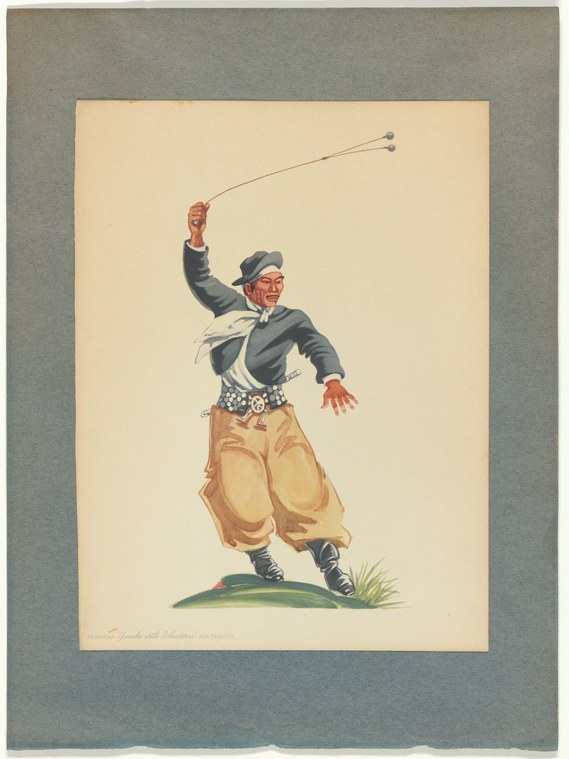
A single male figure stands on a grassy mound against a plain cream background, captured mid-gesture in a moment of exuberant expression. He wears a dark blue or navy jacket with long sleeves, tan or beige knickers, and what appears to be a decorative belt with a patterned buckle at the waist. His feet are clad in dark boots or shoes with visible socks. The figure has one arm raised high overhead, hand extended upward as if reaching or hailing, while the other arm extends to the side with the hand open and relaxed. His posture is dynamic and open, with slight forward lean suggesting movement or momentum. A small tuft of grass appears at the base of the mound. The composition is spare and frontal—the figure dominates the composition with no other dancers or setting elements to suggest a narrative context.
The dancing
A single adult male dancer in a stance of pronounced openness and reach. His weight appears evenly distributed, with the body unfolded rather than twisted or closed. One arm extends upward at approximately 150 degrees from the body, the other outward at roughly 90 degrees, both hands open and relaxed rather than grasping. The posture suggests a moment of exultation, celebration, or invitation rather than a structured ballroom hold or partnered frame. There is no visible partner or social connection to another dancer.
The dance depicted
The image cannot be confidently identified as depicting any specific recognizable dance form. The pose—arms raised and extended, open body, celebratory demeanor—aligns loosely with folk or regional celebrations common to rural Argentina, Brazil, Paraguay, or Uruguay in the early 20th century, but the stance lacks the technical specificity of established vernacular forms such as samba, candombe, or regional chacarera. The figure's dress and grooming suggest a European-influenced rural or working-class male of the period. The image may document a stylized or generalized notion of South American popular celebration rather than a precise choreographic moment.
How it was made
This appears to be a watercolor or gouache illustration on paper, mounted on gray board. The technique shows careful hand-coloring with delicate washes: the face and hands are rendered in flesh tones with subtle shading, the blue jacket is evenly applied, and the tan knickers are built up in a warm ochre. The line work is clean and decisive, particularly in the contours of the figure and the decorative details of the belt and boots. The simplicity of the background and the frontal presentation suggest this was made as a study, costume design reference, or page in a larger ethnographic or commercial series—possibly a print series documenting regional or national types.
About this work
This is a hand-colored illustration of a single male dancer or folk figure from South America, circa early-to-mid 20th century, shown in a moment of open, celebratory gesture. The figure is dressed in a style consistent with rural or working-class dress of Argentina, Brazil, Paraguay, or Uruguay. The image belongs to a collection or series titled 'People of Argentina, Brazil, Paraguay, and Uruguay,' suggesting it was part of a larger ethnographic or cultural documentation project. The work sits at the intersection of folk documentation, costume study, and dance illustration—capturing not a specific choreography but an idealized or representative moment of South American popular culture and movement.
How to look at it
Notice the artist's choice to show the figure in a moment of full, unguarded expression rather than a formal pose or working gesture. The raised arm and open stance convey emotion and spontaneity rather than technique. The careful rendering of costume detail—the pattern on the belt, the fit of the knickers, the style of boots—suggests the artist was documenting dress as a marker of cultural identity. The sparse background and frontal presentation treat the figure almost as a portrait, elevating the individual moment over narrative or context.
The period
In the early 20th century, European and North American publishers issued illustrated series documenting the ethnic, regional, and national 'types' of the world, often accompanied by text describing costume, manners, and character. These were marketed as educational, ethnographic, or exotic entertainment. South America, particularly after modernist artists' rediscovery of folk and indigenous forms, became a subject of renewed visual interest. Simultaneously, developments in lithography and chromolithography made color illustration accessible and affordable. This work likely circulated within that commercial context—a curious, sympathetic, but fundamentally outsider's view of South American popular culture.
Where it lives
The work is held in the New York Public Library's print collection, catalogued under 'Prints depicting dance.' It is part of a series or collection titled 'People of Argentina, Brazil, Paraguay, and Uruguay,' the artist of which is not recorded.
Dance in this work
Questions about this work
Is this a real dance or a costume study?
The pose is too generalized to represent a specific codified dance form. It appears to be an idealized or representative gesture of South American popular celebration, intended to embody a cultural 'type' rather than document actual choreography. It may have served as a costume or character reference for theater or illustration.
Why is only one person shown?
The series appears to focus on individual figures as representatives of regional or national identity. A single figure, shown in full frontal view with identifying costume and gesture, was the conventional format for such ethnographic and commercial illustration in the early 20th century.
What does the outfit tell us?
The combination of European-style jacket, decorative belt, knickers, and boots suggests rural or working-class dress of the period, likely intended to signify an idealized 'peasant' or regional type. The patterned belt buckle is a deliberate marker of folk identity.
More dance artwork





