49 works in this view — arrow keys or swipe to move between them.
Dance in Art
National costumes of Yugoslavia
Unknown artist
- Collection:
- Prints depicting dance
- Source:
- New York Public Library
- Rights:
- Public domain — free to use, share and adapt.
- Recorded as:
- Public Domain
This work documents the material culture and aesthetic of Balkan folk dress at a moment before World War II transformed the region's political boundaries and cultural institutions. For dance historians, it provides concrete evidence of how traditional costumes were actually constructed and decorated, informing the understanding of how regional identity was performed and displayed in folk dance practice.
What you are looking at
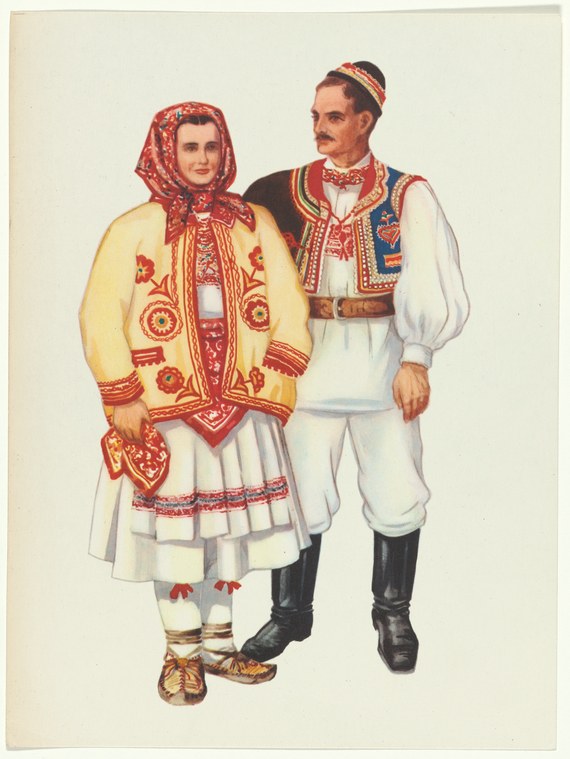
Two figures in matching formal folk dress stand posed against a plain cream background, presenting a frontal view as if for documentation or display. The woman on the left wears a striking yellow jacket densely embroidered in red and gold geometric patterns over a white full skirt with red hem accents, her head covered by a red patterned scarf tied under the chin. The man on the right wears a white linen shirt and white breeches, with a red and gold embroidered vest and a red embroidered headband. Both stand upright with neutral posture, feet positioned naturally on the ground. The image appears to be a hand-colored print or lithograph, rendered in the style of ethnographic costume documentation common to the early 20th century.
The dancing
Both figures stand in a formal, frontal stance with arms relaxed at their sides—a presentation posture rather than one capturing active movement. The woman's full skirt falls to mid-calf in regular accordion pleats; the man stands in an at-ease military-like position. Neither figure displays the dynamic line, frame, or lifted carriage associated with dance in motion. The composition suggests they are modeling costume for study rather than performing.
The dance depicted
This is not an image of dance in progress but rather a costume documentation plate. The dress shown—particularly the woman's heavily embroidered jacket and kerchief style, and the man's embroidered vest and headband—corresponds to traditional folk costume of the Balkan region, most likely Serbian or Croatian based on the embroidery patterns and style. The catalogue title "National costumes of Yugoslavia" confirms this identification. While such costumes would have been worn in folk dances of the region (particularly line dances like kolo), the figures here are posed statically for ethnographic illustration, not captured in movement or dance position.
How it was made
This is a hand-colored lithograph or color-printed illustration, likely from an early 20th-century ethnographic or costume reference publication. The soft modeling of the figures, the flat cream background, and the precision of the embroidery rendering are consistent with commercial print production for educational or reference circulation. The hand-coloring—particularly the yellow of the woman's jacket and the gradated reds—shows the technique and costs involved in color costume documentation of the period. Such prints were distributed as teaching materials, travel souvenirs, or ethnographic references.
About this work
This is a costume documentation plate from the early 20th century depicting the traditional folk dress of Yugoslavia (the Balkans), presented as a reference study rather than a dance image. The two figures model male and female formal costume with the embroidered jackets, embroidered vests, kerchiefs, and headbands characteristic of Balkan folk dress. Though the garments shown would have been worn in regional circle and line dances, the static frontal presentation and neutral posture indicate this work belongs to the category of ethnographic costume illustration—a significant body of print imagery that documented folk practice for European and North American audiences during a period of intense interest in national and regional identity. It occupies a space between fine art documentation and anthropological reference, reflecting the early 20th-century fashion for illustrated folk costume books and travel literature.
How to look at it
Look at the density and precision of the embroidery patterns on both garments—the gold and red geometric designs are labor-intensive hallmarks of Balkan folk costume and would have taken weeks to produce by hand. Notice the specific construction details: the woman's kerchief tied under the chin, the man's headband, and the cut and fullness of the skirt, which are all functional and regional markers. The formal, documentary pose—feet planted, arms at rest—was the standard convention for costume illustration, designed to display the garment fully and clearly rather than to suggest movement. This is reference material, not art theater.
The period
This image dates to the early-to-mid 20th century, when European and American audiences developed intense interest in national folk traditions and ethnic costume as markers of cultural authenticity. The rise of ethnographic museums, international folk festivals, and illustrated travel literature created sustained demand for costume documentation. In the Balkans specifically, this period coincided with the formation of Yugoslavia (1918) and the consolidation of regional folk practices into an emerging national identity. Print documentation of folk costume served both educational and nationalist purposes, presenting regional dress as evidence of distinct cultural heritage within the new Yugoslav state.
Where it lives
The work is held in the New York Public Library's collection of prints depicting dance. As a mass-produced color print, it likely circulated widely in educational contexts, travel guides, or costume reference books during the early-to-mid 20th century.
Dance in this work
Questions about this work
Is this showing a dance or just costumes?
It is costume documentation, not dance. The figures are posed statically for reference and study, not captured in movement. However, these garments would have been worn in Balkan folk dances, especially circle and line dances like the kolo. This is the kind of print people used to learn what traditional dancers actually wore.
Where would people have worn these clothes?
These are formal folk costumes from the Balkans (within the territory of Yugoslavia). The embroidered jacket, kerchief, vest, and headband styles indicate Serbian or Croatian tradition. They would have been worn at celebrations, festivals, and during folk dances—particularly important at weddings and seasonal gatherings.
When was this made?
The catalogue record does not give a date, but the style of the print, the color technique, and the reference to 'Yugoslavia' suggest the 1920s–1950s. Yugoslavia as a unified state was formed in 1918, so any costume documentation under that label dates after that.
Why is this in a gallery about dance if no one is dancing?
Because understanding dance means understanding the material culture around it—the costumes, the contexts, the visual signals of identity and tradition. This print documents the folk costume tradition that gave shape and meaning to Balkan dance practice. It's the kind of reference material dance historians and choreographers use to understand authentic costume.
More dance artwork





