49 works in this view — arrow keys or swipe to move between them.
Dance in Art
People of Argentina, Brazil, Paraguay, and Uruguay
Unknown artist
- Collection:
- Prints depicting dance
- Source:
- New York Public Library
- Rights:
- Public domain — free to use, share and adapt.
- Recorded as:
- Public Domain
The image preserves a moment of lived bodily practice from a period and geography (colonial/post-colonial South America) from which such documentation is rare, and from which the voices and bodies of working, market-based, or formerly enslaved communities are underrepresented in art history. The solitary, exuberant pose and the foregrounding of cloth as a tool of display offer insight into how movement was understood and valued outside court or theatrical contexts.
What you are looking at
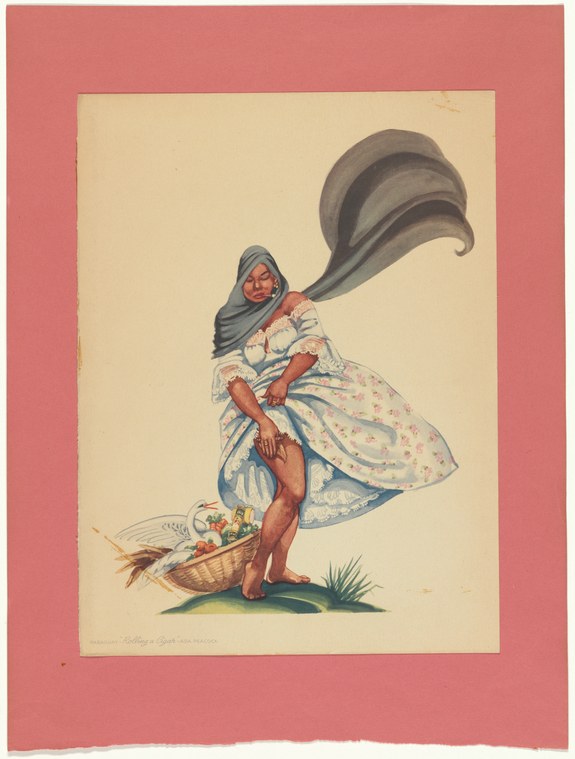
A single figure in folk dress stands barefoot against a plain cream ground, holding aloft a large dark fabric—possibly a shawl or skirt—that billows dramatically overhead in a sweeping arc. The figure wears a blue-grey headscarf (possibly a kerchief or tignon) and a white chemise under a floral-printed skirt with blue accents. The pose is dynamic and exuberant, the body angled with weight shifted onto one leg. At the figure's feet sits a small woven basket, suggesting either a vendor or market context, or perhaps an attribute identifying the wearer's status or occupation. The palette is muted and earthy—cream paper, soft blues, terracotta skin tones, and the warm ochres of printed fabrics—typical of hand-coloured prints of the 18th and early 19th centuries. The composition isolates the figure and centres the movement of the cloth, emphasizing the moment of lift and flourish.
The dancing
A single dancer or figure in a lunging or striding stance, weight forward on the left leg with the right leg extended or trailing. Both arms are raised in an open, celebratory frame, hands lifted to manage the large piece of cloth overhead. The torso is upright but animated; the posture suggests joy, display, or exhibition rather than technical training. The body appears relaxed and vernacular rather than balletic—the movement reads as social, celebratory, or occupational.
The dance depicted
This image most likely documents a folk or street dance tradition, possibly from Latin America or the Caribbean given the catalogue's attribution to Argentina, Brazil, Paraguay, and Uruguay. The pose—a single figure executing an exuberant gesture with billowing cloth—resembles the material culture and celebratory movement of carnival or festival traditions, or street and market dances associated with working or enslaved communities. The basket and dress suggest a vendor, market woman, or street performer. Without inscription or dated documentation, the specific dance cannot be named with certainty, but the dynamic use of fabric and the solitary, display-oriented pose suggest either a moment captured from a larger social dance or a stylized portrait of a dancer or vendor.
How it was made
This is a hand-coloured print, likely an engraving or etching from the late 18th or early 19th century, based on the fine linework, the cream laid paper, and the subtle hand-applied watercolour or gouache. The technique allowed for both precision in the figure and atmospheric softness in the background. The hand-colouring—visible in the slight unevenness of the flesh tones and the careful layering of blue and pink in the fabrics—indicates this was produced for a wealthy or educated market, possibly as part of a series documenting costume, dance, or regional 'types'. The medium's capacity for wide circulation and reproduction would have made such images influential in shaping European or colonial understanding of non-European dance.
About this work
This hand-coloured print documents a moment of dynamic folk movement—a single figure in colonial or post-colonial dress executing an exuberant gesture with cloth, set against a plain ground and accompanied by a market basket. The work sits at the intersection of costume study, ethnographic interest, and dance documentation, recording both the material culture and the bodily practice of a tradition now difficult to name with precision. It belongs in a dance archive as evidence of how movement, dress, and occupation were visualized and circulated in the period when European interest in 'national' and 'exotic' dance was intensifying, and as a record of a now-obscure tradition of public performance or celebration.
How to look at it
Notice the moment the artist chose to freeze: not a step or a turn, but a moment of lift and flourish—the instant when the cloth reaches its apogee and the figure's body extends upward to meet it. This emphasis on the peak of the gesture, rather than a technical phrase or position, suggests that the artist was capturing display, exuberance, and the visual spectacle of movement rather than its structural logic. Observe too the isolation of the figure against the blank ground and the way the basket grounds the scene in labour or commerce—together these tell us that this is a record of public, working, vernacular movement rather than trained or staged dance.
The period
The print dates to a period of heightened European ethnographic and costume interest, roughly 1780–1820, when travel narratives, costume books, and dance documentation circulated widely among the educated classes. This was also the period of the Haitian Revolution (1791–1804), the Napoleonic Wars, and the destabilization of colonial rule in Latin America, during which European interest in documenting 'national character' through dress and movement was at its peak. Such prints were often compiled into albums or series marketed as costume studies or as records of 'people and manners' from specific regions, serving simultaneously as fashion inspiration, ethnographic documentation, and entertainment for European viewers.
Where it lives
The work is held in the New York Public Library's prints collection, catalogued under the genre heading 'Prints depicting dance' and attributed broadly to a series on the peoples of Argentina, Brazil, Paraguay, and Uruguay. The print's original publication details, artist, date, and intended use or circulation remain unrecorded in the available catalogue information.
Dance in this work
Questions about this work
What is the woman holding over her head?
A large piece of cloth—likely a shawl, skirt, or kerchief—rendered as billowing fabric in motion. The way she lifts and displays it suggests it is part of the movement or gesture itself, either as a tool of dance or as an element of dress and display.
Is this a specific named dance?
The catalogue records it only as documenting 'dance' from South America, and the image alone does not provide enough detail to identify a specific tradition with certainty. The exuberant, cloth-based movement and the presence of the basket suggest it may be a festival, carnival, or street dance tradition associated with market or working communities, but without written inscription or additional context, the name is lost.
Why is there a basket at her feet?
The basket likely identifies the figure as a vendor or market woman, suggesting that this movement may have been part of street life, commerce, or street performance rather than formal theatrical dance. It grounds the figure in a specific social context—public, working, urban or market-based.
How old is this print?
Based on the technique (hand-coloured engraving or etching), the paper, and the style of dress and rendering, it likely dates to the late 18th or early 19th century, roughly 1780–1820. The precise date is not recorded.
More dance artwork





