49 works in this view — arrow keys or swipe to move between them.
Dance in Art
Narcisin Malalbergo
Unknown artist
- Collection:
- Prints depicting dance
- Source:
- New York Public Library
- Rights:
- Public domain — free to use, share and adapt.
- Recorded as:
- Public Domain
This work is valuable as a record of the non-balletic performance traditions—the comedic and character theater—that coexisted with and influenced Romantic-era dance. It documents the costume, character types, and theatrical conventions of the popular stage during the period when ballet was establishing itself as the dominant theatrical dance form.
What you are looking at
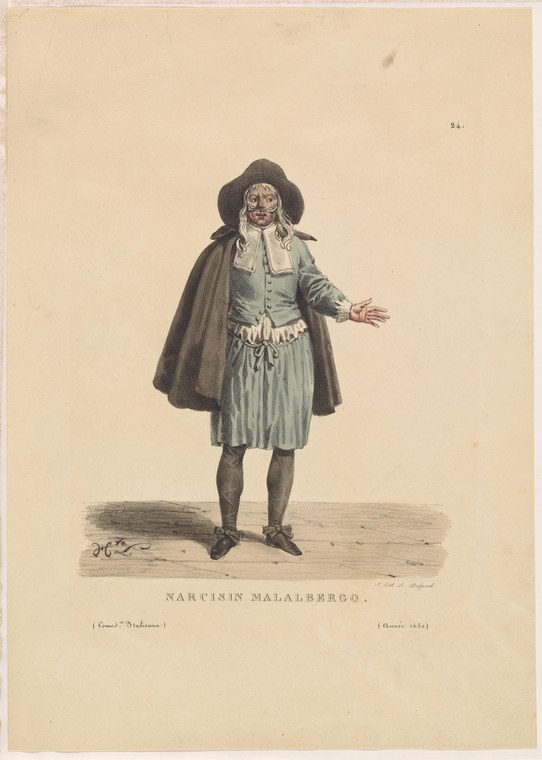
A single male figure stands alone against a plain cream background in a three-quarter frontal pose, looking directly forward with one arm extended in a gesture of address or presentation. He wears early 19th-century dress: a dark coat and cape, light-colored knee breeches, dark stockings, and buckled shoes. His hair is styled in long ringlets typical of the Romantic era, and his face is rendered with exaggerated features—prominent nose, pale complexion—giving the figure a character-comedy air. The pose is theatrical and declamatory rather than naturalistic, with the extended arm and upright carriage suggesting performance. The figure casts a shadow on the ground, and the composition isolates him completely, placing all focus on his character and bearing. The rendering is hand-colored, with careful attention to the fabric textures and the delicate detailing of costume.
The dancing
The single figure stands with weight evenly distributed, feet planted in a stable, frontal stance. His left arm extends outward at about shoulder height, palm open in a declarative or imploring gesture; his right arm hangs naturally. The carriage is upright and dignified despite the exaggerated facial features, suggesting a performer of comic or character roles rather than a classical dancer. There is no evidence of movement—no leap, turn, or balletic line—but rather a pose of dramatic presentation.
The dance depicted
This does not appear to depict dance as a movement practice. The figure is styled as a theatrical character—likely a stock commedia dell'arte or character-comedy figure of the Romantic stage. The title 'Narcisin Malalbergo' suggests a named character role, and the costume, pose, and setting all point to theatrical portraiture of an actor or comic performer in character rather than to any specific dance form or style. The gesture and stance are theatrical address, not choreographic movement.
How it was made
The work is a hand-colored engraving or aquatint, executed with fine linear detail in the costume and facial features. The printing allows for multiple impressions, indicating this was intended for circulation as a theatrical portrait print—a common format for documenting popular character roles and performers of the period. The hand-coloring adds specificity to the costume and complexion, suggesting production for a middle-class market interested in theater and performance.
About this work
This is a theatrical character portrait in the form of a hand-colored engraving, depicting a Romantic-era stock character or named role in comedic dress. It documents not a dance but a performed character type from the popular theater of the early 19th century. While it belongs to the broader archive of performance imagery, it does not depict dance movement or any recognizable dance form, though it shares the period and social context with the emergence of Romantic ballet.
How to look at it
Attend to the costume details—the cape, the breeches, the stockings, the shoes—which establish the character and period. Note the facial caricature, which is not naturalistic but heightened for comic effect. Observe the gesture of the arm, which is a moment of address or declaration rather than a balletic position. The isolation of the figure against the plain background and the frontal stance create an effect like a theatrical playbill illustration: the character presented for identification and recognition.
The artist
The artist is not recorded in the catalogue. The signature or mark on the stone/plate is not legible in this reproduction. The work belongs to the tradition of Parisian theatrical portrait prints, a commercial genre with multiple makers producing and colorizing similar works for the theater-going public.
The period
This print dates stylistically to the early 19th century, the Romantic period. At this moment, theatrical performance in Europe was flourishing across multiple forms: opera, melodrama, pantomime, and character comedy existed alongside the emerging Romantic ballet. Character actors and comedians had established repertoires of stock roles, each with its own costume and performance style. These were documented in portrait prints for circulation to audiences and collectors. The theatrical portrait print was a major form of celebrity culture and performance documentation before photography.
Where it lives
The work is held in the NYPL's collection of prints depicting dance (or dance-adjacent performance). It entered the collection under the category 'dance' but appears to document character theater rather than dance proper.
Questions about this work
Who was Narcisin Malalbergo?
The title suggests a character name or the name of a performer known for a specific role, likely from early 19th-century Parisian theater. The character type—evident from the costume, features, and comedic styling—appears to be a stock figure of popular comedy or commedia dell'arte tradition. Without additional documentation, his identity cannot be confirmed from the image alone.
Is this a dancer?
Not in the modern sense. The figure is a theatrical character, most likely a comedic actor or performer in a named role. While the Romantic era saw significant overlap between theater and dance, this portrait documents character performance and costume rather than dance movement or technique.
Why is this in a dance collection?
The classification likely reflects the broad categorization of theatrical performance in the period, when dance and drama were not always sharply separated. It may also indicate that the collector or cataloguer viewed performance costume and character portraiture as part of dance history's visual archive. It is a useful reminder that dance history intersects with theater, costume, and popular entertainment.
More dance artwork





