49 works in this view — arrow keys or swipe to move between them.
Dance in Art
People of Argentina, Brazil, Paraguay, and Uruguay
Unknown artist
- Collection:
- Prints depicting dance
- Source:
- New York Public Library
- Rights:
- Public domain — free to use, share and adapt.
- Recorded as:
- Public Domain
This print documents a vanished or transformed performance tradition—a character-dance from the colonial or early republican era of South America that would otherwise leave no trace. It shows how European theatrical forms were adapted, localized, and performed by and for colonial audiences, and it preserves the visual vocabulary of a specific character whose movements mattered enough to print and preserve.
What you are looking at
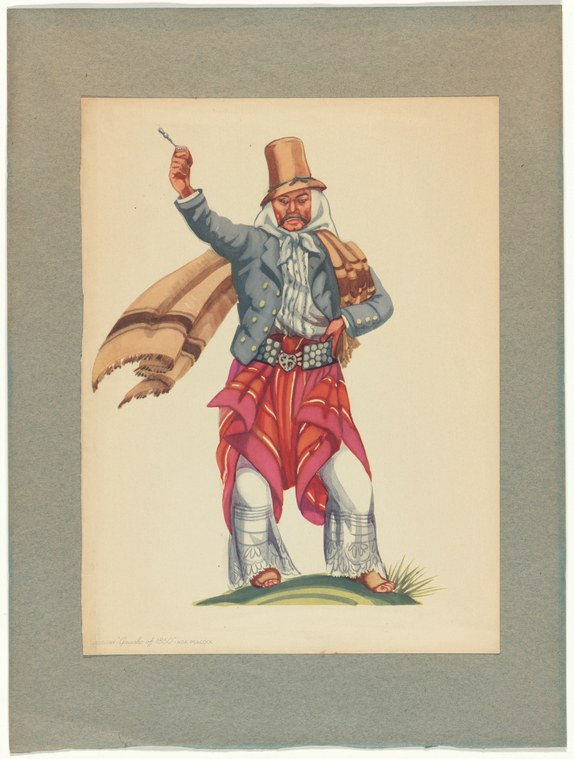
A solitary male figure stands at center stage against a plain cream background, wearing a tall top hat and theatrical costume in shades of blue, red, and white. His jacket is blue with decorative buttons and white ruffled collar; his breeches are bright red with white stockings below, and he wears red shoes with decorative buckles. A large tan and brown cape or cloak is draped across his left shoulder, billowing dramatically outward. His right arm is raised high with fist clenched, while his left hand holds the edge of the cape. His stance is emphatic and confrontational—weight forward, legs splayed. A thin line of grass or ground is visible beneath his feet. The figure's expression is animated and his bearing suggests a character role rather than an abstract dance pose.
The dancing
A single male dancer dominates the composition, drawn in a highly theatrical contrapposto with one leg advanced and arms in an asymmetrical, gestural frame. The raised right fist and cape-bearing left arm create a diagonal tension through the torso. His posture is emphatic and declarative rather than balletic—this is acting-through-dance rather than pure movement vocabulary. The weight is concentrated and grounded; there is no suggestion of weightlessness or extension.
The dance depicted
The figure appears to represent a character from an early 19th-century European theatrical or carnivalesque tradition, possibly a stock character from commedia dell'arte or related popular theater traditions. The costume is consistent with the kind of character-dance or dance-drama that emerged from folk traditions of South America (given the title's reference to Argentina, Brazil, Paraguay, and Uruguay), where European theatrical forms mixed with colonial and indigenous performance practices. The exaggerated costume, weaponized posture, and dramatic cape suggest this is a representation of a specific named character or type rather than an abstract dance lesson. Without further documentation, the precise genre cannot be confidently established, but the visual evidence points toward folk-theatrical hybrids or carnival figures rather than ballroom or classical forms.
How it was made
This is a hand-colored engraving or lithograph, executed with fine line work for the figure and applied watercolor or gouache for the costume details—visible in the careful grading of the blue jacket, the vivid red of the breeches, and the tonal modeling of the cape. The paper is aged cream or off-white, mounted on a gray backing board. The technique allowed for mass production and circulation as a print, suggesting this was a widely distributed image—likely a costume print or theatrical character sheet from the 19th century, the kind that would have been collected, pasted into albums, or sold individually at theaters or markets.
About this work
This is a hand-colored engraving or lithograph depicting a single theatrical character in an exaggerated South American folk or carnival costume, possibly from a traveling theater tradition or carnival pageant. The figure is identified only as one of the "People of Argentina, Brazil, Paraguay, and Uruguay"—a title suggesting this was part of a larger series documenting the costumes, types, and character-dances of the South American colonies or newly independent nations. The work sits at the intersection of ethnographic documentation, theatrical portraiture, and popular printmaking. It belongs in a dance collection because it represents a living dance-drama tradition, a named character-type whose movements and gestures were codified, repeatable, and performed in public.
How to look at it
Attend to the exaggerated cape and the dramatic arm positions: these are not naturalistic but coded, legible gestures meant to signal a recognizable character-type to an audience familiar with the tradition. The raised fist and forward stance suggest confrontation or dominance—this is a character with agency and attitude, not a servant or subordinate role. The print captures a moment of stillness, a pose or tableau rather than mid-movement, which was the convention for theatrical character prints of the period.
The period
This print was made in an era (likely 1810s–1840s) when European printmakers and publishers were intensely documenting the costumes, peoples, and customs of the colonial world and newly independent Latin American nations. Such prints circulated in Europe as curiosities and souvenirs of empire, but they also served as costume references for theatrical productions. The character depicted here belongs to a tradition of folk-theatrical types (often with roots in commedia dell'arte, Spanish sainete, and indigenous performance practices) that flourished in colonial Latin America and survived into the early republican period.
Where it lives
The work is held in the New York Public Library's collection of prints depicting dance. No further provenance information is recorded. It appears to be part of a larger series or album of costume prints, based on the standardized format and the collective title.
Dance in this work
Questions about this work
What is this character supposed to be?
The print does not label the figure by name, only as one of the 'People of Argentina, Brazil, Paraguay, and Uruguay.' Based on the costume, the theatrical pose, and the era, this is almost certainly a character-type from a colonial or early-republican folk-theatrical tradition—possibly a carnival figure, a stock character from traveling theater, or a character from sainete (Spanish popular comedy). The character type was recognizable to audiences of the time but is now largely lost to us without additional documentation or historical records.
Is this a dance or a costume print?
It is both. The figure is posed in a theatrical attitude that suggests movement and gesture rather than static dress display. This is a character-dance tradition, in which a codified set of movements, gestures, and expressions defined a specific role. The print preserves both the costume and the physical vocabulary of the character as understood by the artist.
Who made this print and when?
The artist and date are not recorded. Based on the style, technique, and the subject matter, it was likely made in the early 19th century (roughly 1810s–1840s) by a European printmaker, possibly for a European publisher specializing in exotic or colonial subjects. Such prints were commercially produced and widely circulated.
More dance artwork





