49 works in this view — arrow keys or swipe to move between them.
Dance in Art
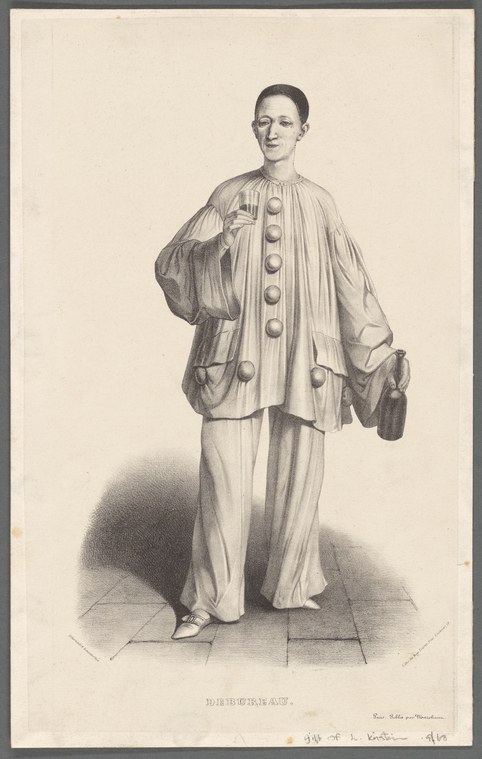
Debureau [i.e., Jean Gaspard Deburau as Pierrot]
Unknown artist
- Collection:
- Prints depicting dance
- Source:
- New York Public Library
- Rights:
- Public domain — free to use, share and adapt.
- Recorded as:
- Public Domain
Debureau revolutionized mime and pantomime as a serious form of theatrical expression, and this portrait records the visual presence of a legendary performer in a role that redefined European theater. For dance and movement historians, the image documents how mime was performed, presented, and marketed in the 19th century, at a moment when gesture-based theater enjoyed comparable prestige to ballet.
What you are looking at
A single figure stands in three-quarter view against a plain background, facing slightly left with a composed expression. The man wears a loose, flowing white tunic-like garment with voluminous sleeves gathered at the wrists, fastened down the front with a column of large round buttons. Over this he wears a darker outer robe or coat in a lighter tone, also generously cut. His feet are planted firmly on the ground in a stance suggesting ease and balance rather than dynamic motion. The figure's posture is upright and dignified, with one arm bent at the elbow and the other hanging naturally. The rendering is a fine engraving or lithograph in black and white, executed with careful attention to the fall of fabric and the play of light and shadow across the costume's surfaces.
The dancing
The single male figure is presented in a standing position with weight evenly distributed and feet parallel, suggesting a moment of repose or formal presentation rather than active performance. The arms hang naturally at the sides with minimal gesture; there is no suggestion of the expansive, energetic arm vocabulary of theatrical dance. The posture conveys calm control and deliberation, with the body held upright and composed. The costume drapes heavily and obscures detail of the underlying movement or musculature.
The dance depicted
This appears to be Pierrot, the pantomime character, rendered in a state of composed repose rather than caught in comedic or acrobatic movement. The title attributes this to Deburau—almost certainly Jean-Gaspard Deburau, the legendary French mime of the early 19th century who redefined the Pierrot character as a vehicle for subtle emotional and physical expression rather than crude farce. The image captures not an instant of action but a formal portrait of the character in costume: Pierrot at rest, embodying the figure's melancholic dignity. This reflects Deburau's revolutionary approach to the role, in which psychological depth and refined pantomimic gesture replaced slapstick comedy. The absence of dynamic movement or exaggerated expression is itself the point.
How it was made
The image is executed as an engraving or lithograph—most likely a lithograph given the tonal range and soft modeling of the fabric—printed on paper. The technique allowed for wide circulation and affordable reproduction, making this the kind of print that would have been sold to theater-goers and collectors of theatrical imagery in the 19th century. The careful attention to fabric texture and the refined line work suggest a professional theatrical print rather than a casual sketch, indicating this was a marketed image of a celebrated performer in a famous role.
About this work
This is a formal portrait engraving or lithograph of the Pierrot character, identified in the title as associated with Jean-Gaspard Deburau, the mime who transformed Pierrot from a comic grotesque into a figure of poignant expressiveness in early 19th-century French theater. The work depicts the character in full costume—the traditional white tunic and outer robe—presented in a composed, dignified stance rather than captured mid-performance. It belongs in a gallery of dance imagery as a document of theatrical mime and pantomime, a form of movement that relies on gesture, facial expression, and bodily eloquence rather than steps or balletic vocabulary. The image records both a specific performer's interpretation of a character and the broader cultural moment in which pantomime achieved serious artistic status.
How to look at it
Observe the stillness and formality of the pose—this is not a moment of action but a presentation of the character and costume to the viewer. Notice the careful rendering of the fabric and the way the voluminous sleeves and robes establish a visual vocabulary of fluidity and grace, qualities that Deburau was famous for bringing to his controlled, elegant gestures. The composed expression and upright posture suggest dignity and emotional interiority, qualities that Deburau's mime performance was celebrated for conveying without words or broad physical comedy. The print itself is evidence of how theatrical mime was marketed, consumed, and remembered in the 19th century.
The artist
The artist is not recorded in the catalogue. The print's professional execution and circulation as a theatrical portrait suggest it was produced by a commercial printmaker working in Paris or another major European theater center in the early-to-mid 19th century, likely made to commemorate and promote Deburau's performances. Such prints were routine merchandise of theatrical culture.
The period
The early 19th century witnessed a revival and radical transformation of the commedia dell'arte character Pierrot, who had been a comic servant figure for centuries. Jean-Gaspard Deburau (1796–1846) famously reinvented the role as a vehicle for silent, poetic expression—a figure of alienation and pathos rather than jokes. This shift coincided with the rise of Romantic sensibility in the arts and reflected broader changes in how actors and performers understood character depth. Mime and pantomime achieved new respectability and attracted serious audiences; Deburau became a celebrity of comparable stature to the era's leading actors and dancers. His performances influenced visual artists, writers, and the development of modern mime.
Where it lives
This lithograph or engraving is part of the New York Public Library's collection of prints depicting dance and theatrical performance. Such theatrical portrait prints were standard commercial products, sold at theaters and through print shops to document celebrated performances and performers.
Questions about this work
Who was Deburau and why is he important to dance history?
Jean-Gaspard Deburau (1796–1846) was a French mime who fundamentally transformed the Pierrot character from a stock comic figure into a vehicle for subtle, psychologically complex pantomimic expression. Working primarily at the Théâtre des Funambules in Paris, he pioneered silent acting that emphasized refined gesture, facial expression, and emotional nuance. His work influenced the development of modern mime, acting techniques, and the art of physical storytelling, and he achieved celebrity status comparable to leading actors and dancers of his era.
Is this a depiction of an actual performance moment?
No. This is a formal portrait of the Pierrot character and costume, presented in a composed, standing pose suitable for theatrical merchandising. It represents how the character was presented to audiences and collectors rather than capturing a moment from performance. Such prints served as souvenirs and promotional materials for theatrical celebrities.
What is pantomime and how does it relate to dance?
Pantomime is a form of theatrical expression that relies entirely on gesture, movement, and facial expression rather than speech or dialogue. While distinct from ballet, which has codified steps and vocabulary, pantomime shares dance's reliance on the expressive body as the primary vehicle of meaning. Deburau's approach to mime bridged these forms, bringing balletic refinement and control to a traditionally comedic theatrical tradition.
What do the costume elements mean?
The white tunic, voluminous sleeves, and simple outer robe form the traditional Pierrot costume, derived from commedia dell'arte. The costume's generous draping and soft lines became associated with Deburau's refined, elegant movement style. The formal presentation of the costume in this portrait was itself part of the merchandise of theatrical celebrity—audiences and collectors bought prints to own images of the costumes and characters they admired.
More dance artwork





