49 works in this view — arrow keys or swipe to move between them.
Dance in Art
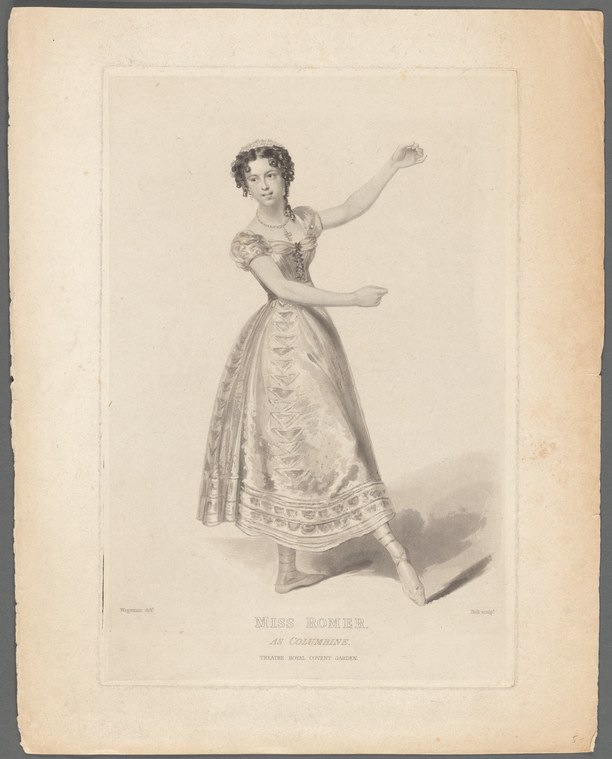
Miss Romer as Columbine, Theatre Royal Covent Garden
Unknown artist
- Collection:
- Prints depicting dance
- Source:
- New York Public Library
- Rights:
- Public domain — free to use, share and adapt.
- Recorded as:
- Public Domain
Columbine is a foundational figure in the history of physical comedy and theatrical movement in the English-speaking world, and her costume and manner of presentation shaped audience expectations for decades. This engraving is evidence of how pantomime and commedia dell'arte characters were visualized and promoted to the public, and what physical ideals—grace, elegance, composure—were valued in a performer of the role.
What you are looking at
A young woman in theatrical dress stands alone against a plain background, captured in a moment of performed grace. She wears a pale silk gown with a fitted bodice and full skirt decorated with draped swags and embroidered trim at the hem; her dark curled hair is arranged fashionably atop her head. Her right arm extends upward and outward in an elegant gesture, while her left arm hangs at her side, her body turned three-quarters toward the viewer. Her weight appears settled, her posture composed and dignified. The engraving is finely detailed, with careful attention to the fall of fabric and the modeling of her face and form through careful line work. The image carries the formal quality of a theatrical portrait—a record of a performer in a specific role rather than a candid moment.
The dancing
A single standing figure, posed rather than caught in motion. The raised right arm suggests a gesture of greeting, benediction, or theatrical presentation rather than active dance movement. Her weight is evenly distributed; there is no suggestion of weight shift, turnout, or the physical commitment of someone actually dancing. The pose is frontal and static, designed for visual contemplation rather than the depiction of kinetic energy. The body is upright, the line of the torso unbroken.
The dance depicted
This is a portrait of a performer rather than a depiction of dance itself. The inscription identifies the subject as Miss Romer in the role of Columbine at Theatre Royal Covent Garden—Columbine being a stock character of the commedia dell'arte and pantomime traditions, typically a clever, flirtatious female figure. The pose and dress suggest the theatrical conventions of early 19th-century English pantomime or farce. While Columbine was often active and graceful in stage performance, this image presents the performer in a formal portrait stance rather than in the midst of choreographed movement. The image records the costume and persona rather than the dance itself.
How it was made
This is a finely executed steel or copper engraving, executed with delicate parallel lines and careful cross-hatching to model form and suggest texture. The technique allowed for precise detail in the rendering of fabric, facial features, and the performer's physique, and would have been reproduced in quantity for theatrical audiences and collectors. The inscription at the bottom is engraved as well. The pale tone and fine line work are characteristic of 19th-century theatrical portraiture engravings, which circulated as souvenirs and promotional materials documenting celebrated performers in their most famous roles.
About this work
This is a theatrical portrait engraving documenting a performer identified as Miss Romer in the role of Columbine, likely from the early 19th century. The work belongs in a dance archive not because it depicts choreography, but because it records how a stock character central to the dance-heavy genre of English pantomime was embodied and presented on stage. Columbine's theatrical identity was built on grace, wit, and physical agility, and while this pose is formal rather than kinetic, it captures the costume and bearing expected of the role. The engraving is a primary document of early 19th-century theatre practice and the public persona of a working performer.
How to look at it
The raised arm and composed posture are gestures of theatrical presentation—the performer showing herself to the audience in a formal portrait mode. The drape and ornamentation of the gown are as important as the figure: this is a document of costume as much as of the performer. Notice the care taken to render the texture of silk, the embroidered hem, and the fashionable arrangement of hair—details that shaped the visual spectacle of the role. The pose itself, though static, embodies the theatrical ideal of composed grace valued in a pantomime performer.
The artist
The artist is not recorded in the catalogue. The engraving is signed in the plate but the signatures are not legible in this reproduction. The style and execution suggest a professional theatrical portraiture workshop active in London in the early 19th century, likely producing on commission for theatres, performers, and collectors.
The period
Columbine was one of the four stock characters of commedia dell'arte, a genre rooted in Italian Renaissance improvised theatre but hugely popular in 18th- and early 19th-century England, where it evolved into pantomime and harlequinade. English pantomime at Covent Garden and Drury Lane was a major theatrical form, combining music, spectacle, physical comedy, and dance. The early 19th century was the golden age of the harlequinade in England, and Columbine—played by women—was celebrated for her agility, wit, and dancing. Theatrical portraiture engraving flourished during this period as a way to publicize stars and allow audiences to own images of performers they admired.
Where it lives
The work is held in the Prints depicting dance collection at the New York Public Library, catalogued from NYPL's collections. It is one of many theatrical portraiture engravings documenting London stage performers of the period.
Questions about this work
What is Columbine?
Columbine is a female stock character from commedia dell'arte, the Italian improvised theatre tradition. In English pantomime and harlequinade of the 18th–19th centuries, she was a witty, graceful, often mischievous young woman, usually paired with the male clown figure Harlequin. The character was central to physical comedy and was always performed by a woman, often praised for her dancing and agility.
Is this a picture of someone actually dancing?
No. This is a formal theatrical portrait—a posed image for publicity and collection, not a depiction of choreography or movement. It records the costume and bearing of Miss Romer in the role of Columbine, but the static pose and formal framing are conventions of theatrical portraiture rather than evidence of how the role was actually performed on stage.
Why would a dance archive collect this?
Because theatrical portraiture documents how dance-central characters and roles were embodied, costumed, and presented to the public. This image is evidence of early 19th-century pantomime culture, performer celebrity, and the physical ideals valued in a role that required significant dancing and physical skill. It is a primary source for the history of theatrical movement and performance.
More dance artwork





