49 works in this view — arrow keys or swipe to move between them.
Dance in Art
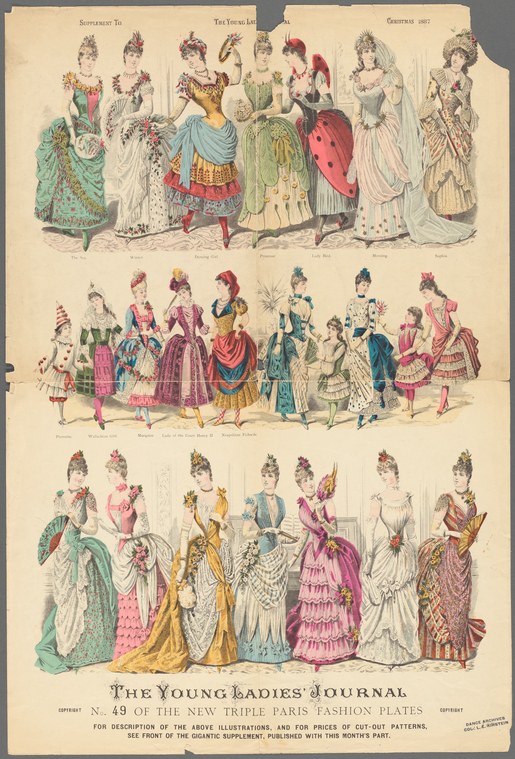
The young ladies' journal: no. 49 of the new triple Paris fashion plates
Unknown artist
- Collection:
- Prints depicting dance
- Source:
- New York Public Library
- Rights:
- Public domain — free to use, share and adapt.
- Recorded as:
- Public Domain
This plate is essential evidence for understanding how Victorian ballroom dance was experienced in the body. The silhouettes and constructions shown here—the tight bodices, full skirts, heavy trains, and restricted arm positions—directly governed the movement vocabulary, frame, and propriety of the era's social dances. Without understanding how these garments shaped the dancer's body, one cannot fully reconstruct what a Viennese waltz or quadrille looked like or felt like when danced in this period.
What you are looking at
This is a fashion plate from *The Young Ladies' Journal*, a mid-to-late Victorian periodical, showing three rows of female figures in contemporary dress arranged across the page. Each row presents eight to nine full-length figures in varying poses and costumes, predominantly in pale tones with selective hand-colouring in pink, green, gold, and blue. The figures are posed as if in social movement—some standing at rest, others captured mid-stride or turn—all against a plain background with minimal setting detail. The topmost row shows elaborate afternoon or evening wear with trains, elaborate skirts with looped and gathered details, and ornamental hair arrangements; the middle row displays more day wear and walking costumes; the bottom row returns to formal gowns with complex drapery, tiers of ruffled skirts, and bustle-back silhouettes characteristic of the period. The overall effect is of a movement study for fashionable social dance and promenade dress rather than theatrical performance.
The dancing
The figures are rendered as individual studies rather than as couples in interaction. They stand in a range of poses suggesting ballroom propriety: upright posture, forward-facing or turned at angles, arms held at the side, in lap, or raised with fans and parasols. Several suggest the moment of social greeting or conversation rather than active dance steps—the weight appears stationary or in gentle locomotion. The bodies are constrained by the heavy, multi-layered skirts and tight bodices of the period, which permit only small, controlled movements; there is no sense of partnered hold or synchronized stepping. The scale and spacing of each figure emphasise individual display of dress over the mechanics of dance movement.
The dance depicted
This image does not depict active dance movement in any formal sense. Instead, it shows the dress, carriage, and social posture expected of fashionable women in ballroom and social contexts of the period—the visual language of respectability, refinement, and readiness for social interaction in dance settings. The silhouettes and poses correspond to the 1880s fashion conventions of upright bearing, restrained gesture, and ornamental presentation. While these women would have waltzed, polka'd, and danced in these garments in the ballrooms of their time, the plate itself is a costume study for social movement and deportment rather than a record of choreography or dance technique.
How it was made
This is a hand-coloured engraving or lithographic print, a mass-produced fashion plate typical of Victorian women's periodicals. The linear work and fine detail of the drapery, faces, and ornament suggest engraving; the selective and often imprecise hand-colouring—visible in the uneven application of pigment and the frequent spillage beyond outline—is consistent with the practice of colouring prints after printing to reduce production cost while adding commercial appeal. The printing and colouring process allowed rapid circulation of fashion standards to middle- and upper-class readers and was a primary vehicle for disseminating ideal dress and comportment. The survival of the page indicates its value as a historical record and its preservation in institutional collections devoted to fashion and social history.
About this work
This is a fashion plate from *The Young Ladies' Journal*, a Victorian ladies' periodical, presenting eight or nine full-length female figures in each of three rows dressed in fashionable evening, afternoon, and day wear of approximately 1887. The image documents contemporary ballroom and social dress rather than choreographed dance, showing the silhouettes, ornament, and posture expected of respectable women in social and ballroom contexts. The hand-coloured engraving or lithograph was produced as a mass-market commodity for readers who would use it as a guide for dressmaking, social deportment, and the acquisition of fashionable identity.
For dance historians, the value of the plate lies in what it reveals about the material constraints and visual conventions of ballroom culture in the late 19th century. The rigid, heavily boned silhouettes, the prominence of trains and bustles, the ornamental accessories, and the formal posture all shaped how women could move and carry themselves in dance. The plate does not record individual dances, but it does preserve the embodied ideal of the ballroom woman—upright, ornamented, constrained, and on display—within which the era's social dances took place.
How to look at it
Study the silhouettes and postures: note how the bodice is boned high and tight, how the skirt is gathered and draped to fall in a controlled line, how the arms hang or are held in a limited range. Observe the absence of any dramatic gesture or stride; these are poses of readiness and social presentation, not movement. The ornament—feathers, lace, ribbons, flowers—is concentrated on the bodice and shoulders, drawing the eye upward and emphasising the static display of the upper body. Compare the different poses across the three rows: some figures turn, some face forward, some hold accessories; none suggests partner contact or the balletic extension that would characterise theatrical dance of the same period.
The artist
The print is uncredited. It is one of numerous fashion plates produced for *The Young Ladies' Journal*, a Victorian periodical aimed at middle- and upper-class female readers seeking guidance on dress, manners, and fashionable life. The periodical relied on a consistent team of commercial lithographers and engravers whose work was rarely individually signed; the priority was rapid, standardised production of multiple plates per issue rather than artistic attribution.
The period
This plate dates to approximately 1887, in the mature Victorian era, when the 'Delsarte' movement and aesthetic dress reformers were beginning to question the rigidity of late-Victorian silhouettes, though high fashion remained dominated by tightly corseted bodies and elaborate ornament. Socially, the ballroom remained the primary context for respectable courtship and social interaction among the middle and upper classes, and fashion plates served as quasi-official guides to the visual standards that governed that world. The ballroom dances of this period—waltz, quadrille, lancers, polka—were social, not theatrical, and were performed by amateur participants in drawing rooms and public assemblies rather than on stages. The fashion plate thus documents the 'uniform' of ballroom participation.
Where it lives
The print is held by the New York Public Library in its collection of prints depicting dance. It is one of a numbered series (*The Young Ladies' Journal*, no. 49 of the New Triple Paris Fashion Plates) from a commercial periodical and was never intended as a unique work of fine art; its preservation reflects the growing recognition of fashion plates as primary-source documents for the history of dress, body, and social practice.
Questions about this work
Did women really dance in these clothes?
Yes. Every stitch of these silhouettes was normal ballroom dress for respectable women of the 1880s. The corseting, heavy skirts, and trains were universal. Women waltzed, polka'd, and performed quadrilles in these garments; the movement vocabulary of the dances adapted to fit the constraints of the body and dress. Movements were smaller, the frame more upright, and the emphasis more on gliding and turning than on large gestures or stride.
Why are these women posed, not dancing?
This is a fashion plate, not a dance image. The purpose is to show dress, posture, and fashionable identity, not to record choreography or teach dance technique. Nonetheless, the poses do communicate the carriage and deportment expected in ballroom contexts—upright, restrained, ornamented, and available for social interaction.
Who would have read this periodical?
Primarily middle- and upper-class women in Britain and the English-speaking world who could afford a subscription and had disposable income for fashionable dress. The periodical provided patterns, instructions, and visual standards for dressmaking and social presentation. It was a commercial product aimed at a specific, affluent demographic.
Are there real people in these images?
No. These are idealized generic figures, not portraits of specific women. They exist to show the proportions, construction, and visual effect of fashionable garments, not to represent individuals. The uniformity and repetition across the page emphasise their function as costume studies rather than as character or personality.
More dance artwork





