49 works in this view — arrow keys or swipe to move between them.
Dance in Art
Dances of French Polynesia in prints
Unknown artist
- Collection:
- Prints depicting dance
- Source:
- New York Public Library
- Rights:
- Public domain — free to use, share and adapt.
- Recorded as:
- Public Domain
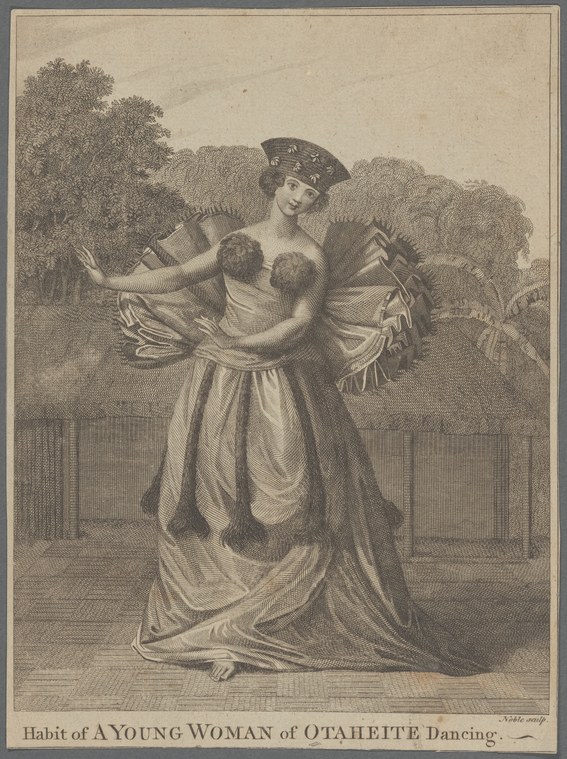
For dance historians, this image documents European perception and representation of Tahitian dance at a moment of first intensive contact, revealing what Enlightenment-era artists chose to emphasize: grace, Classical proportion, and individual beauty rendered in idealized Neo-classical terms. For visual culture scholars, it exemplifies the epistemological problem of ethnographic representation—the dance we see here is as much an artifact of European artistic convention and fantasy as it is a record of actual Tahitian practice.
What you are looking at
A young woman stands in a classical contrapposto pose against a wooded landscape background rendered in fine linear hatching. She wears a draped white chiton or shift gathered at the waist, with a dark headpiece or crown, and holds in each hand what appears to be a feathered fan or plume—possibly made of feathers or fiber. Her left leg bears her weight while her right knee relaxes slightly forward. The landscape behind her, sketched with delicate parallel lines, suggests trees and foliage receding into distance. The woman's body is turned slightly to one side, her arms held at mid-height with the plumes spread, creating an open, expansive silhouette. The engraving's title, printed in an 18th-century typeface, identifies her as 'A Young Woman of Otaheite Dancing.'
The dancing
A single figure is depicted in a relaxed but alert standing position with weight on the back leg. Both arms are raised to approximately shoulder height or slightly below, each hand holding a feathered implement that extends the line of the arm and creates width across the body. The posture is open and uncontracted; the torso is upright rather than folded, and the head is held high with dignity. The stance suggests sustained elegance rather than vigorous movement—this is a posed or stilled moment within a dance rather than a freeze-frame of dynamic action.
The dance depicted
This is an 18th-century European engraving documenting or imagining a Tahitian dance. The title identifies the subject as 'Otaheite' (Tahiti), reflecting European geographical naming of the period. The feathered implements suggest connection to hula or similar Pacific dance traditions employing fans or plumes, though the image may reflect European interpretation or fantasy rather than ethnographic precision. The figure's graceful, open posture and the classical Greek drapery align with Enlightenment-era idealizations of non-European cultures, viewed through the lens of Neoclassical aesthetic values.
How it was made
This is a line engraving, identifiable by the fine parallel hatching that creates tone and texture, the crisp black lines against white paper, and the printed serif typeface of the caption. The technique allows for precise, reproducible dissemination—this print likely appeared in a series documenting world cultures, travel narratives, or ethnographic compilations popular in the 18th century. Engraving was the dominant medium for illustrated books and broad circulation of imagery before lithography and photography; its labor-intensive process signals an educated, affluent audience.
About this work
This is a late 18th-century European line engraving depicting a young Tahitian woman in a pose the artist has identified as 'dancing.' The woman stands in a dignified classical pose, holding feathered plumes or fans in both hands, dressed in draped white linen and a dark headdress. The image belongs to a broader tradition of travel documentation and 'ethnographic' representation popular during the Enlightenment and early Imperial age—a moment when European artists and publishers worked to catalogue and visualize the cultures of newly encountered or expanding colonial territories. The work sits at the intersection of dance history, art history, and colonial visual culture, offering insight into how European audiences understood and fantasized about Pacific Islander movement and dress.
How to look at it
Note the artist's choice to depict the dancer in a still, posed moment rather than in dynamic motion—this emphasizes form and beauty over movement. Observe how the Classical drapery and contrapposto stance would have been immediately legible to an 18th-century European viewer as markers of nobility and dignity, imposed onto a non-European subject. The feathered implements are the only element that signals 'otherness' and 'Otherness'; everything else speaks the language of Western art convention. Ask: What is being shown here, and what is being projected onto it?
The artist
The engraver is not recorded in the catalogue. The style and subject matter suggest affiliation with 18th-century European travel narrative publishing, possibly related to James Cook's Pacific voyages (1768–1779) or successor expeditions. Prints of this kind were often produced by multiple hands—engravers working from drawings or descriptions provided by naturalists or ship artists—and circulated without individual artist attribution.
The period
This engraving dates to the late 18th century, an era of intense European exploration, colonial expansion, and intellectual curiosity about world cultures. The Enlightenment appetite for documentation and classification extended to dance, dress, and custom. At the same time, Neoclassical aesthetics—rooted in idealized Greek and Roman forms—shaped how European artists rendered bodies and drapery, even when the subject was a Pacific Islander. The image also precedes the systematic academic study of non-European dance and reflects instead a tourism-inflected, aestheticized, and often inaccurate encounter with living traditions.
Where it lives
This print is held by the New York Public Library in a collection titled 'Prints depicting dance,' indicating it was recognized by institutional cataloguers as significant to dance history. The NYPL's print collections often originated in 19th-century acquisitions of antiquarian prints and travel narratives.
Dance in this work
Questions about this work
Is this a record of actual Tahitian dance?
Not reliably. The image is filtered through European artistic convention—the Classical drapery, the proportions, the idealized beauty—and reflects what 18th-century European artists and audiences wanted to see as much as what Tahitian dancers actually did. It is better understood as a document of European imagination and colonial aesthetics than as ethnographic evidence.
What are the feathered objects she is holding?
The print does not identify them specifically. They resemble feather fans or plumes, which do appear in some Pacific dance traditions, but without more context it is unclear whether they accurately represent Tahitian practice or reflect European guesswork or invention.
When was this engraved?
The catalogue record does not provide a date. Based on style, printing technique, and the reference to 'Otaheite' (which became common European usage after Cook's voyages in the 1770s), it likely dates to the late 18th or very early 19th century.
More dance artwork





