49 works in this view — arrow keys or swipe to move between them.
Dance in Art
Dances of French Polynesia in prints
Unknown artist
- Collection:
- Prints depicting dance
- Source:
- New York Public Library
- Rights:
- Public domain — free to use, share and adapt.
- Recorded as:
- Public Domain
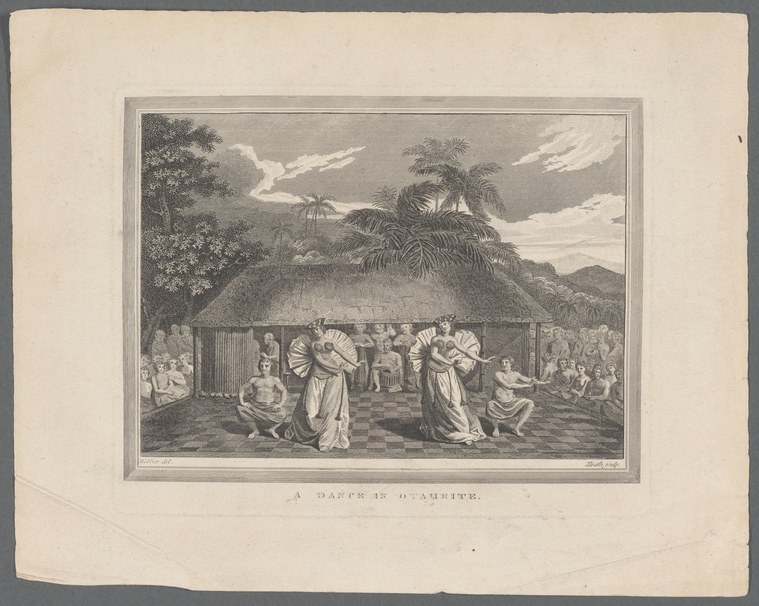
This engraving is one of the earliest European visual records of Polynesian movement practice and reflects the moment when Pacific cultures first became subjects of systematic European documentation and representation. For historians of global dance, it offers evidence of how pre-contact or early-contact Polynesian social movement was understood and misunderstood by European observers, and how those representations shaped European knowledge of Pacific cultures.
What you are looking at
An engraving depicting a large communal gathering in what appears to be French Polynesia, centered on a thatched-roof structure with an open pavilion. Inside and around the building, dozens of figures in light, flowing garments participate in what seems to be a festive or ceremonial occasion. The scene is crowded and convivial: some figures stand in small groups, others appear to be moving or dancing, and several sit or recline on the ground. Palm trees frame the composition on both sides, and the sky shows dramatic clouds lit from behind, suggesting either dawn or evening. The engraver has rendered the thatched roof with careful cross-hatching to show its texture and volume, and the figures are distributed across the foreground and middle ground with varying degrees of detail. The overall effect is one of social gathering and celebration rather than formal choreography—the movement is diffuse and participatory rather than directed.
The dancing
The dancers—if they can be called that—are loosely grouped and informally positioned, standing, moving, or seated with minimal apparent structure. Several figures in the center appear to be moving or gesturing with arms raised or extended, but there is no evidence of closed holds, precise lines, or synchronized formation. The dress is light and unstructured, appearing to be simple wrapped garments typical of tropical Pacific peoples. The overall impression is of social, celebratory movement rather than trained or choreographed dance.
The dance depicted
This appears to document a Polynesian communal gathering or celebration, most likely from the 18th or 19th century when European engravings of Pacific cultures were becoming increasingly common. The specific dance or movement practice cannot be identified with confidence from the image alone, but the scene suggests participatory, festive movement rather than a distinct named form. The setting—the large communal structure, the informal grouping, the mixed-gender participation, and the daylight hour—is consistent with documented Polynesian ceremonies and social dances. Without closer detail or inscription, it is impossible to determine whether this depicts hula, a work celebration, or a general festival gathering.
How it was made
This is an engraving, likely created in the 18th or early 19th century based on the style of line work and the characteristic parallel hatching used to create tone and shadow. The technique allows fine detail in the foreground figures and atmospheric effect in the sky, though the crowd becomes less distinct toward the edges. The existence of this work as a published engraving indicates it was created for circulation to a European audience curious about Pacific cultures, and would have been distributed in scientific or travel journals or sold separately to collectors.
About this work
This engraving documents a festive gathering in French Polynesia, centered on communal movement and celebration within and around a large thatched structure. The work is one of a series depicting Pacific dances and customs, created during the period when European engravings of indigenous cultures were establishing visual knowledge of the Pacific among European audiences. The image captures not a formal, choreographed dance form but rather the social and participatory movement characteristic of Polynesian ceremony and celebration.
For the dance historian, the work is valuable as evidence of Polynesian social practice and the communal nature of movement in Pacific culture, even though it cannot specify a particular named dance form. It also documents the perspective from which Europeans in the 18th–19th centuries understood and represented Pacific dance—as exotic, collective, and inseparable from social and ceremonial life.
How to look at it
Look first at the composition: the engraver has chosen to show the gathering from outside, with the viewer positioned as an observer at a distance, watching a scene of communal activity unfold. Notice how the thatched structure anchors the scene and how the figures are distributed around it—this reflects the centrality of the communal space to Polynesian social life. Observe the variety of postures and positions: some figures stand in apparent conversation or movement, others sit, some recline—this is not a choreographed formation but a record of actual social mingling. The dramatic sky and careful rendering of the landscape suggest the engraver's investment in making the scene vivid and credible to a European audience.
The artist
The artist is not recorded in the catalogue. Based on the style and period of the engraving, this was likely created by a European artist working from a drawing or description by a naturalist, explorer, or naval officer who had witnessed such gatherings. These engravings were often produced collaboratively: a field observer would document the scene in a sketch, and a professional engraver in Europe would execute the plate for publication. The work belongs to a broader tradition of ethnographic engraving that emerged from 18th-century voyages of exploration.
The period
This engraving dates to an era when European curiosity about Pacific cultures was at its height, following Cook's voyages (1768–1779) and the subsequent publication of illustrated travel narratives. In the late 18th and early 19th centuries, engravings of Pacific life—including dance, dress, and ceremony—were produced in large numbers for a European audience seeking visual knowledge of distant peoples. At the same time, Polynesian dance was undergoing rapid transformation due to contact with Europeans and, in many regions, missionary influence that actively suppressed indigenous movement practices. This image thus captures a moment of cultural documentation that was simultaneous with cultural disruption.
In the history of European art, such engravings occupy a complex position: they were produced with scientific intent and circulated as factual record, yet they are also shaped by European aesthetic conventions, the limitations of the engraving medium, and the perspective of outsiders observing unfamiliar practices.
Where it lives
This engraving is held in the New York Public Library collections as part of a series or album of prints depicting dance in French Polynesia. The work was likely published in a travel narrative, scientific journal, or portfolio of ethnographic images in the late 18th or early 19th century, though the exact publication has not been traced in the current record.
Dance in this work
Questions about this work
What dance is this?
The specific dance form cannot be identified from the image alone. This appears to be a communal gathering involving festive or ceremonial movement, but without inscription, further detail, or context from the original publication, it cannot be attributed to a named dance practice. It may document hula, a work celebration, a feast gathering, or another form of Polynesian social movement.
Is this ethnographic documentation or artistic imagination?
The work is intended as documentation, created by a European artist based on observation or description, and circulated as factual record. However, like all representations, it is shaped by the artist's perspective, the limitations of the medium, and European aesthetic conventions. It should be read as a historical artifact of European perception rather than an unmediated record.
How do we know this is set in French Polynesia?
The catalogue record identifies it as such, and the visual markers—the palm trees, thatched structure, light clothing, and tropical landscape—are consistent with Pacific island settings as depicted in European engravings of the period. However, the specific location within Polynesia (Tahiti, Samoa, Tonga, etc.) cannot be determined without further information.
What does the architecture tell us?
The large, open-sided thatched structure is typical of Polynesian communal buildings used for gatherings, ceremonies, and social events. Its prominence in the composition reflects its cultural and practical importance as the center of community life. The open design allowed the gathering to accommodate many people and to remain connected to the surrounding landscape.
More dance artwork





