49 works in this view — arrow keys or swipe to move between them.
Dance in Art
Travestissements
Unknown artist
- Collection:
- Prints depicting dance
- Source:
- New York Public Library
- Rights:
- Public domain — free to use, share and adapt.
- Recorded as:
- Public Domain
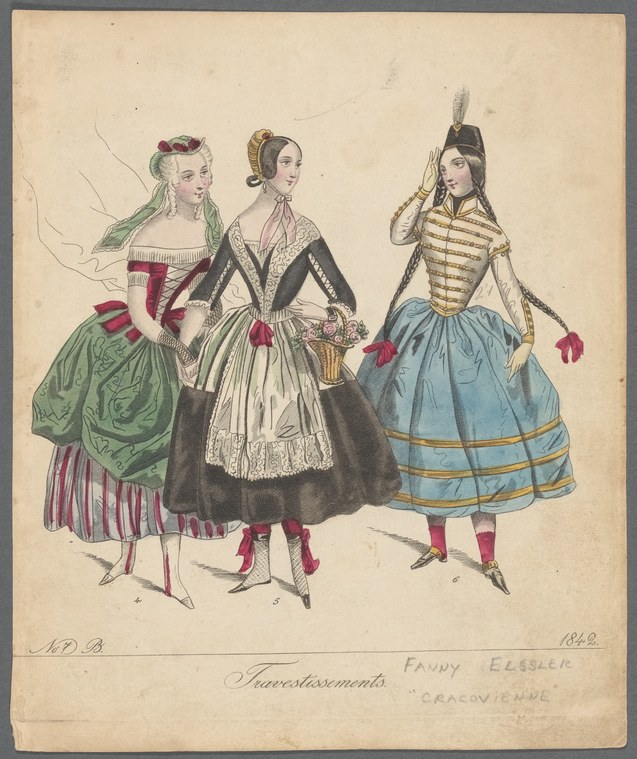
Although no active dance is shown, this work is valuable evidence of the visual language of 19th-century theatrical performance. The three figures represent stock characters whose costume-based identities would have been instantly readable to audiences of the era—a crucial context for understanding what bodies actually did on stage and how movement was framed by clothing and role.
What you are looking at
Three young women stand in a shallow stage space, dressed in contrasting period or national costumes. The figure on the left wears a green silk skirt with deep magenta trim and a white chemise with a green veil or shawl trailing behind her; she gazes downward. The central figure is dressed in a black dress with a white lace apron and white cap or bonnet—a servant's or peasant's costume—and holds a small basket. The third figure, on the right, wears a blue skirt with gold braid trim, a striped military-style jacket in tan and gold, and a tall headdress; she holds what appears to be a fan or small object in one hand. The ground is lightly suggested. The composition is a fashion plate in the theatrical tradition: three distinct characters arranged for comparison, each isolated by costume rather than narrative action. The hand-coloring—green, magenta, blue, tan, and gold—is applied with restraint over a printed engraved base.
The dancing
None of the three figures is in motion or an active dance pose. All three stand upright with neutral, frontal or three-quarter orientation. The leftmost figure's gaze is averted and her veil creates a sense of movement or mystery, but her body is still. The central figure's arms hang simply; the rightmost figure holds up one arm in a gesture that might suggest courtship display or theatrical presentation rather than dance instruction. The bodies are arranged as costume displays rather than as dancers executing steps.
The dance depicted
This work depicts no active dance. It is a costume plate titled 'Travestissements' (Disguises or Cross-Dressing), a common theatrical print genre of the 19th century. The three figures represent different social roles or national stereotypes—possibly a lady, a maid or peasant, and a military or exotic figure—rendered in contrasting dress. Such prints documented theatrical costume and performance personas rather than choreography or social dance.
How it was made
This is a hand-colored engraving or lithograph, likely from the mid-19th century. The base image is professionally engraved or printed, with the characteristic fine lines and formal composition of theatrical fashion plates of that era. The hand-coloring was applied afterward, suggesting a print intended for broad circulation among theater-goers, costume makers, or illustration collectors. The technique allowed rapid reproduction and distribution of costume references.
About this work
This is a theatrical costume plate rather than a dance image. It documents three female performance personas in contrasting dress, arranged for costume study and reference. The work belongs in a dance archive as evidence of theatrical dress conventions and the performance culture that surrounded 19th-century theater and social entertainment. Prints of this type reveal what costumes audiences expected to see, which roles were recognizable by dress alone, and how costume communicated character and social status on the stage.
How to look at it
Study the costume details: the layering of fabrics, the precision of trim and ornament, the headdresses, and how the silhouette changes with each figure. Notice that no two costumes are identical in color, construction, or social register—the print is teaching a visual taxonomy of female theatrical roles. Observe also the neutral poses: these are standing presentations, not movement studies. The refinement of the hand-coloring—especially the saturation of the greens, blues, and magentas—suggests the print was meant for affluent viewers or professionals who could afford such finish.
The artist
The artist is unknown, but the style and execution are consistent with mid-19th-century Parisian theatrical print production. The inscription 'Fanny Elssler' appears on the sheet, suggesting the plate may have circulated in connection with the famous Austrian ballet dancer Fanny Elssler, who was celebrated across Europe in the 1830s–1840s. However, this does not necessarily indicate that Elssler is depicted, only that the print was associated with her name or career in some way—a common practice for theatrical prints.
The period
This print dates to the era of Romantic ballet (1820s–1840s), when theatrical spectacle and costume played central roles in performance. While ballet was moving toward pointe work and ethereal, ankle-length tutus, popular theater and melodrama relied heavily on character costumes and disguise plots. The three costumes shown—aristocratic, peasant, and military/exotic—are the stock figures of Romantic-era theater. Prints documenting such costumes were essential references for performers, dressmakers, and audiences seeking to understand theatrical conventions.
Where it lives
The work is held in the Prints collection of the New York Public Library, part of a broader group of theatrical and dance-related prints. The inscription 'Fanny Elssler' links it to the broader collection history around the celebrated dancer, though the exact circumstances of the connection are not recorded.
Questions about this work
Is this a ballet print?
Not primarily. While it dates to the Romantic ballet era and may have circulated among theater professionals, it documents theatrical costume types rather than ballet choreography or technique. It is a fashion and costume plate oriented to dramatic theater.
Who are the three figures?
The print does not name them. They represent three stock theatrical character types—likely a lady, a servant or peasant, and a military or exotic woman. The costumes themselves communicate the roles.
Why does the sheet say 'Fanny Elssler'?
Fanny Elssler was a famous Romantic-era dancer. The attribution on this print may indicate it was part of a theatrical collection associated with her career, or it may be a later collector's annotation. It does not necessarily mean Elssler is depicted.
How does a costume plate relate to dance history?
Costume plates reveal how performers were expected to look and how audiences recognized character roles by dress alone. They document the visual culture that framed 19th-century performance and show what dancers and actors actually wore on stage.
More dance artwork





