49 works in this view — arrow keys or swipe to move between them.
Dance in Art
Dances of French Polynesia in prints
Unknown artist
- Collection:
- Prints depicting dance
- Source:
- New York Public Library
- Rights:
- Public domain — free to use, share and adapt.
- Recorded as:
- Public Domain
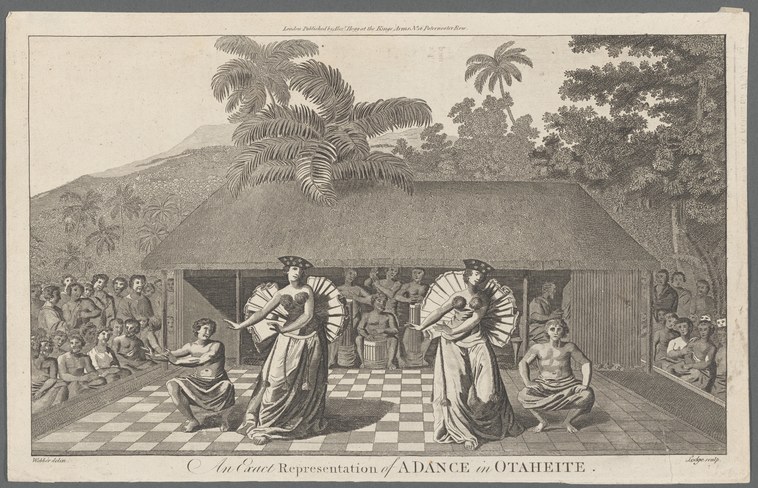
This engraving is evidence of how European visual culture of the late eighteenth century constructed knowledge about Pacific dance—not through direct observation but through stylistic convention and the aesthetic assumptions of the engraving medium itself. For dancers and historians, it demonstrates the profound gap between lived practice and the images that circulated to shape European understanding of other cultures' movement traditions.
What you are looking at
A formal indoor gathering under a large thatched roof structure, arranged as a theatrical or documentary representation. Two central figures in classical European dress—long robes with prominent fan-shaped collar pieces extending behind their shoulders—occupy the center stage, their bodies angled toward one another. They are framed by a densely packed crowd of seated spectators on both sides, arranged in tiers along the walls. The interior features a checkered floor in perspective. Tropical vegetation—palm trees and dense foliage—is visible through openings in the structure and in the background landscape. A mountainous terrain rises beyond. The engraving employs fine line work to render texture and depth, with careful attention to the play of light and shadow across the thatched roof and the gathered crowd. The title inscribed below identifies this as a representation of dance in Otaheite (Tahiti).
The dancing
The two central dancers stand nearly upright with their bodies held at a formal distance from one another, suggesting either a courtly protocol or an introductory formation. Their arms are raised and extended, with the hands positioned expressively at shoulder height or above. The posture is restrained rather than grounded; weight appears centered over the feet rather than flowing through them. No close embrace or ballroom hold is present. The surrounding figures—at least thirty—sit passively, observing rather than participating, which indicates this is a performance or demonstration before an audience rather than a participatory social dance. The focal pair dominate compositionally through scale and central placement.
The dance depicted
This is almost certainly a European artist's interpretation of Tahitian dance (aparima or 'otea), filtered through eighteenth-century artistic and ethnographic conventions. The formal dress of the central figures—classical European robes rather than traditional Hawaiian or Polynesian costume—signals that this is not documentary representation but rather a theatrical recreation or imaginative reconstruction made for a European audience. The raised arms and expressive hand gesture are consistent with Polynesian dance vocabulary, but the rigid posture and lack of hip or lower-body movement visible in the engraving suggest the artist either did not witness the dance directly or deliberately 'refined' it for European taste. The architectural framing and staged composition place this within the tradition of European prints depicting 'exotic' cultures as spectacle rather than as living practice.
How it was made
This is an engraving, likely made from a copper plate using the line-engraving process standard in the late eighteenth century. The fine parallel lines (hatching and cross-hatching) create tonal gradation and suggest volume, particularly visible in the rendering of the thatched roof, the crowd's clothing, and the landscape beyond. Engravings of this type were expensive to produce but economical to print in large numbers, making them the primary medium for circulating images of distant lands to educated European audiences. The careful composition and refined technique suggest this was a professional work intended for a travel narrative or natural history publication rather than a casual sketch. The title cartouche and formal inscription are typical of works bound into illustrated books.
About this work
This is a late eighteenth-century European engraving representing a dance performance in Tahiti (Otaheite) as it was imagined and depicted for a European audience. The work sits at the intersection of several traditions: the ethnographic print, the theatrical representation of the 'exotic,' and the documentary impulse that accompanied European exploration of the Pacific. It is not a faithful record of Tahitian dance but rather a cultural translation—European dress, formal posture, and stage composition imposed on Polynesian movement vocabulary to make it legible and acceptable to European viewers. The work belongs in a gallery about dance precisely because it reveals how European artists and audiences of the period understood, or chose to understand, non-European movement practices: as performance, as spectacle, and as something requiring translation into European formal language to be appreciated.
How to look at it
Attend to the tension between the dancers' formal European dress and the setting that signals Pacific origin. Note the posture: upright, controlled, restrained—very different from the hip-centered, weight-shifting movement that characterizes actual Polynesian dance. Observe how the artist has used the checkered floor and the architecture to frame the dancers formally, as if viewing a ballet or court dance rather than a social or participatory event. The seated crowd around the edges is key: they are not dancing but witnessing, which transforms this from a record of lived practice into a theatrical performance staged for an external viewer—much as European audiences themselves might have attended such a 'demonstration' in a theater or salon.
The period
The late eighteenth century was the age of European Pacific exploration and the proliferation of illustrated travel narratives. Works like those of James Cook's voyages (1768–1779) generated enormous appetite for images of Pacific peoples and their customs. Engraving was the dominant medium for reproducing such images, and a substantial market existed for prints depicting dance, ritual, and 'native life' in the colonies and newly contacted lands. At the same time, European theatrical dance—particularly ballet—was becoming more formalized and codified. The clash between these two contexts—the documentation of 'exotic' movement and the European aesthetic standards applied to represent it—shaped works like this one. Otaheite (Tahiti) was a particular focus of European fascination following Cook's visits, and representations of Tahitian dance appeared frequently in published travel accounts and natural history collections.
Where it lives
The work is held by the New York Public Library as part of its prints collection. The inscription and formal composition suggest it was part of an illustrated travel narrative or natural history publication from the late eighteenth century, though the specific publication and artist remain unrecorded in the current catalogue.
Dance in this work
Questions about this work
Is this what Tahitian dance actually looked like?
No. This is a European artist's interpretation filtered through eighteenth-century conventions about how 'exotic' movement should look when represented for a European audience. The formal dress, rigid posture, and staged setting are European additions. The raised arms and hand gestures do appear in Polynesian dance, but the overall composition is more European theatrical than documentary.
Who were these people and why are they wearing European clothes?
The central figures are meant to represent Tahitian dancers, but the artist has clothed them in classical European dress to make the scene comprehensible and aesthetically acceptable to European viewers of the time. This was a common practice in ethnographic prints: translating 'exotic' subjects into European visual language rather than attempting accurate representation of actual clothing or appearance.
What is the building in the background?
The large thatched structure is meant to evoke a Polynesian meeting house or gathering space, but it is rendered in a stylized, European manner. The architectural clarity and the checkered floor are conventions of European theatrical or formal interior representation rather than accurate architectural documentation.
More dance artwork





