49 works in this view — arrow keys or swipe to move between them.
Dance in Art
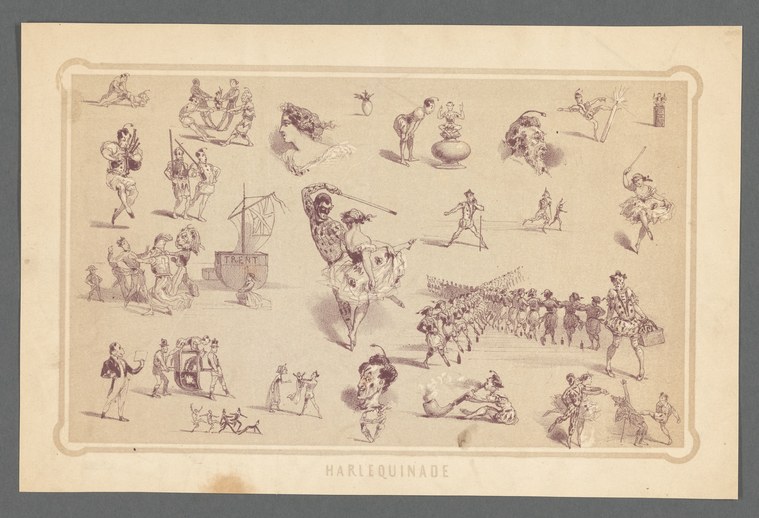
Harlequinade
Unknown artist
- Collection:
- Prints depicting dance
- Source:
- New York Public Library
- Rights:
- Public domain — free to use, share and adapt.
- Recorded as:
- Public Domain
This print is one of the few surviving visual documents of how commedia dell'arte was actually performed. Because commedia was improvisational and unscripted, images like this are among our only evidence of the physical techniques, stock characters, and comic bits that shaped theatre and influenced dance traditions across Europe for nearly three centuries. The print shows that commedia was understood by contemporaries as a bodily practice first—a dance-like tradition in which acrobatics, speed, and physical deformation of the body were central to the form's power and appeal.
What you are looking at
A densely composed sheet of theatrical vignettes depicting the stock characters and comic business of commedia dell'arte, the Italian improvisational theatre tradition. The print is organized as a collection of discrete episodes rather than a single narrative: scenes accumulate across the surface showing acrobatic feats, slapstick encounters, processions, and mock-formal moments. Harlequin appears repeatedly in his distinctive diamond-patterned costume, executing high kicks and exaggerated gestures; elsewhere figures tumble, strike formal poses, or cluster in small groups. A notable procession of figures—possibly soldiers or a carnival crowd—processes toward the right side of the composition. The dress ranges from the commedia masks and costumes to contemporary (to the print) street clothes and military garb. The setting is suggested minimally: a few props like a banner or sign appear, but the focus is entirely on the figures and their physical comedy. The line work is delicate and precise, with light shading giving volume to the bodies.
The dancing
The bodies throughout show the exaggerated, acrobatic vocabulary of commedia: impossibly high leg extensions, twisted torsos, arms flung wide for balance or emphasis, and feet leaving the ground. The artist has understood physical comedy as dynamic—bodies are caught mid-leap, mid-stumble, or in unstable positions that read as intentional loss of control. Several figures execute what appear to be cartwheel or tumbling sequences. The groupings are intimate and direct: two figures often locked in chase or embrace, or a soloist occupying the centre of a vignette while onlookers cluster at the edges. The artist shows familiarity with how weight transfers during rapid movement and how the body deforms under impact or effort.
The dance depicted
This is a visual record of commedia dell'arte performance, the comedic theatre form that dominated European popular entertainment from the sixteenth century onward. The print documents the physical vocabulary and stock characters central to the tradition: Harlequin (Arlecchino) recognizable by his patched costume, the acrobatic servants and zannis who drove the physical comedy, and the masked or exaggerated-face characters who relied on gesture and movement rather than scripted dialogue. The image shows commedia as a dance-like practice—rapid, rhythmic, acrobatic movement synchronized with comic timing and designed to be read from a distance by a crowd. No specific 'dance' in the ballroom sense is depicted, but the athletic physicality and deliberate exploitation of the body's comic potential is central to how commedia was performed.
How it was made
This is an engraving or etching—the precise line work, the parallel hatching for shadow, and the delicate detail suggest intaglio printing rather than woodcut or lithography. The technique allowed for fine detail and tonal gradation across the paper while remaining reproducible, making this the ideal medium for circulating images of theatrical practice to a broad audience across Europe. The composition as a sheet of vignettes, rather than a single large scene, was economical and allowed viewers to study individual moments of performance or comic 'bits' in isolation. The durability of the metal plate meant multiple impressions could be pulled, and the portability of prints meant images of commedia characters circulated widely among actors, audiences, and collectors.
About this work
This is a sheet of theatrical prints documenting commedia dell'arte, the improvisational comedy tradition that shaped European theatre and dance from the Renaissance through the eighteenth century. The engraving presents a catalogue of the form's physical vocabulary: tumbling, high kicks, exaggerated gestures, and comic falls executed by the stock characters—especially Harlequin—who were the heart of commedia performance. Rather than narrating a single story, the artist has assembled dozens of discrete moments and 'bits,' each showing a different aspect of how the form's comedy emerged from the body's unexpected movements and the collision of bodies in space.
Commedia performance depended entirely on physical skill, comic timing, and the audience's familiarity with character types and their routines. This print is not a record of a single performance but a teaching and reference document: a way to preserve and transmit the physical vocabulary of a form that was never written down and relied on collective memory and apprenticeship. It belongs in a dance archive because commedia *was* physical performance—organized, practiced, and transmitted as a skilled tradition in which the body was the primary instrument.
How to look at it
Approach this as a reference sheet rather than a single narrative composition. Follow individual vignettes: notice how the artist has frozen the moment of maximum physical distortion or comic effect—the instant a body leaves the ground, or when two figures collide, or when a character assumes an impossible balance. The repeated appearance of Harlequin across multiple vignettes shows how a single character type could generate many different 'bits' or routines. Pay attention to the relationship between stillness and movement: some figures are frozen mid-gesture, while others are caught in motion, creating a visual rhythm across the page. The density of figures and episodes recreates something of the frenetic energy of actual commedia performance.
The period
Commedia dell'arte emerged in sixteenth-century Italy and spread rapidly across Europe, becoming the dominant popular theatre form for two centuries. It was performed by semi-professional touring companies of masked actors who relied on a shared repertoire of stock characters (Harlequin, Pantaloon, the Captain, the lovers, servants, and zannis) and a vocabulary of comic bits and acrobatic feats. The form reached its peak in the seventeenth and early eighteenth centuries; by the time prints like this circulated, commedia had already influenced courtly ballet and was beginning to be absorbed into the emerging comic opera tradition. Prints documenting commedia performance became more common in the late seventeenth and eighteenth centuries, reflecting both the form's enduring popularity and the growing market for theatrical imagery among educated audiences.
Where it lives
This print is held in the Prints collection of the New York Public Library and is catalogued as depicting dance. It is one of a category of seventeenth and eighteenth-century theatrical prints documenting commedia dell'arte and its influence on European performance traditions.
Questions about this work
Why are all these little scenes on one sheet?
This is a 'composite' or 'anthology' print, a common format for theatrical imagery. It allowed viewers, actors, and collectors to study different moments of performance and different character types on a single sheet, making it useful as a reference or teaching tool. Because commedia relied on improvisation and a shared repertoire of standard 'bits' or routines, a print like this could function as a kind of visual script—a reminder of the physical vocabulary performers were expected to master.
Is this actually showing dance?
Yes, though not in the sense of courtly ballet or ballroom dance. Commedia was performed as rapid, rhythmic, acrobatic movement closely coordinated with comic timing. The physicality was codified and practiced: actors trained in tumbling, high kicks, falls, and how to move across a stage at speed while maintaining character. Contemporary accounts describe commedia as intensely physical and athletic—qualities evident in this print, where nearly every figure is captured mid-movement or in an unstable, exaggerated position.
Who was Harlequin?
Harlequin (Arlecchino in Italian) was one of the stock 'zanni' or servant characters central to commedia dell'arte. Recognizable by his patched or diamond-patterned costume and masked face, Harlequin was the acrobat and physical comedian of the commedia troupe—a role that demanded exceptional skill in tumbling, high kicks, rapid gestures, and physical transformation. The character survived the decline of commedia and was absorbed into pantomime and ballet, where 'Harlequinade' remained a popular entertainment into the nineteenth century.
When was commedia dell'arte performed?
Commedia emerged in Italy in the sixteenth century and remained the dominant popular theatre form across Europe through the eighteenth century. It was at its height from roughly 1550 to 1750, though elements of commedia persisted longer in pantomime and carnival traditions. This print likely dates from the seventeenth or eighteenth century, though the exact date is not recorded.
More dance artwork





