49 works in this view — arrow keys or swipe to move between them.
Dance in Art
Dances of French Polynesia in prints
Unknown artist
- Collection:
- Prints depicting dance
- Source:
- New York Public Library
- Rights:
- Public domain — free to use, share and adapt.
- Recorded as:
- Public Domain
This work exemplifies how dance imagery has historically served European imperial vision and racial fantasy. Understanding it means understanding how European artists and audiences visualized non-European dance not as it was practiced but as it satisfied European desires for the exotic, the erotic, and the controllable. It is a crucial artifact of how art helped construct the "Pacific islander" as an object of European gaze.
What you are looking at
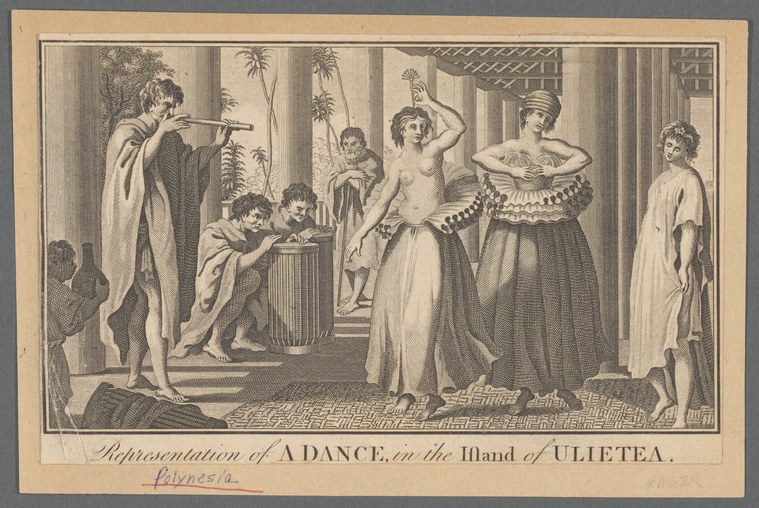
A formal interior colonnade frames a scene of aristocratic revelry. In the center, a partially nude woman with elaborate headdress and jeweled collar dances or poses, attended by elaborately dressed female courtiers in layered skirts and ornamental dress. To the left, a man in draped cloth holds a telescope or viewing instrument, observing the scene. In the foreground, attendants and putti (cherub-like figures) support the composition. The architectural setting—columns, pediments, checkerboard floor—suggests a classical palace or temple. The style is eighteenth-century engraving, with fine cross-hatching and careful perspective. The title references Ulietea (Raiatea), one of the Society Islands, framing this as an imagined scene of Pacific island life filtered through European courtly convention.
The dancing
The central dancer stands in an open, relatively static pose rather than mid-movement—weight balanced, one arm raised, the other at her side, observing rather than executing dynamic steps. She is attended by standing figures rather than integrated dancers. The women flanking her wear the elaborate court dress of 1770s–1780s Europe: tall headdresses, panniers, ornamental fabrics. The male observer at left holds the telescope in a pose of scientific curiosity. No closed holds, no footwork visible, no formation typical of European social dance.
The dance depicted
This is not documentation of actual Pacific dance but rather an imagined European fantasy of it, shaped by eighteenth-century courtly aesthetics and the vogue for depicting non-European "exotic" subjects. The title indicates the artist knew of Polynesian places (Ulietea/Raiatea), but the choreography, dress, and setting are entirely European baroque and rococo. The central figure is presented as a curiosity—a spectacle observed through scientific instruments—rather than as a participant in community ritual or social dance. The work belongs to the genre of orientalist and exotic imagery rather than ethnographic documentation.
How it was made
This is an engraving (established from the image: formal line work, cross-hatching for tone, the characteristic appearance of printmaking). The technique allows wide circulation and reproduction; the fine detail and perspective lines indicate skilled execution. The image was made for print publication and viewing in series or albums. The medium itself was a marker of refined taste and education in the eighteenth century, aimed at aristocratic or wealthy bourgeois audiences familiar with courtly culture and literary references to distant lands.
About this work
This engraving represents an eighteenth-century European fantasy of Pacific island life, dressed in the formal language of baroque court art. It is not a record of Polynesian dance but rather a projection—a European woman in pseudo-Pacific costume, framed by courtly architecture and attended by aristocratic figures. The telescope held by the observer signals the work's real interest: the visual consumption of the exotic from a position of scientific and social authority. It belongs in a dance gallery not as evidence of Pacific choreography but as evidence of how eighteenth-century European art imagined, constructed, and colonized the dancing bodies of distant peoples.
How to look at it
The viewer should attend to the still, observed quality of the central figure—she is not dancing as Europeans understood dance (with formation, rhythm, partner work), but rather standing as a spectacle. Notice the telescope: it is the actual protagonist of the scene, the instrument that allows European observation and possession of the exotic. The elaborate dress of the attendants frames the central figure as an oddity among the familiar. The classical architecture insists that even this imagined Pacific scene must be comprehended through European orders of beauty and knowledge.
The artist
The artist is not recorded. The style and execution suggest a skilled professional engraver working in the mid-to-late eighteenth century, likely in France or a major European cultural center. The sophistication of the composition and the knowledge of classical architecture suggest training in academic conventions. The work was likely produced for a series or collection of exotic travel imagery popular among educated European audiences of the period.
The period
This dates to the era of Pacific exploration by European powers and the widespread publication of travel narratives and illustrated accounts. Works like those following James Cook's voyages (1768–1779) created hunger for images of Pacific islands and peoples. At the same time, rococo aesthetics celebrated ornament, sensuality, and the exotic; aristocratic audiences consumed representations of distant lands partly as entertainment and partly as evidence of European superiority and knowledge. Dance imagery of non-European peoples was rare and almost always mediated through European aesthetic frameworks—costumes hybridized, poses classicized, contexts reframed.
Where it lives
The work is held in the New York Public Library's prints collection, catalogued as part of a series of engravings depicting dance and exotic scenes. Such collections were assembled as records of global culture, dance practices, and travel imagery available to educated European and American audiences.
Questions about this work
Did Polynesian people actually dance like this?
No. This is an eighteenth-century European fantasy. The pose, dress, and setting are entirely European baroque and rococo in origin. The artist knew the title—Ulietea—but had no access to or interest in depicting actual Polynesian movement, costume, or ritual context. This work tells us more about European desire and imagination than about Pacific dance.
Why is there a man with a telescope?
The telescope is a symbol of European scientific authority and the gaze of empire. It frames Pacific peoples as objects of observation and knowledge to be possessed visually and intellectually by Europe. This reflects the era's ideology: the exotic is something to be looked at, measured, and ultimately controlled.
Is this a historical record of how Pacific Islanders danced?
No. It is a record of how eighteenth-century Europeans imagined Pacific dance, filtered through their own aesthetic values and power fantasies. Actual Polynesian dance—hula, aparima, and other forms—involved very different body positions, rhythms, and social contexts. This work is valuable only as evidence of European colonial vision, not as ethnographic documentation.
More dance artwork





