49 works in this view — arrow keys or swipe to move between them.
Dance in Art
Dances of French Polynesia in prints
Unknown artist
- Collection:
- Prints depicting dance
- Source:
- New York Public Library
- Rights:
- Public domain — free to use, share and adapt.
- Recorded as:
- Public Domain
This image provides visual evidence of Pacific dance vocabulary and practice from the period of first intensive European contact, before colonial and missionary intervention substantially altered island dance traditions. For historians of Pacific dance, it preserves a moment when 'Otea, Aparima, and related forms were still practiced within their original social context rather than as staged performances for tourists. For visual artists and historians, it also illustrates the conventions of early nineteenth-century ethnographic documentation—how European engravers interpreted and sometimes distorted the bodies and movement of non-European peoples.
What you are looking at
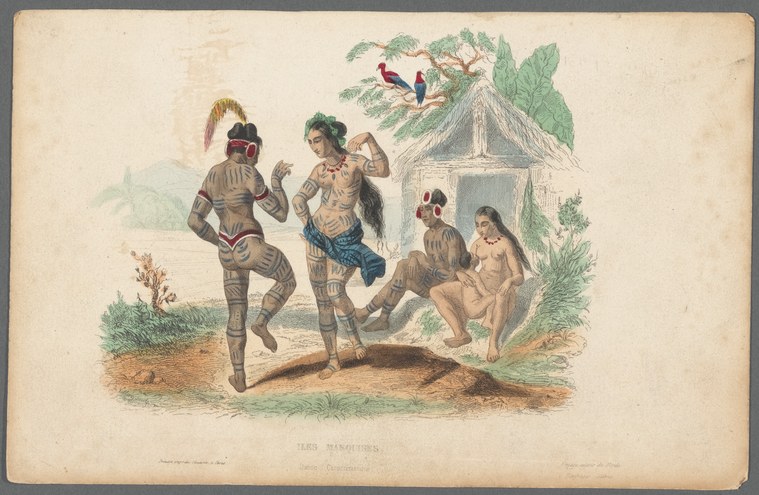
This hand-colored engraving depicts a scene of Indigenous Pacific Islander dancers and community members in a village setting. Two adult figures with elaborate body decoration dominate the foreground—both wearing intricate patterns across their torsos and limbs in what appears to be traditional tattooing or body paint. The figure on the left wears a feathered headdress and stands in an active, dynamic pose with arms raised and bent, weight forward on the balls of the feet, suggesting vigorous movement. To the right, another decorated adult adopts a complementary stance. Two smaller figures, likely children, sit or crouch at ground level to the right, also bearing body decoration. Behind them stands a thatched-roof structure typical of Pacific island architecture, with tropical vegetation—palms and flowering plants—framing the scene. A parrot is perched in the foliage above. The composition uses warm ochre earth tones for the ground and muted greens and blues for vegetation, with the figures' decorative patterns rendered in darker pigments that create visual emphasis on their bodies as the primary subject.
The dancing
Both standing figures demonstrate bent knees, forward-leaning torsos, and raised arms with flexed elbows—postures consistent with energetic, grounded movement rather than the vertical alignment of European ballroom dance. The left figure's arms are spread wide and slightly back, the right figure's arms bent at chest height. Their weight appears distributed through the balls of the feet, suggesting rhythmic bouncing or stepping rather than gliding. The seated figures maintain upright spines and composed postures, suggesting either a pause in dancing or a different role in the performance. The body decoration itself—not costume but permanent or semi-permanent marking—is rendered as integral to the dancers' identity rather than applied stage dress.
The dance depicted
This image depicts what appears to be a Tahitian or broader French Polynesian social or ceremonial dance, most likely from the early nineteenth century based on the engraving style and European artistic conventions used to document Pacific cultures. The vigorous, grounded stance and emphasis on hip and torso movement—visible despite the body decoration covering much of the forms—suggest dances such as 'Otea or Aparima, which were central to Tahitian social and recreational life. The presence of both adult performers and younger community members, and the village setting rather than a formal theatrical stage, indicates this was a community practice rather than a staged performance for European consumption, though it is being documented by a European artist. The body decoration and the pairing of figures suggest ritual or celebratory context.
How it was made
This is a hand-colored engraving, identifiable by the fine linear hatching visible in the background and architectural details, combined with watercolor or gouache for the figures and setting. The technique allowed for both fine detail in costume and decoration and relatively broad distribution as a printed work, making it a document of early European ethnographic interest in Pacific cultures. The coloring is applied selectively—emphasizing the dancers' bodies and the natural setting while leaving much of the sky uncolored—a convention that directs the viewer's eye to the action. Engravings like this circulated in European scientific and travel publications throughout the early 1800s, shaping European understanding of Pacific islanders.
About this work
This engraving documents Pacific Islander dance as observed and interpreted by a European artist, likely in the early nineteenth century during the height of European contact and ethnographic documentation of the Pacific. It is one of a series of prints depicting French Polynesian dances—apparently collected as a coherent suite—and represents both a genuine record of island choreography and the aesthetic and interpretive lens through which Europeans viewed Pacific cultures. The work belongs in a dance gallery because it captures not only the formal elements of movement—the bent knees, the forward lean, the use of the entire body—but also the social context in which dance was performed: as community practice, as a form involving all ages, and as inextricable from bodily identity and decoration.
How to look at it
Notice first the posture of the two central dancers: they are not standing upright but are bent forward from the waist, with knees distinctly flexed and weight carried low and forward. This is fundamentally different from the carriage of European ballroom dancers of the same era, and it tells us something about the dance's logic—it is ground-connected and rhythmic rather than linear and processional. Second, observe the emphasis placed on the decorated body itself: the tattooing or body paint is rendered in as much detail as the movements, suggesting that the performer's body, marked and adorned, is the instrument and primary visual subject. Third, note the compositional choice to include figures at rest alongside the active dancers, and the village setting rather than a performance stage—this frames dance as social practice rather than theatrical entertainment.
The period
European fascination with Pacific island cultures intensified dramatically in the late eighteenth and early nineteenth centuries following voyages by Cook, Bougainville, and others. Dance was a particular focus of both scientific and popular interest—it was exotic, it was embodied, and it seemed to offer insight into island life and social organization. French colonial interest in Polynesia was especially keen in this period. These engravings were likely produced in Europe from sketches or descriptions brought back by travelers, and they circulated in travel narratives, natural history publications, and popular prints. By the 1820s-1840s, when this print was likely made, European audiences had developed a substantial appetite for such imagery, and engravers and colorists were producing it in quantity.
Where it lives
This print is part of a series titled 'Dances of French Polynesia' held in the New York Public Library's Prints collection. The series format suggests it was either published as a coherent portfolio or assembled later by collectors of travel and ethnographic material. The work is housed within the broader collection of prints depicting dance, indicating it was recognized and catalogued as a dance document.
Dance in this work
Questions about this work
What island or islands do these dancers come from?
The print is titled 'French Polynesia,' which in this period (early nineteenth century) would refer primarily to islands under French influence or eventual French control—most likely Tahiti and the Society Islands. The body decoration patterns, the thatched architecture, and the movement vocabulary are consistent with Tahitian dance, but without additional documentation this cannot be stated with certainty. The title may reflect the publisher's or collector's attribution rather than the artist's precise knowledge.
Is this a 'real' dance or a European fantasy?
The movement vocabulary shown here—the bent knees, the forward lean, the emphasis on the torso and hips—is consistent with documented Tahitian dances of this period, particularly 'Otea and Aparima. However, the image is filtered through European artistic convention: the perspective, the anatomical rendering, and the selective emphasis on certain elements reflect the artist's training and assumptions. It is probably best understood as a partial record: the artist saw real dancers and attempted to document what they saw, but the result is both observation and interpretation.
Why are the bodies so heavily decorated?
The markings shown are likely tattoos (tatau or tatoo in Polynesian languages), which were central to Polynesian identity, status, and spirituality. In this period, extensive tattoos often marked adults, particularly men, who had completed initiation or achieved particular status. The dancers' heavy decoration thus signals their adult status and community role. The engraver emphasized this decoration—rendering it in considerable detail—which suggests it was visually striking and culturally significant.
When was this print made?
The catalogue record gives the date as unknown. However, the engraving style, the hand-coloring technique, and the style of dress and ethnographic interest suggest it was made in the early nineteenth century, probably between 1800 and 1850. During this period, European publishers were producing substantial quantities of ethnographic prints based on travel narratives and sketches brought back from Pacific voyages.
More dance artwork





