49 works in this view — arrow keys or swipe to move between them.
Dance in Art
Morris dancers
Unknown artist
- Collection:
- Prints depicting dance
- Source:
- New York Public Library
- Rights:
- Public domain — free to use, share and adapt.
- Recorded as:
- Public Domain
Morris dancing is one of the oldest continuous dance traditions in English culture, and this print is rare documentary evidence of how the form was understood and taught in the early modern or Georgian period. The image shows not just that morris dancing existed, but how it looked in motion, what costume signified the form, and how performers were trained. For historians of folk dance, English cultural practice, and the transmission of movement knowledge before film, this print is invaluable.
What you are looking at
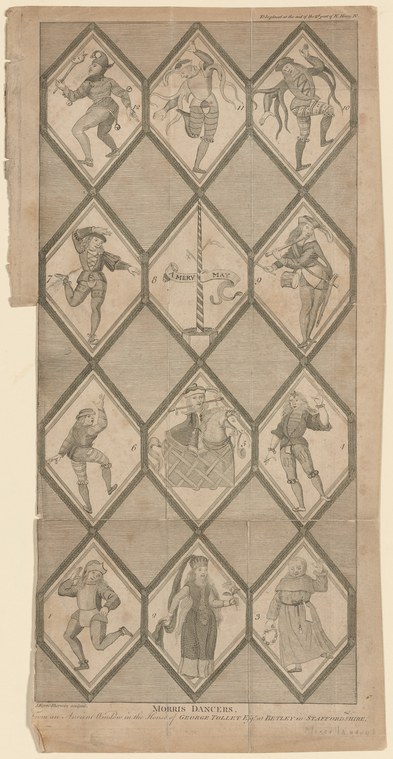
This is an engraved print presenting twelve morris dancers arranged in a three-by-four grid of diamond-shaped frames, with a central framed emblem containing a morris bell motif. Each figure is rendered in black ink on tan paper, showing individual male dancers in mid-movement against plain backgrounds. The dancers wear period costume—breeches, stockings, and decorated jackets with what appear to be bells or ornaments attached. The composition is methodical and instructional rather than narrative: each frame isolates a single dancer in a different pose or stage of the dance, as if documenting the sequence of steps and attitudes that constitute morris dancing. The central emblem breaks the grid pattern, marking the thematic heart of the composition. The print is uniform in execution, suggesting a didactic or documentary purpose—perhaps a record for teaching, or a visual inventory of the dance form itself.
The dancing
Each dancer is shown in a distinct attitude: some with legs raised in high kicks or lifts, others with arms extended or bodies twisted in dynamic postures. The figures are drawn with anatomical attention to weight and balance; several appear to capture the moment of a leap or bound. The morris bell is central to several poses—some dancers seem to carry or ring bells, indicated by objects in their hands or the suggestion of bells at ankle or waist. The variety of positions suggests an attempt to document the range of movement within morris dancing rather than freeze a single group moment. The bodies are generally shown in three-quarter view, allowing the viewer to see both the extension of limbs and the twist of the torso.
The dance depicted
This is morris dancing, a form of English folk dance with roots reaching back centuries. Morris dancing traditionally involved small groups of male dancers, often adorned with bells, ribbons, and distinctive dress, performing in synchronized or interlocking patterns. The print appears to be a didactic document, presenting the essential motions and positions of the form—the high leaps, the rhythmic footwork, the use of bells, and the particular postures that distinguish morris from other English country dances. The caption at the base of the print (partially legible) likely identifies this as morris dancing and may date the documentation. The emphasis on individual poses rather than group formation suggests this is instructional material, possibly for performers learning the dance or for record-keeping by a dance master or community.
How it was made
This is an engraving, a relief or intaglio print technique suitable for fine detail and wide circulation. Engravings were among the most economical ways to distribute visual instruction in the early modern and Georgian periods, making this work likely aimed at a broad audience of dancers, patrons, or curious readers. The technique allowed for precise rendering of costume, anatomy, and sequential positioning. The neat grid structure and consistent scale suggest this was designed as a teachable, reproducible document—multiple copies could be printed and distributed. The choice of engraving over painting marks this as a practical, educational object rather than a display piece for a single patron.
About this work
This engraved print documents the core movements and postures of morris dancing through twelve carefully positioned male figures arranged in a grid. Morris dancing was a centuries-old English folk tradition performed by groups of men in bells and distinctive dress, combining rhythmic footwork, leaps, and coordinated ensemble work. The print functions as a visual manual, presenting the key attitudes and steps that a performer or student of the dance would need to master. By isolating each figure and showing the range of positions—from high leaps to twisted torso work—the engraver created a comprehensive inventory of the dance's vocabulary, likely intended for teaching or documentation.
How to look at it
Attend to the variety of leg positions and the recurrence of the high leap or bound—this was clearly a signature movement of the form. Notice how the bells appear to be positioned at the shin or ankle, suggesting they were activated by the striking of the legs together or against the ground. Observe the arms: some are held high and extended, others at the sides, others gesturing—this hints at the coordinated or mimetic elements of the dance. The grid format is itself instructive: it invites the viewer to read across and down, comparing one pose to the next as if following a sequence, which is likely exactly what the artist intended.
The period
Morris dancing flourished in England from the medieval period through the 18th and 19th centuries, with particular revivals in the Georgian era and again in the late 19th-century folk revival. The style of this print—its engraving technique, costume rendering, and layout—suggests it was made sometime in the 17th or 18th century, a period when dance documentation was becoming more common and when morris dancing remained a living tradition, especially in rural communities and seasonal celebrations. The print appears contemporary with or slightly before the great collections of English country dances and folk practices that emerged in the 18th century.
Where it lives
The print is held in the New York Public Library's collection of prints depicting dance. It is catalogued with minimal metadata, reflecting the common state of such works in institutional holdings; the catalogue record offers no artist attribution, date, or medium specification.
Dance in this work
Questions about this work
What are the bells for in morris dancing?
The bells (visible in several of the figures' hands and on their costume) were struck rhythmically against the legs, ground, or other dancers' bells to create a percussive accompaniment to the footwork and music. They served both a musical and a visual function—the bright sound and movement of the bells were essential to the form's character and made the dancers' footwork audible and visible.
Who danced morris in this period?
Morris dancing was traditionally performed by groups of working men—weavers, smiths, farmhands—in villages and market towns, often for seasonal celebrations, fairs, and festivals. By the 17th and 18th centuries, it had become a recognized folk form performed by skilled dancers who were sometimes invited to perform for gentry. This print may document the form as it was practiced in both amateur and semi-professional contexts.
Why are they all shown alone instead of as a group?
By showing each figure separately, the engraver created a visual dictionary of morris positions and steps—a teaching tool. A performer or master could use this grid to understand the range of individual movement required, then apply that understanding to ensemble work. This kind of isolated-figure approach was common in dance instruction prints of the period.
More dance artwork





