49 works in this view — arrow keys or swipe to move between them.
Dance in Art
A. Mérante
Unknown artist
- Collection:
- Prints depicting dance
- Source:
- New York Public Library
- Rights:
- Public domain — free to use, share and adapt.
- Recorded as:
- Public Domain
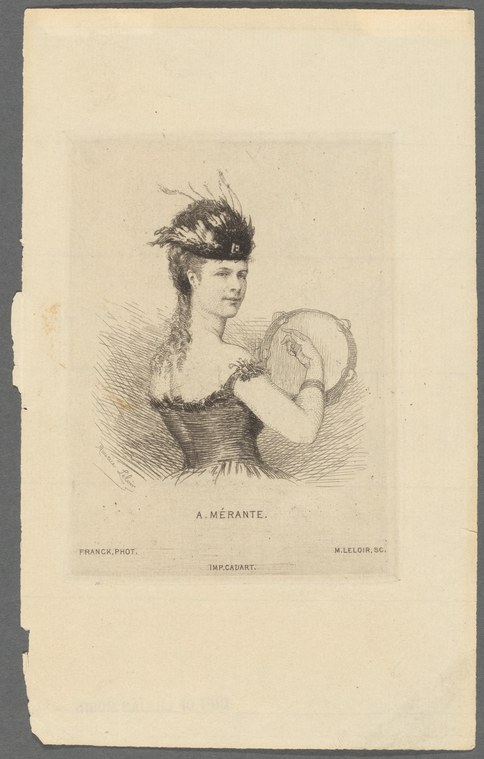
This print documents a specific genre of mid-nineteenth-century dance imagery and the performers who were famous enough to be immortalized in engravings and sold as popular prints. For historians of dance costume, performance convention, and the celebrity of minor theatrical figures, such prints are primary evidence. The print also shows how the fan functioned as a tool of gesture and style in this period—not as costume decoration but as an active prop in the dancer's vocabulary.
What you are looking at
A three-quarter length portrait of a woman in mid-nineteenth-century dress, shown against a plain background. She wears a dark, form-fitting bodice with short sleeves and a full skirt, and a feathered headdress or fascinator tilted smartly to one side. Her pose is animated and directional: she faces left, her weight appears to be on her back leg, and her arms are raised—the nearer arm bent at the elbow with hand near her chest, the farther arm extended outward at shoulder height, holding what appears to be a large, circular fan or tambourine. Her expression is lively and engaged, her body angled in a way that suggests movement or the moment just before movement. The engraving technique captures fine detail in the fabric and feathers, and employs cross-hatching to model form, particularly in the shading of her torso and the drape of her skirt.
The dancing
A single female figure in a posture of active engagement, not passive display. Her stance—asymmetrical weight distribution and forward-tilted torso—suggests a step or weight transfer, while her raised arms frame the body in a way consistent with ballroom or theatrical dance of the period. The extended arm and hand position imply she is holding or about to handle an object—most likely a fan, which was an essential prop and gesture vocabulary in social and theatrical dance of this era. There is clear anatomical understanding: the artist has rendered the shift in weight, the curve of the back, and the energy in the limbs.
The dance depicted
This appears to depict a dancer or performer in the costume and pose of a mid-nineteenth-century theatrical dance, most likely a solo character piece or specialty dance from the ballroom or music-hall repertoire. The title 'A. Mérante' almost certainly refers to a specific dancer or choreographer of the period, though the print itself identifies neither the dance nor its context. The fan-as-prop and the vivid, directional pose suggest social dance (waltz, polka, quadrille) rendered as theatrical spectacle, or possibly a Spanish or exotic character dance, which were popular subjects for such prints. The animated stillness—caught between poses rather than in static presentation—is characteristic of dance prints meant to capture performance energy rather than formal instruction.
How it was made
This is an engraving or etching on paper, printed from a metal plate. The technique is evident in the crisp line-work, the use of fine parallel lines (hatching and cross-hatching) to build tone and shadow, and the delicate detail in fabric texture and facial features. The signature marks indicate the photographer (France, Piot), the engraver (M. Leloir, Sc.), and the publisher (Imp. Gavarnri, Paris). The separation of roles—photograph as source, engraver as executor, publisher's mark—points to a commercial print house producing popular reproductive prints, likely for sale to the middle-class market. This was standard practice in mid-nineteenth-century Paris and made dance imagery widely accessible.
About this work
This is a commercial reproductive engraving of a female dancer or performer, printed in Paris in the mid-nineteenth century. The sitter is identified in the title as A. Mérante, though whether this refers to a celebrated dancer or a performer now forgotten is unclear. The print captures a moment of animated performance—a woman in fashionable mid-century dress, posed with fan or tambourine in a posture of balletic or ballroom grace, ready to step or turn. It belongs to a substantial tradition of dance portraiture from this period: single-figure prints meant to commemorate performers and distribute images of them to a paying public. The work sits at the intersection of social dance, theatrical spectacle, and commercial print culture.
How to look at it
Observe the asymmetry of the pose: the weight is not centered, the arms do not mirror, and the body is angled in space. This is not formal portraiture but a dancer mid-step or caught between moments. The fan or tambourine is not merely held but deployed as part of the gesture—the arm extended suggests the object is being used or offered to the viewer. Notice too the tilt of the head, the set of the mouth, and the direction of the gaze: all point to engagement and performance rather than mere display. The engraver has chosen a moment of action, not repose.
The artist
The engraving credits M. Leloir as the engraver and 'France, Piot' as the photographer (or source artist). Leloir was a significant reproductive engraver in mid-nineteenth-century Paris; Piot's role is less certain from this credit alone. The work was published by Imprimerie Gavarnri, a commercial printing house. The division of labor—photograph or drawing, engraving, printing—was typical of the mid-century print trade and allowed rapid production of topical images for a mass market.
The period
The 1840s–1860s saw an explosion in dance imagery as both social dancing (waltz, polka, quadrille) and theatrical spectacle became central to bourgeois leisure and urban culture. Prints of dancers—both famous performers and idealized types—were produced in enormous quantities and sold cheaply. This period also saw the rise of photography, which provided new reference material for engravers. At the same time, theatrical dance was diversifying: Romantic ballet held sway, but character dances, national dances, and music-hall performance were equally popular with the public. The fan, visible here, was undergoing a shift from purely social tool to theatrical prop, especially in Spanish or exoticized dances.
Where it lives
The print is held in the New York Public Library's collection of prints depicting dance. It was created using a photograph or drawing as a source and engraved for commercial distribution by a Paris publishing house. The NYPL catalog provides minimal description, listing it simply under the title and a general 'dance' subject heading.
Dance in this work
Questions about this work
Who was A. Mérante?
The title refers to the subject of the print, but the NYPL record does not identify her further. Mérante may have been a celebrated performer of the mid-nineteenth century, now obscure, or the name may refer to a choreographer or dance master. Without additional research, we cannot say.
What is she holding?
Most likely a fan, which was an essential accessory in both social and theatrical dance of the period. Fans served both practical and gestural purposes—they could be waved, snapped open with a flourish, or used to direct movement and attract attention. The large circular object could also be a tambourine, used in character or national dances.
Is this a social dance or a theatrical performance?
The line between the two was blurred in the mid-nineteenth century. The costume and pose suggest theatrical dress, but the pose and props are consistent with fashionable social dancing rendered as spectacle. It may represent either a famous performer of social dances, or a character dance performed on stage.
Why is this print in a dance collection?
Because it documents a performer and a style of dance from a specific historical moment. Such prints were and are valuable to historians and collectors of performance, fashion, and social history. They show how dancers were presented to the public and what movements and costumes were considered worth recording.
More dance artwork





