49 works in this view — arrow keys or swipe to move between them.
Dance in Art
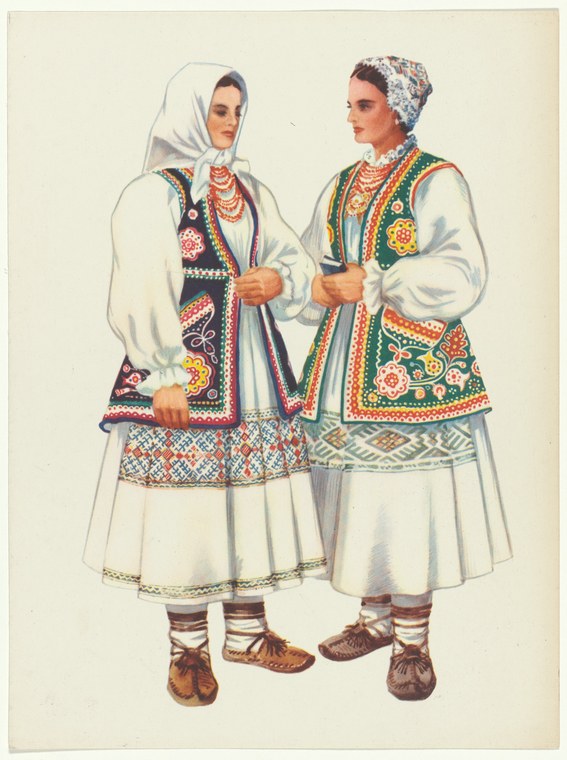
National costumes of Yugoslavia
Unknown artist
- Collection:
- Prints depicting dance
- Source:
- New York Public Library
- Rights:
- Public domain — free to use, share and adapt.
- Recorded as:
- Public Domain
For dance historians and ethnographers, costume documentation like this reveals the material reality of regional folk traditions—the weight and drape of garments, the specificity of embroidery patterns, and regional distinctions that structured communal identity and dance practice. The image demonstrates how visual culture participated in early Yugoslav nation-building by cataloging and codifying regional folk traditions at a moment when those traditions were becoming objects of national interest and preservation.
What you are looking at
Two women stand facing each other in traditional Yugoslav folk dress, their bodies angled slightly as if in conversation or greeting. Both wear white linen shifts beneath richly embroidered vests in contrasting colors—one with navy and magenta patterning, the other with forest green and gold. The vests are cut deep and decorated with dense geometric and floral embroidery. The figure on the left wears a white linen headscarf tied under her chin, while the figure on the right wears a printed headscarf with floral motifs. Both wear ankle-high white stockings striped in darker colors and brown leather shoes. Below their vests, white linen skirts with decorative borders reach to mid-calf. The figures are rendered with careful attention to textile detail and the specific weaving and embroidery patterns characteristic of particular regional traditions. The composition is formal and documentary rather than dynamic—a museum-like presentation of costume elements arranged for comparison and study.
The dancing
The two figures stand upright and frontal, with relaxed arm positions and their weight distributed evenly on both feet. Their posture is neither animated nor performative—this is a static presentation stance. They stand at a slight angle to each other as if displaying their clothing to a viewer, not executing any particular dance movement. The absence of closed hold, turned-out positions, or directional weight shift indicates this is a costume documentation rather than a dance capture. Their bodies are at rest.
The dance depicted
This image does not depict dance in progress. It is a costume ethnography—a documentation of traditional Yugoslav folk dress elements arranged for visual comparison. While both costume traditions certainly belonged to cultures with rich folk dance repertoires, the figures themselves are posed statically for clothing display rather than caught in movement. The formal, frontal arrangement and museum-like presentation suggest this work serves a documentary or educational purpose rather than capturing dance practice. No specific dance genre or regional style can be identified from the figures' postures or gestures.
How it was made
This is a hand-colored lithograph or chromolithograph, a process that allowed color printing from multiple stone plates, each carrying one color separation. The rendering shows the careful modeling of fabric texture, the precise rendering of geometric embroidery patterns, and the subtle color gradations typical of chromolithographic work. The technique was ideal for ethnographic documentation and costume reference materials, permitting wide circulation in educational and museum contexts while maintaining fine detail. The careful draftsmanship and soft color palette suggest production for a serious ethnographic or educational publication rather than popular prints.
About this work
This is a comparative study of two regional variants of traditional Yugoslav folk costume, presented as a paired documentation of female dress and adornment. The figures wear the embroidered vests, linen shifts, headscarves, and footwear characteristic of their respective regions, suggesting different cultural areas within the former Yugoslavia—possibly Serbia and another neighboring region. The work belongs to a tradition of ethnographic illustration and costume documentation that emerged in the 19th and early 20th centuries as anthropological interest in regional and national dress traditions grew. Rather than depicting dance itself, it serves as a visual archive of the material culture within which folk dance was performed.
How to look at it
Examine the precision and specificity of the embroidery patterns—each region developed distinct geometric and floral motifs that marked community identity. Notice how the two costumes differ not only in vest color but in the width and placement of embroidered bands, the style of headscarves, and the decoration of the skirt hems. These details would have been immediately readable to someone from that region as markers of village or district origin. The formal, static presentation is deliberate: this is a museum display translated into print, intended to preserve and make legible distinctions that oral tradition and lived practice had kept clear for generations.
The artist
The artist is not recorded. The work's style and format suggest it was produced by a commercial lithographic publisher or ethnographic institution during a period of intense interest in documenting European folk traditions. The careful draftsmanship and chromolithographic process indicate professional production, possibly as part of a larger series on Yugoslav or Balkan costume traditions.
The period
This work emerged during a period—likely late 19th or early 20th century—when European nations were engaged in intensive documentation and celebration of folk traditions as expressions of national identity. Yugoslavia, particularly after the Balkan Wars and World War I, became a site of ethnographic and folkloric study as new national boundaries were drawn. Folk dance and costume became important symbols of national heritage and regional distinctiveness. Chromolithographic costume documentation circulated widely in museums, educational institutions, and publications devoted to comparative ethnography, making folk traditions visible and collectible for metropolitan audiences.
Where it lives
The work is held in the New York Public Library's prints collection devoted to dance imagery. It arrived as part of a broader acquisition of ethnographic and costume documentation materials, though the collection date and acquisition history are not recorded.
Questions about this work
Are these women dancing?
No. The figures stand in static display posture, not engaged in movement or any recognizable dance position. This is a costume documentation print, designed to preserve and display the components of traditional dress rather than to capture dance in performance.
Why are the two costumes different?
They represent different regional traditions within Yugoslavia. The variation in vest colors, embroidery patterns, headscarves, and trims marks these as belonging to distinct communities or regions, likely indicating different cultural or geographic areas. This comparative presentation was typical of ethnographic documentation, which aimed to preserve visible evidence of regional distinctiveness.
What was this print used for?
Prints like this served educational, museum, and ethnographic purposes. They were published for reference collections, educational institutions, and ethnographic societies interested in cataloging and preserving folk traditions during a period of intense national interest in regional heritage. They made distant or disappearing traditions visible to audiences who would never encounter them in person.
How can you tell the medium?
The soft, uniform color areas and the precise separation of colors into distinct zones—with little overlap or blending—are characteristic of chromolithography, a process that used separate stone plates for each color. The quality of color registration and the delicacy of line work indicate skilled commercial production rather than a simpler printing method.
More dance artwork





