49 works in this view — arrow keys or swipe to move between them.
Dance in Art
National costumes of Yugoslavia
Unknown artist
- Collection:
- Prints depicting dance
- Source:
- New York Public Library
- Rights:
- Public domain — free to use, share and adapt.
- Recorded as:
- Public Domain
For dancers and choreographers working with Balkan traditions, this image preserves specific details of authentic regional costume—embroidery patterns, construction, proportion, and color—essential for historically informed reconstruction or contemporary interpretation. The print also testifies to early-20th-century interest in collecting and standardizing national folk costume as a marker of cultural identity, a project that intersected closely with the documentation and preservation of folk dance.
What you are looking at
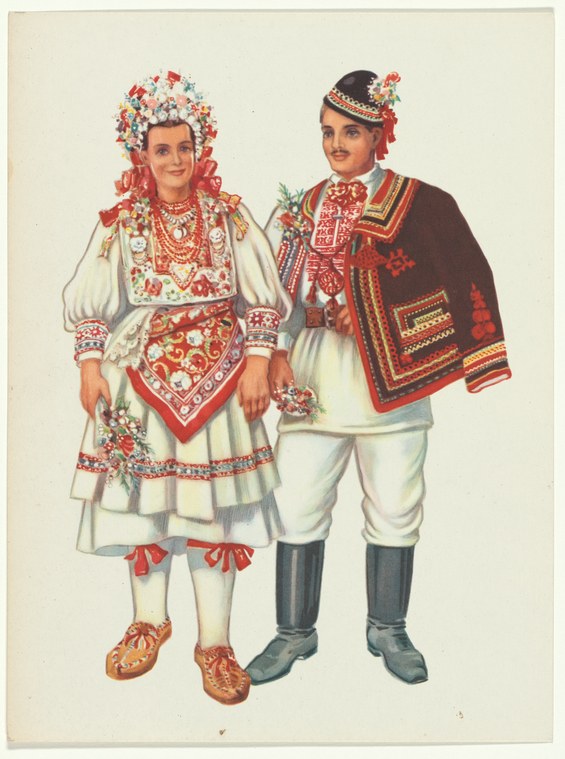
Two figures stand in formal poses against a plain background, dressed in elaborately embroidered traditional costume. The woman on the left wears a white linen dress with a high-waisted apron featuring geometric and floral embroidery in red, black, and gold thread. Her sleeves are gathered and voluminous, and she wears a distinctive headdress of white flowers and ribbons with long red ribbon streamers. Her feet are shod in embroidered slippers. The man on the right wears white linen breeches tucked into black boots, paired with a dark burgundy or brown embroidered jacket with red and gold patterning along the front and sleeves. He also wears a flower crown with a red feather or ribbon accent. Both figures face forward with composed expressions, their bodies held upright in a formal, presentational stance rather than caught mid-movement. The image is rendered as a hand-colored illustration on a cream-colored ground, with careful attention to the precise details of embroidery and textile patterning.
The dancing
The two figures stand in a neutral, frontal stance—neither in a dance hold nor in active movement. Their arms hang at their sides or rest naturally; the woman's hands are visible at waist level, the man's similarly relaxed. Both are placed at equal prominence in the composition, suggesting a paired presentation of male and female traditional dress. There is no visible interaction between them—they are isolated figures displayed for costume documentation rather than engaged in narrative or choreographic action.
The dance depicted
While the title identifies these as national costumes of Yugoslavia, the image itself does not depict active dance. The figures are presented as costume studies in a static, heraldic arrangement typical of ethnographic documentation. However, the garments—particularly the embroidered apron, the gathered sleeves, the floral headdresses, and the decorative patterning—are consistent with folk costume worn in Balkan circle dances and celebration contexts. The formal presentation suggests this is a reference document for traditional dress, possibly from a region where folk dance remains central to cultural identity, but the image captures costume, not choreography.
How it was made
This is a hand-colored lithograph or chromolithograph, evidenced by the careful layering of color, the precision of the printed contours, and the characteristic texture of the background. The technique allowed for economical reproduction of richly detailed costume documentation, making it ideal for educational, ethnographic, or theatrical costume reference materials. Such prints circulated widely in the early-to-mid 20th century as part of illustrated ethnographic surveys, encyclopedias, or costume reference collections. The hand-coloring suggests either a limited edition or a more expensive presentation copy.
About this work
This is a costume reference print documenting traditional Yugoslav dress, rendered as a hand-colored lithograph showing a man and woman in formal, static presentation. Rather than depicting an active dance scene, it functions as ethnographic illustration—a visual record of the embroidery, cut, and decoration of folk costume. The garments themselves carry the trace of dance culture (the construction and ornamentation of the apron, the headdress, the embroidered jacket are all typical of festival and celebration attire), but the image is a costume study, not a dance representation. It belongs in a dance art collection as documentation of the material culture and dress traditions that frame folk dance practice.
How to look at it
Attend to the extraordinary density and specificity of the embroidered patterning: the geometric motifs on the apron, the placement and style of the sleeve gathered, the construction of the headdress, and the cut of the jacket. These details are the point of the image—they are what a costume maker or dancer would study to understand how the garment was actually constructed and worn. Notice also the formality of the presentation: the figures are shown frontally and slightly apart, the convention of costume documentation rather than narrative scene. This is a catalog, not a story.
The period
This print likely dates to the interwar or early Cold War period, when systematic documentation of 'national' folk culture became a state priority across Eastern Europe. The formal, pedagogical style suggests publication in an ethnographic encyclopedia, costume reference manual, or national cultural survey. The Yugoslavian framing reflects the geopolitical consolidation of the South Slavic region after World War I and the subsequent state interest in codifying and displaying folk heritage as a marker of national identity. Such costume prints circulated both as scholarly reference and as popular visual culture, supporting both academic ethnography and theatrical costume departments.
Where it lives
The work is held in the New York Public Library's prints collection, cataloged under 'Prints depicting dance.' The sparse catalogue record reflects the common practice of attributing such prints generically to national or regional folklore surveys rather than to individual artists.
Dance in this work
Questions about this work
Is this actually a dance image?
The figures are not dancing, but the costume is historically and culturally inseparable from dance. In Balkan folk tradition, such garments are worn for circle dances, celebrations, and festivals. The print functions as material documentation of the dress culture that frames and enables folk dance practice.
What region of Yugoslavia is this from?
The catalogue record identifies it only as 'Yugoslavia,' without regional specificity. The embroidery patterns, the cut of the apron, and the style of the headdress suggest Balkan origin, but the print does not identify a specific region, village, or ethnic group.
How would a dancer use this image?
As a reference for authentic costume reconstruction. The embroidery details, proportions, and construction are precisely rendered, allowing a costume maker or dancer to understand how the garment was actually built and worn in its cultural context.
More dance artwork





