49 works in this view — arrow keys or swipe to move between them.
Dance in Art
National costumes of Yugoslavia
Unknown artist
- Collection:
- Prints depicting dance
- Source:
- New York Public Library
- Rights:
- Public domain — free to use, share and adapt.
- Recorded as:
- Public Domain
This work is significant for understanding how European folk traditions were documented and circulated during a period of emerging nationalism and anthropological interest in 'authentic' national cultures. For dance historians, it provides visual evidence of the costume context in which Yugoslav folk dances were performed and transmitted, showing the relationship between textile tradition, regional identity, and social practice.
What you are looking at
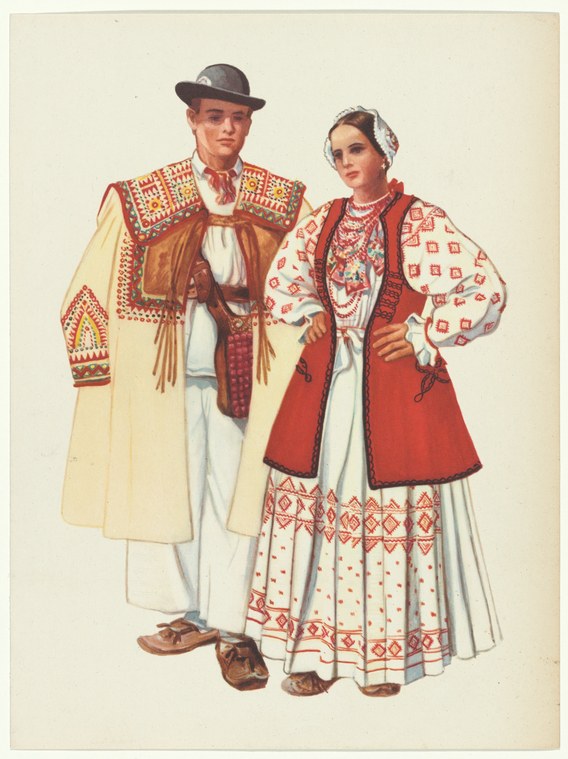
Two figures in traditional Yugoslav folk costume stand against a plain background in a formal presentation pose. The man, on the left, wears a cream-colored long coat (likely a *jelek* or traditional tunic) embellished with intricate geometric embroidery in red and gold across the chest, shoulders, and sleeves. Over this he wears a striking red-and-gold patterned vest or sleeveless jacket. White breeches extend to his ankles, and he wears simple leather shoes. A dark felt hat with a brim completes his ensemble. The woman, on the right, wears a white linen shift dress as a base layer, topped with a red sleeveless overdress or apron featuring geometric patterned trim. Her white blouse has puffed sleeves decorated with red embroidery, and a distinctive red patterned headscarf covers her hair. Both figures face forward with composed, dignified bearing, their posture upright and formal. The illustration uses soft watercolor tones and careful attention to textile patterning, suggesting this is a documentary costume study rather than a dynamic dance scene.
The dancing
Both figures stand in a static, formal presentation pose with upright posture and neutral arm positions—the woman's right arm rests at her side while the man stands with hands at rest. Neither figure is captured mid-movement; their feet are positioned naturally, with no indication of active stepping or weight shift. The composition emphasizes the costumes themselves over physical engagement or partnering. The figures occupy equal visual weight, standing side by side rather than in any dance hold or relationship.
The dance depicted
This is not a depiction of dance in motion, but rather a documentation of folk costume associated with Yugoslav traditional culture. While the garments shown—particularly the woman's dress and the man's embroidered coat—are consistent with folk dances performed in the Balkans, no dance is actually being performed or represented here. The image functions as a costume reference guide, showing the formal dress worn for ceremonial or social occasions, which may have accompanied folk dance but is presented here as static ethnographic documentation rather than choreographic representation.
How it was made
This appears to be a chromolithograph or hand-colored lithograph, created using careful layering of translucent color washes to render the textile patterns and embroidery. The technique allows for precise documentation of geometric patterning and the subtle tonal variations in embroidered decoration. The soft, matte finish and fine detail suggest a printing process refined for popular circulation as an educational or reference document, likely from a larger series on national or regional costume types. The careful draftsmanship and even lighting indicate a work intended for accurate ethnographic or commercial documentation.
About this work
This is a chromolithographic study of Yugoslav folk costume, presenting male and female traditional dress in formal presentation. It documents the elaborate embroidered garments, geometric patterning, and textile combinations that characterized Balkan folk culture in the late 19th or early 20th century. While folk dress is intimately connected to folk dance traditions, this image is a costume reference rather than a dance scene—a static ethnographic document that would serve educational, commercial, or reference purposes in an era of growing interest in national folk traditions across Europe.
How to look at it
Examine the geometric embroidery patterns carefully—note how they differ between male and female garments and are concentrated on specific areas (chest, shoulders, hem borders). The textile combinations (the layering of overdress, apron, and shift) reveal social and practical functions. Observe how the artist has rendered the three-dimensional quality of the embroidered decoration through subtle shading and color variation, using the flat medium of lithography to suggest texture and depth. The formal frontality and symmetry of the pose emphasize the garments as objects of display rather than evidence of movement.
The artist
The artist is not recorded. The work's style and execution suggest it was produced by a commercial printer or lithographic workshop, likely in Central or Eastern Europe, specializing in ethnographic or costume documentation for educational or popular circulation. Such images were typically produced as series and distributed widely through almanacs, encyclopedias, or standalone costume prints.
The period
This work was created during a period of intense European interest in folk traditions and national identity, a movement that gained momentum throughout the 19th century and into the early 20th. The documentation of Yugoslav (South Slavic) costume coincided with the region's complex political history and growing awareness of distinct ethnic and cultural identities within the Ottoman and Austro-Hungarian spheres. Folk dance and costume were being collected, standardized, and promoted as markers of national character, with educational prints like this one serving to preserve and disseminate knowledge of these traditions.
Where it lives
This chromolithograph is held in the New York Public Library's collection of prints depicting dance. It is catalogued as a costume reference document and likely formed part of a larger series on national or regional dress types, popular as educational materials and reference works in the late 19th and early 20th centuries.
Dance in this work
Questions about this work
Is this a dance scene?
No. This is a static costume documentation, not a representation of dancing. The figures are posed formally for display of their garments rather than captured in movement. However, the costumes shown are those worn for folk dance occasions in Yugoslav tradition.
What do the geometric patterns mean?
The embroidered patterns are characteristic of South Slavic folk textile traditions and likely carry regional and possibly family significance. Different regions of the Yugoslav lands had distinct pattern vocabularies and color preferences, encoded in geometric designs that distinguished communities from one another.
When and where was this made?
The catalogue record does not provide a date or place of origin. The style and printing technique suggest late 19th or early 20th century production, likely in Central Europe as part of a commercial series on national or regional costumes. The specific techniques and subject matter indicate a period of growing ethnographic and nationalist interest in folk traditions.
Why is women's costume so different from men's?
In folk traditions across the Balkans, gender differences in costume reflected social roles, marital status, and community function. Women's dress often involved more elaborate layering (shift, overdress, apron) and extensive embroidered decoration, while men's garments emphasized the decorated tunic or vest worn as a status marker. The headscarf worn by the woman was a crucial marker of respectability and social position.
More dance artwork





