49 works in this view — arrow keys or swipe to move between them.
Dance in Art
National costumes of Yugoslavia
Unknown artist
- Collection:
- Prints depicting dance
- Source:
- New York Public Library
- Rights:
- Public domain — free to use, share and adapt.
- Recorded as:
- Public Domain
For historians and practitioners of Balkan folk dance, costume documentation is essential evidence. While the image does not capture choreography or technique, it records the precise construction, decoration, and material of dress worn in kolo and other South Slavic circle dances—information that modern folk-dance companies and cultural conservationists use to reconstruct historically grounded performance. The image also reflects the early twentieth-century European fascination with folk culture and ethnic identity, a context in which dance and costume became markers of national character.
What you are looking at
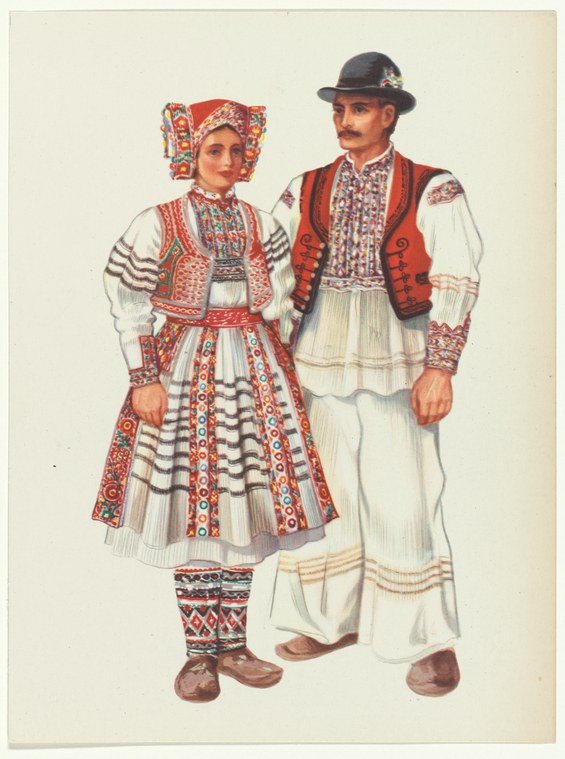
Two figures stand against a plain background in a formal pose, representing a man and woman in traditional Yugoslav folk dress. The woman on the left wears a striking red embroidered vest over a white linen shirt with long sleeves trimmed in red geometric borders; her skirt is cream linen with a prominent red stripe pattern that extends around the hem, complemented by matching embroidered leggings in red and dark blue. She wears a tall, elaborate red kokoshnik (traditional headdress) with elaborate gold ornamental trim. The man on the right wears a cream linen shirt with red embroidered decoration on the front and a red sleeveless vest or jerkin decorated with black and gold embroidery; his lower garment is also cream linen, gathered at the ankle above brown leather shoes. Both figures stand upright and still, facing slightly toward the viewer. The image appears to be a hand-colored lithograph or engraving, rendered in the documentary style of early-to-mid twentieth-century ethnographic costume illustration.
The dancing
Both figures stand in stationary, frontal poses with arms at rest—the woman with hands at her sides, the man with one hand relaxed. There is no active dance gesture or movement frozen in the frame. The bodies are presented vertically and symmetrically, as dress documentation rather than action study. The woman's slight rightward turn of the torso creates minimal dynamic tension. No hold, frame, or footwork engagement is visible; this is costume display rather than choreographic capture.
The dance depicted
The image presents folk costume rather than a moment of dance in action. The dress—particularly the woman's kokoshnik headdress and embroidered vest, and the man's decorated shirt and jerkin—is consistent with South Slavic folk traditions (likely Serbian, Croatian, or Bosnian based on the embroidery style and construction). While these costumes are worn in regional folk dances such as kolo and other Balkan circle dances, the image itself does not depict dancing. The figures are posed as a couple for ethnographic documentation, the standard convention for costume illustration in this period.
How it was made
This appears to be a hand-colored lithograph or color engraving, a technique widely used for costume documentation in the late 19th and early 20th centuries. The precise rendering of textile patterns, the careful attention to embroidery detail, and the pale background are typical of commercial ethnographic illustration intended for distribution in costume anthologies, museum guides, or educational materials. The hand-coloring is precise but not photorealistic, preserving clarity of pattern and ornament over atmospheric effect. This technique made such images reproducible and affordable, facilitating wide circulation among museums, schools, and folk-dance enthusiasts across Europe.
About this work
This is a documentary illustration of traditional Yugoslav folk costume, likely Serbian or South Slavic, rendered as a hand-colored lithograph in the style of early twentieth-century ethnographic publishing. The work is representative of a vast body of costume illustration that served both scholarly and popular markets, preserving visual records of regional dress traditions during a period of rapid modernization. It belongs in a dance gallery not because the image shows dance in motion, but because such costume studies are foundational to the history of folk-dance revival and reconstruction: choreographers, dancers, and historians depend on images like this to understand the material culture in which regional dances were embedded and performed.
How to look at it
Examine the embroidery patterns on the vest, shirt, and leggings—the geometric designs, thread colors, and placement are specific to a particular region and time, and were essential markers of identity and skill in the communities that made them. Note the woman's kokoshnik: its height, ornament, and construction vary significantly across South Slavic regions and are diagnostic of origin. The stillness of the pose, though it may seem static to a modern viewer, was the convention for costume illustration: the point was to present the garment clearly and completely, not to suggest movement. Compare this style of documentation with photographs of the same period to see how lithographic illustration prioritized pattern and ornament over realistic proportion or lighting.
The period
This work was created during a period of intense European interest in folk culture, driven by Romantic nationalism and modernist primitivism. The Balkan region, newly independent from Ottoman rule and politically fragmented, was a focus of ethnographic documentation as European scholars and artists recorded regional costume and custom before industrialization erased them. In this same period (roughly 1890–1930), folk-dance revival movements across Europe—including the Balkans—began systematizing traditional dances, and costume illustration served both scholarly and promotional purposes. Museums and dance companies commissioned such images to establish regional authenticity and educate performers and audiences.
Where it lives
The work is held in the New York Public Library's Prints collection, catalogued as a representation of Yugoslav national costume. The collection includes a broad range of nineteenth- and twentieth-century ethnographic and costume illustration, much of it produced for educational, curatorial, and performance purposes.
Dance in this work
Questions about this work
Is this image actually showing a dance?
No. The figures are posed statically for costume documentation. However, the dress shown—particularly the woman's kokoshnik and embroidered vest and the man's decorated shirt and jerkin—are the authentic garments worn in South Slavic folk dances such as kolo. The image is valuable to dance history as a record of the material context in which these dances were performed and are still reconstructed today.
What region of Yugoslavia does this represent?
The embroidery style, kokoshnik form, and overall construction are consistent with Serbian or broader South Slavic (possibly Croatian or Bosnian) tradition, but without additional documentation or an artist signature, the specific region cannot be stated with certainty. The geometric patterns and red-on-white color scheme are characteristic of several overlapping regional traditions.
When was this image made?
The catalogue record does not provide a date. Based on the lithographic technique, color registration, and style of ethnographic documentation, it was likely produced between 1890 and 1930, during the height of European folk-culture documentation.
Why are both figures shown together?
In folk-dance documentation of this period, couple dress was often illustrated together to show how the genders' costumes coordinated and to suggest the social context of dance—pairing and courtship were central to many regional circle and couple dances. This pairing convention also followed the museum and educational publishing norms of the time.
More dance artwork





