49 works in this view — arrow keys or swipe to move between them.
Dance in Art
National costumes of Yugoslavia
Unknown artist
- Collection:
- Prints depicting dance
- Source:
- New York Public Library
- Rights:
- Public domain — free to use, share and adapt.
- Recorded as:
- Public Domain
This work is valuable not as a dance image but as evidence of how folk costume and dance were linked in early 20th-century cultural documentation and museum practice. The print demonstrates the visual conventions used to present non-Western or regional dress to an educated Western audience during a period when nationalism and anthropology were reshaping how cultures understood themselves.
What you are looking at
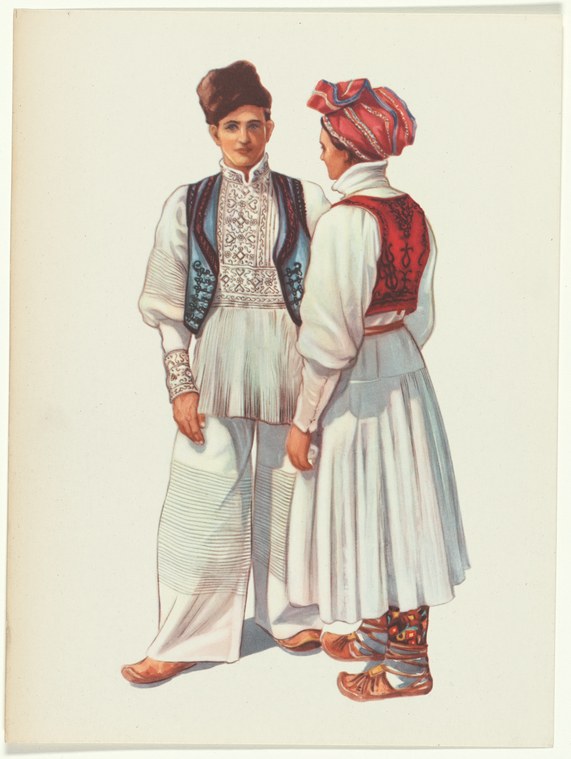
Two figures stand in frontal presentation against a plain cream background, wearing what are labeled as Yugoslav national costumes. The figure on the left faces forward, wearing a white linen shirt with elaborate geometric embroidery at the chest and cuffs, a dark blue sleeveless vest or bodice equally embroidered in blue and gold thread, and white pleated skirts that fall to the ankles with a horizontal striped underskirt visible. A tall dark red cylindrical hat sits on their head. The figure on the right is shown from behind wearing similar white garments with red and gold embroidery on a red vest, a red patterned headwrap, and reddish sandals or shoes with straps. Both figures are poised in upright, dignified stances with hands positioned at their sides, as if demonstrating traditional dress rather than captured in movement. The precision of the costume rendering and the formal presentation suggest this is a ethnographic or costume study rather than a dance scene in progress.
The dancing
Both figures stand in formal, neutral posture with weight evenly distributed and arms relaxed. There is no dynamic lean, no evidence of a hold between the two figures, and no body position suggestive of active dance movement. The stance is that of dress presentation or costume documentation—the bodies are still and upright, used as mannequins to display the embroidered garments and regional variants. The frontality and mirror-like symmetry (one facing forward, one behind) reinforce that this is a reference document rather than a moment of dance captured.
The dance depicted
While the title claims these are national costumes of Yugoslavia, the image shows ethnographic dress presentation rather than dance in action. Yugoslav folk dance traditions, particularly from the Balkans, involve vigorous group movement with specific holds and footwork patterns—circle dances, line formations, and couple configurations. Nothing in this image depicts dance: there is no footwork visible, no dynamic spacing, no evidence of music or rhythmic engagement. The costumes themselves are clearly associated with folk traditions that included dance, but the image documents clothing, not choreography.
How it was made
This appears to be a chromolithograph or hand-colored lithographic print, a process that allowed for faithful color reproduction and fine detail rendering of embroidered textiles. The precision of the geometric patterns on the vests and the subtle color gradations in the dyes suggest either a skilled lithographic transfer or hand coloring of a lithographic base. The technique was standard for ethnographic and costume documentation from the late 19th through mid-20th centuries, allowing wide circulation of costume studies in educational and museum contexts. The flat perspective and staged presentation are characteristic of costume plate conventions used in anthropological and regional studies.
About this work
This is a costume study presenting two variants of Yugoslav traditional dress, rendered as a chromolithographic print in the ethnographic documentation tradition. The figures are displayed in formal, still positions against a neutral background, their elaborate embroidered garments and regional markers—headdress, vest patterns, footwear—laid out for comparative study. The image is part of the visual archive of European folk costume that gained popularity in the 19th and early 20th centuries as nationalism and cultural preservation movements spurred interest in regional identities and traditional dress.
While the costumes derive from cultures with rich dance traditions, this particular image does not depict dance. It is a technical, documentary representation of material culture—a reference work for costume historians, textile specialists, and those studying Yugoslav or Balkan regional identity. Its presence in a dance archive reflects the historical reality that folk dance and folk costume were often studied together, and that costume documentation served as evidence of cultural heritage even when no movement was shown.
How to look at it
Examine the embroidery patterns closely: the geometric designs on the vests reveal regional variation and the skill of textile workers. Notice the different headwear—the tall cylindrical hat and the wrapped head cloth—which were markers of regional or ethnic origin within Yugoslavia. The formal, static poses are deliberate: costume plates were designed to show each garment element clearly and completely, leaving no wrinkles or folds that would obscure the patterns. This is not naturalistic representation but systematic documentation, a visual catalog rather than a moment of lived practice.
The period
This print belongs to the late 19th and early 20th-century vogue for systematic documentation of European regional and national costume, driven by both romantic nationalism and the emerging discipline of ethnography. Yugoslavia as a political entity did not exist until 1918, and this print likely dates to the interwar period (1918–1941) or shortly after, when the young nation was asserting a unified cultural identity by documenting the distinct traditional costumes of its constituent regions. Similar costume studies were produced across Europe during this period—Germany, Scandinavia, Hungary, and the Balkans all generated substantial print archives of folk dress. The practice reflected both genuine scholarly interest in textile and sewing traditions and a nation-building impulse to visually prove cultural coherence and historical depth.
Where it lives
The work is held in the New York Public Library's Prints collection, which includes extensive holdings of European costume plates and ethnographic prints. This type of image circulated widely in educational, museum, and scholarly contexts in the early 20th century, and the NYPL's acquisition reflects its role as a major repository of visual documentation on culture and material history.
Questions about this work
Does this image show Yugoslav folk dance?
No. While the costumes are associated with Yugoslav folk traditions that included dance, the image itself shows static dress presentation, not movement. The figures stand in formal, neutral poses designed to display the embroidered garments and regional markers. It is a costume study, not a choreographic document.
Why is a costume study in a dance archive?
Because folk dance and folk costume were historically studied together, and costume documentation was treated as evidence of cultural heritage and dance tradition. Museums and archives often grouped them because they conveyed related information about regional identity and performance practice—even when the specific image showed only dress.
What do the embroidered patterns tell us?
The geometric designs on the vests are distinctive enough to indicate regional or ethnic origin within Yugoslavia. The embroidery styles, color choices, and motifs were markers of cultural identity and demonstrated the textile skill of the communities that produced them. Comparative costume documentation allowed for systematic study of these regional variations.
When was this printed?
The record does not specify a date, but the style and technique are consistent with early-to-mid 20th-century ethnographic printing. Yugoslavia was not a unified nation until 1918, suggesting this print dates to the interwar period (1918–1941) or shortly after, when the state was actively documenting regional costume.
More dance artwork





