49 works in this view — arrow keys or swipe to move between them.
Dance in Art
National costumes of Yugoslavia
Unknown artist
- Collection:
- Prints depicting dance
- Source:
- New York Public Library
- Rights:
- Public domain — free to use, share and adapt.
- Recorded as:
- Public Domain
For dance historians and ethnographers, this image is valuable not as a depiction of dance itself, but as documentary evidence of the costume context in which regional folk dances were performed. The precise rendering of embroidery, construction, and regional variation provides information about the material conditions of folk performance and the visual markers by which regional identity was expressed.
What you are looking at
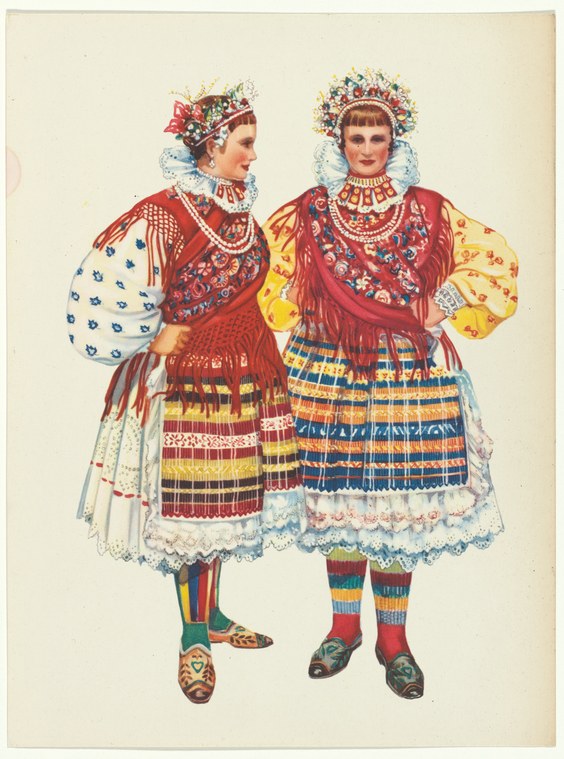
Two young women stand side by side in richly decorated traditional dress. Both wear elaborate embroidered vests in deep red with geometric and floral patterns, white linen shift sleeves with blue printed designs, and tiered skirts composed of horizontal bands in contrasting colors—red, yellow, navy, and black—trimmed with white lace at the hem. Each wears a tall, ornate headdress adorned with flowers and embellishments, and white linen kerchiefs frame their faces. Their footwear—embroidered shoes visible at the hem—shows distinct regional detail. The figure on the left is shown in profile; the one on the right faces forward. Both stand at ease in a formal presentation pose against a neutral ground, suggesting this is a documentary illustration of folk costume rather than a captured moment of dance. The precise rendering and careful color registration indicate this is a professional ethnographic or costume study.
The dancing
The two figures stand in static, formal poses with upright posture and relaxed arms at their sides—the conventional stance for costume documentation rather than active dance. There is no dynamic weight shift, no partnering, no engaged frame. The detailed embroidery and structural precision of the garments are clearly the visual priority; the bodies are presented as supports for the clothing.
The dance depicted
This appears to be a costume study rather than a dance depiction. While the garments are characteristic of Yugoslav folk traditions that historically included circle dances (such as the Kolo, common across the Balkans), nothing in these static, frontal poses indicates active dance. The image serves an ethnographic purpose—documenting the distinctive dress of different regions—rather than depicting performance or movement. The costume itself is the subject.
How it was made
This is a hand-colored print, likely a chromolithograph or color-separated woodcut, a technique that allowed fine detail and accurate color reproduction for publication. The registration is clean and the palette precisely controlled, suggesting this was produced for a book or portfolio intended for wider circulation. The style and finish indicate late 19th or early 20th-century ethnographic documentation practices, when such illustrated costume albums were popular educational and collectible works.
About this work
This is a costume documentation print showing two regional variants of Yugoslav traditional dress, rendered in detailed color with ethnographic precision. The two figures present different versions of folk costume, marked by distinct embroidery patterns, headdress styles, and skirt colorations. While the garments belong to cultures with living dance traditions, the image itself is not a dance scene but a comparative study of material culture—the kind of reference image that might accompany a museum collection or travel account.
How to look at it
View this as a comparative study: note how the two costumes differ in headdress design, embroidery patterns, and the sequence of colors in the skirt tiers. The precision of the rendering—the individual floral motifs, the geometry of the lace trim, the construction of the necklines—shows the illustrator's attention to costume detail as material evidence. This is the visual language of documentation, not dramatic narrative.
The artist
The artist is not recorded. The style and execution suggest a trained illustrator working in the commercial or museum publishing world of the late 19th or early 20th century, when ethnographic and costume documentation was a recognized field. The technical quality and color consistency point to an established print workshop rather than amateur work.
The period
This print dates to an era when European publishers were producing illustrated albums of folk costumes from newly independent or ethnically diverse regions—a practice that combined nationalist interest in traditional culture with anthropological documentation. Yugoslav folk traditions, including circle dances and regional variations, were the subject of renewed interest during this period as national identity crystallized. Such prints circulated widely among educated audiences and collectors, often accompanying travel narratives or museum catalogs.
Where it lives
The print is held by the New York Public Library in a collection designated 'Prints depicting dance.' The catalogue record identifies it as showing National Costumes of Yugoslavia but provides no date, artist, or publication information.
Dance in this work
Questions about this work
Is this actually a dance image?
Not in the sense of depicting movement or performance. It is a costume documentation study. The figures stand in formal, static poses used for ethnographic illustration. However, the garments shown are the traditional dress worn for regional folk dances, particularly the Kolo and related circle dances of the Balkans, so the image is related to dance culture even if it does not show dance in action.
How do I know these are from different regions?
The two costumes show systematic differences in headdress style, embroidery pattern, and skirt colorations. The figure on the left has a more compact headdress with red elements and blue-printed sleeves; the figure on the right wears a taller, broader headdress and shows different proportions in the skirt banding. These variations are typical of how regional folk dress encoded geographic and ethnic identity within multi-ethnic regions like Yugoslavia.
What dances would have been performed in these costumes?
The Kolo, a circle dance found across the Balkans, is the most likely candidate. Regional variants include the Serbian Kolo, Croatian circle dances, and Macedonian and Bulgarian variants. These were social dances performed at celebrations, and the costume variations shown here would have marked regional origin and cultural identity within the broader tradition.
More dance artwork





