49 works in this view — arrow keys or swipe to move between them.
Dance in Art
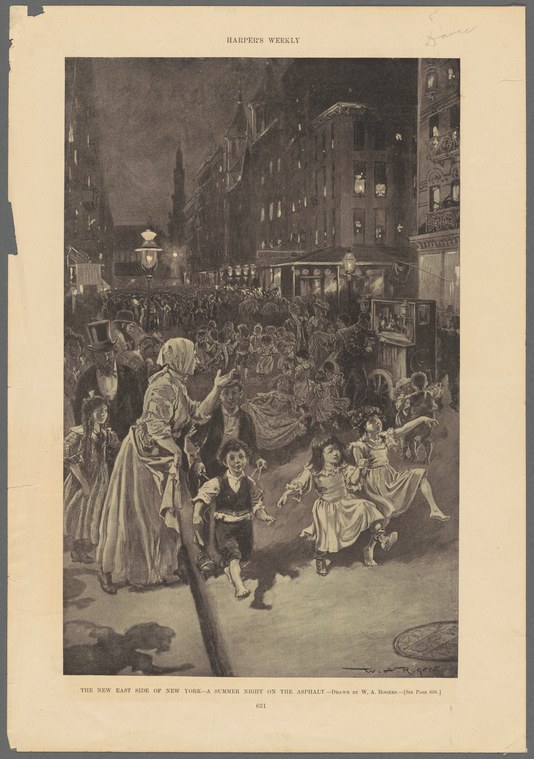
The new East Side of New York—A summer night on the asphalt
Unknown artist
- Collection:
- Prints depicting dance
- Source:
- New York Public Library
- Rights:
- Public domain — free to use, share and adapt.
- Recorded as:
- Public Domain
This image is historical evidence of how immigrant and working-class New Yorkers actually danced and gathered in the street, a lived culture that would have been invisible to polite society and is difficult to recover from written sources alone. It shows dance not as entertainment or competition but as a form of neighborhood life and survival, inseparable from housing conditions, poverty, and the social structures that forced communities outdoors. For dancers and historians, it offers a rare visual document of vernacular street culture from a period when such scenes were both common and largely undocumented in art.
What you are looking at
A densely crowded street scene set on the Lower East Side of New York, rendered in dark tones with dramatic chiaroscuro lighting. The composition shows hundreds of figures—adults and children—occupying a narrow urban street lined with tall buildings and storefronts. In the foreground, a woman in a long light-colored dress dominates the left side, her figure monumental in scale compared to the crowd. Children in various states of undress or summer clothing move through the throng, some dancing or moving with exuberance. The street recedes into shadow, with a street lamp glowing in the distance and illuminated windows suggesting evening. The scene captures a moment of collective outdoor movement and social gathering during a hot summer night, when residents spill into the streets seeking relief and community.
The dancing
The bodies are animated and varied in their movement: several children are in active motion, some with arms raised or extended, suggesting uninhibited dancing or play. The woman in the foreground has her arms extended in a gesture that is both welcoming and directive, her posture suggesting she may be leading or encouraging the gathered crowd. The figures are not arranged in formal dance couples or lines; instead, they occupy the street in an organic, improvisational fashion. Weight appears distributed freely across the group, with no visible closed holds or partnering in the ballroom sense—this is collective, street-based movement rather than structured social dance.
The dance depicted
This image documents vernacular social dance and street culture rather than theatrical or ballroom dance. The scene depicts what appears to be spontaneous, communal movement on a hot summer night—a moment when neighborhood residents, particularly immigrant communities and working-class families, would gather in the streets because their tenement apartments were unlivable in the heat. Children and adults move together in an informal, participatory manner that suggests street games, folk traditions, and improvised celebration rather than learned choreography. The specific identity of any particular dance style is impossible to determine from the image, as the movement appears embedded in a broader culture of public gathering and community expression rather than representing a named dance form.
How it was made
This is a halftone or photomechanical print, reproduced from what appears to be an original illustration or photograph. The tonal range moves from deep blacks in the background architecture through midtones in the crowd to bright highlights on the woman's dress and certain faces. The technique allowed for rapid reproduction and wide circulation in newspapers and popular magazines, which is consistent with the Harper's Weekly attribution visible at the top of the page. The halftone process converts continuous tone into a pattern of dots, visible on close inspection, which creates the sense of depth and atmosphere through density rather than line. This was a modern, mass-circulation medium, placing the image within the tradition of documentary illustration and social reportage rather than fine art.
About this work
This is a social-documentary illustration depicting everyday street dance and gathering on the Lower East Side of New York City, almost certainly from Harper's Weekly, a major illustrated newspaper of the late 19th century. The artist captures a moment of collective urban life—immigrant and working-class residents claiming the street as a social and recreational space on a summer evening. The image documents not a named dance genre but rather the vernacular culture of movement, music, and community that emerged from the conditions of tenement life in crowded immigrant neighborhoods. It belongs in a gallery of dance art because it shows how dance functioned as social necessity and cultural expression outside the theater and ballroom—how bodies moved together in public space, and why.
How to look at it
Attend to the scale and prominence of the woman in the foreground—she is painted larger and lighter than the crowd, suggesting the illustrator saw her as a focal point or leader. Notice the variety of body positions among the children: some are in motion, some stationary, creating a sense of lived, uncoordinated movement rather than synchronized dance. The lighting is crucial—the darkness of the buildings and street, pierced by the glow of gas lamps and lit windows, creates the sense of evening and public space. The composition pulls the viewer into the crowd rather than offering a distant, observational perspective, suggesting this is an image intended to make middle-class readers feel present in and sympathetic to street life they would not normally witness.
The artist
Unknown. The image is attributed to Harper's Weekly, the major American illustrated newspaper founded in 1857 by Fletcher Harper. Harper's employed a large stable of illustrators and staff artists who created scenes of contemporary life for weekly publication, often working from photographs or eyewitness accounts. The particular illustrator of this scene is not recorded in the catalogue, which was common practice—such illustrators were often uncredited or credited only by initials. The style is consistent with the documentary-realist approach that characterized Harper's coverage of urban life, social issues, and contemporary events.
The period
This image dates from the era of mass immigration to New York, when tenement overcrowding made streets the primary social space for poor and working-class residents, particularly immigrant communities from Southern and Eastern Europe. The 1880s and 1890s saw the rise of illustrated newspapers and magazines as the dominant form of visual news and social documentation, before photography could be easily reproduced in print. In dance history, this was the era before jazz and popular dance forms that would emerge from these same communities had yet gained commercial visibility. The image captures a moment before working-class street culture became commodified and staged for middle-class consumption.
Where it lives
The image is held by the New York Public Library as part of a collection of prints depicting dance. The Harper's Weekly attribution and the visible publication header date it to that periodical's publication run (1857–1916), though the exact date is not recorded. Harper's Weekly plates were distributed widely and survive in numerous institutional collections.
Questions about this work
What dance are they doing?
There is no single named dance here. The image shows vernacular street gathering and informal movement—the kind of collective social activity that happened when tenement residents came out to the streets on hot nights. Some children appear to be dancing or playing games, others are simply moving through the crowd. This is street culture rather than choreographed dance.
Why are so many people in the street?
Tenement apartments in the Lower East Side were extremely crowded and had no air conditioning. In summer, particularly at night, residents came into the streets because it was the only livable space available. The streets became centers of social and recreational life by necessity, not choice.
Who is the woman in the foreground?
She is not identified. She may be a specific person the illustrator chose to emphasize, or she may be a representative figure—a woman or mother among the crowd, given prominence by the artist to draw the viewer's eye and suggest leadership or care within the community.
Is this a real scene or an invented one?
Harper's Weekly illustrators worked from eyewitness observation, photographs, and reporting, though the final image was drawn rather than photographic. The scene depicts a type of event that actually happened regularly on the Lower East Side. Whether this is a specific event or a composite image representing typical street life is not recorded.
More dance artwork





