49 works in this view — arrow keys or swipe to move between them.
Dance in Art
National costumes of Yugoslavia
Unknown artist
- Collection:
- Prints depicting dance
- Source:
- New York Public Library
- Rights:
- Public domain — free to use, share and adapt.
- Recorded as:
- Public Domain
For dancers and historians studying Slavic and Balkan folk traditions, this image is valuable as a record of authentic costume construction and regional embroidery at a particular moment in the 20th century. However, it does not document dance movement itself, and should be consulted alongside choreographic records and film to understand how these costumes functioned in actual performance.
What you are looking at
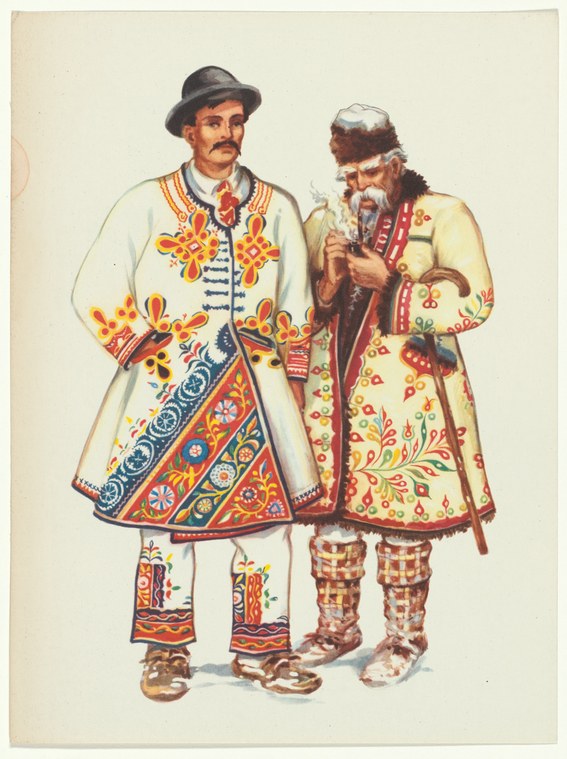
Two men stand facing the viewer in traditional Eastern European costume, painted in a style typical of early-to-mid 20th-century ethnographic illustration. The figure on the left wears a light linen shirt with elaborate geometric embroidery in orange and blue, a decorative belt with patterned panels, and a dark bowler hat; his legs are wrapped in puttees and he stands in a relaxed contrapposto. The man on the right, bearded and older-looking, wears a cream-colored coat with dense red and green floral embroidery, a white cap, and similarly wrapped leggings in a geometric pattern; he holds a walking staff or cane. The embroidery is the focal point of the composition—dense, symmetrical, and clearly the subject of documentation. Both men's posture suggests neither active movement nor the formal stillness of a portrait; they appear to be presented as types or examples rather than as individuals engaged in a specific moment.
The dancing
Neither figure is in an active dancing pose. Both stand with weight evenly distributed, facing forward in a neutral stance. Their positioning is presentational rather than narrative—arranged side by side for comparison. The older man's grasp of a staff is the only gesture that suggests action or character, but it does not indicate dance movement. The bodies are upright and static, without the characteristic flexion, extension, or momentum that would mark an active dance posture.
The dance depicted
This appears to be a costume study rather than a depiction of dance in action. While the title refers to 'national costumes,' there is no evidence of active dancing, choreography, or movement culture in the image itself. The figures are presented as ethnographic specimens showing garment construction and decoration. If these costumes were worn for traditional folk dances—as Eastern European embroidered dress often was—the image does not document that use; instead it functions as a sartorial record. Without active dance movement, footwork, spatial relationship to music, or any context of performance, this cannot reliably be identified as depicting a specific dance tradition.
How it was made
This is a chromolithograph or hand-colored lithograph, typical of early-20th-century ethnographic and anthropological publishing. The technique allowed for fine detail in the embroidery patterns and subtle color gradation in the garments, and the format suggests it was designed for reproduction in a book or educational series. The crisp outline, bright palette, and documentary precision are characteristic of instructional or museum-catalog illustration rather than fine-art printmaking. This method of production and presentation indicates the work was intended for a broad audience interested in folk costume and ethnic dress rather than artistic connoisseurs.
About this work
This is an ethnographic costume study depicting two male figures in traditional Eastern European dress, presented without narrative context or indication of active performance. The work documents garment construction, embroidery patterns, and regional variation through careful rendering of textiles and decoration. While folk costumes of this region were worn for traditional dances, the static, presentational pose of the figures and the focus on sartorial detail rather than movement culture place this work in the category of costume documentation rather than dance representation. It belongs in a dance archive primarily as evidence of the garments that dancers wore, not as evidence of how they danced.
How to look at it
Attend to the density and precision of the embroidery: the geometric patterns on the left figure's garments and the floral arabesques on the right figure's coat are rendered with documentary accuracy. Notice how the artist has positioned the figures to display the full front and side views of the costumes, and how the wrapping of the leggings and the construction of the belts are clearly visible. The scale of the embroidered panels relative to the body and the precise repetition of pattern indicate that this is a technical illustration designed to allow a craftsperson or historian to understand construction and decoration—not an artistic interpretation of a moment in motion.
The artist
Unknown. The style and execution suggest this was produced by an illustrator working for an ethnographic publisher or museum collection in the early-to-mid 20th century, when such systematic documentation of folk costume was a standard practice in European and North American academic institutions.
The period
This work dates from an era of intense ethnographic collection and cataloging, particularly in the 1920s–1950s, when European and American institutions were documenting folk traditions they perceived as endangered by modernization. Yugoslavia as a political entity was newly formed or consolidated during this period, and documentation of its diverse regional costumes was a priority for both nationalist and academic projects. Folk dance and costume were treated as expressions of national identity, though the actual contexts of performance—seasonal celebrations, courtship rituals, work songs—were often abstracted away in favor of static costume presentation.
Where it lives
Held in the New York Public Library's collection of prints depicting dance. This work is cataloged under 'National costumes of Yugoslavia' and likely comes from a published ethnographic series or museum catalog, though the specific source and publication details are not recorded.
Questions about this work
Is this a dance image?
Not in the sense of depicting active dance movement. It is a costume study showing the garments worn for folk dance traditions, but the figures are posed statically for documentation of textile and garment design rather than to capture or illustrate a moment of performance. For understanding how these costumes moved in actual dance, you would need choreographic records, film, or written descriptions of the dances themselves.
What region of Yugoslavia is shown?
The title indicates these are 'national costumes' rather than costumes of a specific region, which suggests the image may be presenting selected or composite examples. The embroidery styles, colors, and silhouettes are consistent with Balkan and South Slavic traditions, but without further documentation it is not possible to attribute these costumes to a particular village, region, or ethnic group with confidence.
What can I learn about folk dance from this image?
This image documents what dancers wore—the weight and drape of the fabrics, the placement of ornament, the style of footwear and leg wrapping—but not how they moved. To understand the dances themselves, you would need to consult film documentation, choreographic notation, written ethnographic accounts, or oral histories from dancers in these traditions. Costume alone cannot tell you the tempo, the music, the social context, or the specific movements of a dance.
More dance artwork





