49 works in this view — arrow keys or swipe to move between them.
Dance in Art
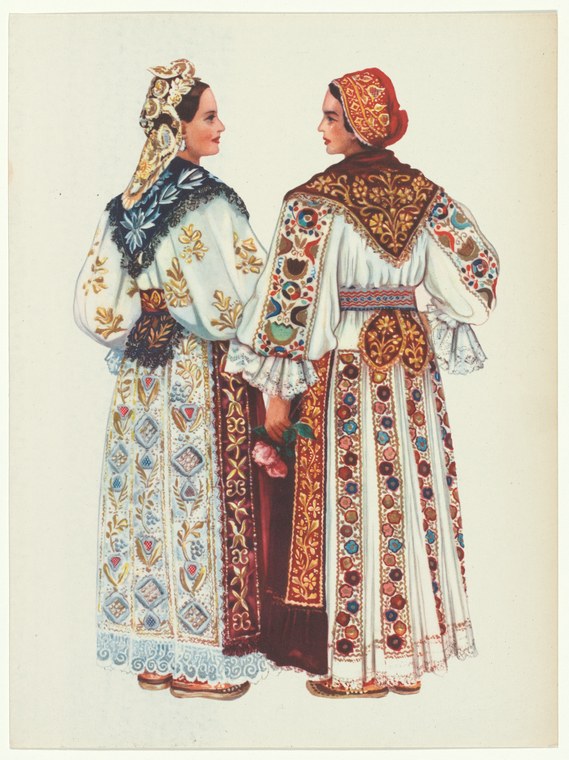
National costumes of Yugoslavia
Unknown artist
- Collection:
- Prints depicting dance
- Source:
- New York Public Library
- Rights:
- Public domain — free to use, share and adapt.
- Recorded as:
- Public Domain
For dance historians and ethnographers, costume is primary evidence of regional identity, status, and cultural practice. This careful documentation shows how embroidery design, fabric choice, and construction techniques differed across Yugoslav regions, and such records are essential for understanding how dancers were visually marked and how folk tradition was maintained. The plate contributes to the broader archive of dance costumery that shaped how regional dances were performed and recognized.
What you are looking at
Two women in traditional dress stand facing each other against a pale background, presented in profile or three-quarter view. The figure on the left wears a light linen dress embroidered with geometric and floral motifs in gold and blue, with a dark patterned vest or overdress. Her hair is bound in an ornate golden filigree headdress and matching lace veil. The figure on the right faces away, displaying an elaborate burgundy overdress heavily embroidered in gold thread with floral and geometric patterns; beneath it is a pale pleated underdress, and she wears a burgundy embroidered headscarf with similar ornamental designs. Both figures wear substantial embroidered belts at the waist. The rendering is precise and colorful, documenting the textiles and construction of these garments in meticulous detail. This appears to be a costume documentation plate rather than a scene of active movement or dance performance.
The dancing
Both figures stand still in upright posture, with no suggestion of partnered hold, weight shift, or active footwork. They are presented as statuary costume displays—the woman on the left with arms at rest, the woman on the right with her back three-quarter turned. There is no interaction between them, no embrace, no frame suggestive of ballroom, folk, or theatrical dance practice. The bodies serve as mannequins for the garments rather than as dancers in motion.
The dance depicted
This is not a depiction of active dance. The image documents national costumes of Yugoslavia, likely from different regions, presented for ethnographic or historical record. While these costumes would have been worn during regional folk celebrations and dances, the plate itself shows no dancing bodies, no movement vocabulary, and no evidence of a specific dance being performed. The formal presentation suggests this is a reference work for costume study rather than a scene of dance in practice.
How it was made
Based on the image characteristics—the precise linear rendering, the flat application of color, the careful attention to textile pattern and embroidery, and the pale cream background—this appears to be a color lithograph or hand-colored engraving, techniques well suited to ethnographic and costume documentation in the late 19th and early 20th centuries. The registration and finish suggest commercial publication, likely from a regional costume atlas or ethnographic survey. The medium allowed for accurate color reproduction of embroidery and textile design, making it ideal for costume reference.
About this work
This is a costume documentation plate showing two regional variations of Yugoslav women's traditional dress, presented as ethnographic record rather than as a dance scene. The meticulous rendering of embroidery, textile structure, and construction details indicates it is part of a systematic archive of regional costume, likely from the early 20th century. While these garments were central to folk identity and would have been worn during dance celebrations, the image itself records costume history rather than choreography or movement practice. Its value lies in the precise visual documentation of material culture and regional dress variation.
How to look at it
Examine the embroidery patterns closely: the woman on the left displays geometric and floral designs in restrained gold and blue on pale linen, while the woman on the right wears a much heavier, densely patterned brocaded or embroidered cloth in burgundy and gold. Notice the construction details—the layering of garments, the placement and size of the embroidered panels, the treatment of sleeves and necklines. These differences signal regional variation and possibly different occasions or social positions. The careful documentation of every stitch and pattern indicates this was intended as a practical reference, not a romantic or artistic interpretation of folk life.
The period
This plate dates from an era of intense ethnographic documentation and national identity formation in the Balkans. As the Ottoman Empire withdrew from the region and new nation-states emerged or consolidated, there was systematic collecting and cataloging of "national" costume, often undertaken by museums, cultural societies, or state agencies. Such plates were produced for reference by costume makers, dancers, theatrical producers, and ethnographers. The style and approach are consistent with early 20th-century European ethnographic publishing.
Where it lives
The New York Public Library holds this plate as part of its collection of prints depicting dance, suggesting it was cataloged within a dance-related or performance-related collection despite its primary function as costume documentation. This reflects how ethnographic costume plates were understood to bear on dance history and practice.
Questions about this work
Are these women dancing?
No. They stand still in formal poses designed to display the garments. This is a costume reference plate, not a depiction of dance in progress. However, these costumes would have been worn during regional folk celebrations and dances.
What regions of Yugoslavia do these costumes represent?
The plate is titled 'National costumes of Yugoslavia' but does not specify which regions. The embroidery styles, color palettes, and construction differ markedly, indicating distinct regional traditions, but the specific locations are not labeled in the image itself.
Why is this in a dance collection?
Costume is integral to dance history. Regional folk costumes shaped how dances were performed, who could be recognized as a participant, and how traditions were transmitted. Ethnographic costume plates were used by dancers, choreographers, and cultural institutions as references for authentic movement and presentation.
More dance artwork





