49 works in this view — arrow keys or swipe to move between them.
Dance in Art
National costumes of Yugoslavia
Unknown artist
- Collection:
- Prints depicting dance
- Source:
- New York Public Library
- Rights:
- Public domain — free to use, share and adapt.
- Recorded as:
- Public Domain
Folk dance history depends on visual documentation of costume, because the structure, weight, and decoration of garments directly shaped how dances were performed and how dancers moved. This image preserves the specific textile patterns, bead work, and garment layering that defined Yugoslavian women's festive dress across the early modern period. For dancers and historians, it is evidence of how folk traditions were visually represented and circulated to international audiences during an era when chromolithography made ethnographic costume documentation widely accessible.
What you are looking at
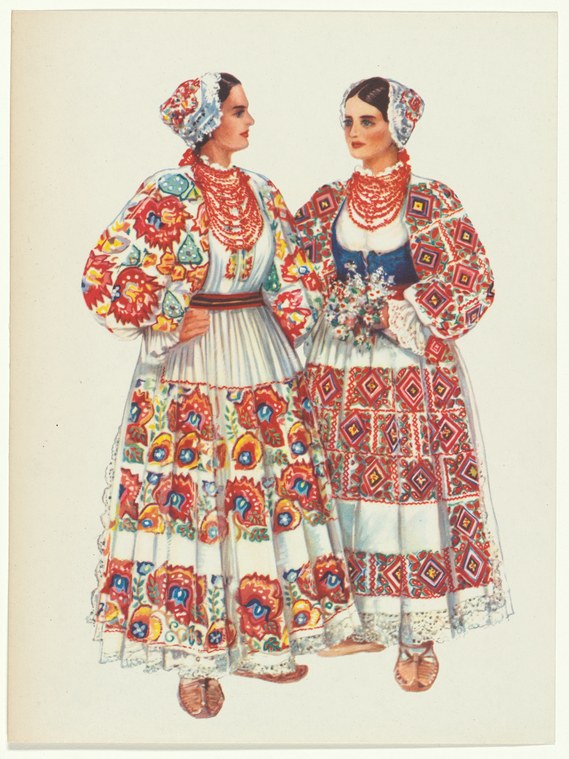
Two women stand before a pale background, each wearing elaborate traditional costumes identified as Yugoslav national dress. The figure on the left wears a white pleated skirt decorated with large-scale floral embroidery in red, orange, and blue; a fitted white blouse; and an ornate embroidered jacket or vest in matching colors with intricate patterning. A decorative headwrap in white with floral detail frames her face. She stands in profile, her posture upright and composed. The figure on the right wears a darker ensemble—a navy blue waist-tied bodice over a white shift, paired with a geometric patterned skirt in red and cream featuring diamond and striped motifs. Her headwrap is similarly decorated with geometric patterning. Multiple strands of red coral or glass beads drape across both figures' chests. Both wear embroidered aprons and what appear to be leather ankle wraps or shoes. The work presents these costumes as formal documentation, with careful attention to textile patterning, color, and the layering of garments typical of Balkan folk dress.
The dancing
Both figures stand in relaxed, static poses—neither is in motion or engaged in dance movement. Their bodies are upright and still, presented frontally or in profile as though for costume documentation rather than choreographic capture. The positioning suggests these are portrait studies of dress rather than action studies. There is no hold between them, no frame, no dynamic weight shift or footwork visible—they function as dress forms or models rather than as dancers captured mid-movement.
The dance depicted
The costumes depicted are associated with folk dances of the Balkans, particularly from regions that would have been part of Yugoslavia. While the work documents traditional dress rather than depicting an actual dance performance, such costumes were worn in circle dances, line dances, and couple dances typical of Balkan folk traditions (including genres like the Horo, Kolo, and regional variants). The elaborate embroidery, coral beadwork, and structured garments suggest formal festive wear used in ceremonial and social dance contexts. However, this image functions as ethnographic dress documentation rather than as a record of dance in action.
How it was made
This appears to be a hand-colored print—likely a lithograph or chromolithograph given the flat color fields, the even registration of hues, and the characteristic way embroidered detail is rendered through fine line-work over colored grounds. The pale background and the precise linear rendering of textile patterns are consistent with late 19th or early 20th-century chromolithographic practice. This technique allowed for wide circulation of ethnographic and costume documentation, suggesting this work was produced for educational, touristic, or encyclopedic audiences rather than as a unique artwork.
About this work
This work is a chromolithographic costume study documenting two versions of traditional Yugoslavian women's dress, presented as formal portraiture of folk garments. The costumes themselves belong to the material culture of Balkan folk dance—specifically the festive dress worn for circle and line dances that remain central to regional social life. The work functions as ethnographic documentation rather than as a dance scene; it records the material and decorative elements that defined formal participation in folk traditions without capturing the movement or social context of dance itself. It belongs in a dance archive because understanding traditional dance requires understanding the costumes that were inseparable from performance, and because such works shaped how European and non-European audiences understood folk traditions visually.
How to look at it
Attend to the textile detail—the scale and placement of the floral embroidery on the left figure's skirt, the geometric patterning on the right figure's garments, and the way coral beads are massed at the chest on both figures. These details were functionally important: the weight and stiffness of embroidered fabric would have shaped the silhouette and movement quality of dances performed in these clothes. Notice also the contrast between the more naturalistic floral motifs of the left costume and the abstract geometric patterns of the right, suggesting regional or community variation within Yugoslavian folk dress traditions. The precision of the lithographic line work allows these patterns to be read clearly, which would have been important for anyone seeking to recreate or understand these costumes.
The period
This work was produced during the era of intensive European interest in documenting folk traditions—roughly the mid-to-late 19th century through the early 20th century. Such costume studies were typically made for ethnographic encyclopedias, travel literature, and popular education about the 'folk' peoples of Eastern Europe and the Balkans. The chromolithographic medium made such images economical to produce in series and to distribute widely. The work reflects the broader ethnographic project of the period, which sought to categorize, document, and visualize the dress and customs of regional and national groups, often in service of nationalist or imperial agendas. Yugoslavian folk dress became a subject of particular interest as nationalist movements in the Balkans sought to codify and celebrate regional identity.
Where it lives
The work is held in the New York Public Library's print collection devoted to dance imagery. It was catalogued as a generic example of national costume documentation rather than as a specific historical or artistic object, suggesting it is one of a series of such educational prints.
Dance in this work
Questions about this work
Is this a dance picture or a costume picture?
It is a costume picture—both figures stand still and posed rather than moving. However, it documents the dress worn for folk dances, so it belongs in dance archives because understanding how traditional dances were performed requires knowing what dancers wore and how garments moved with them.
What region of Yugoslavia do these costumes represent?
The print is labeled simply as 'National costumes of Yugoslavia,' so it presents these as examples of Yugoslavian women's dress generally rather than identifying a specific region. The variation between the two costumes (floral versus geometric patterning) may suggest regional types, but the work does not specify which regions these represent.
What dances would have been performed in these clothes?
Balkan folk traditions include circle dances like the Kolo and Horo, line dances, and couple dances. The weight and structure of these embroidered garments, particularly the heavy skirts, would have shaped the footwork and body carriage of dances—generally favoring grounded, controlled movement rather than high extension or turning.
Why are there multiple costume versions shown?
The two figures may represent regional variants of Yugoslavian dress, or variations by occasion or community. Presenting multiple versions within a single image was a standard ethnographic practice, allowing viewers to see related but distinct costume traditions.
More dance artwork





